

Let's face it. Most of us don't own expensive field strength measurement equipment to allow us to truly determine range. I don't, and generally use a car radio, which is highly selective and very sensitive.
The problems of using listening for range testing with any old radio, however, were illustrated to me just today, when I decided to use an inexpensive portable (an old Sony Walkman - yes, I still own one) to see how far I could hear my signal since I elevated the antenna.
I knew that the Sony wasn't very sensitive, and would only hear strong signals. However, it wasn't sensitivity that was the limiting factor. It was the poor selectivity, or the ability to reject strong adjacent signals, that really messed up my testing.
There is certainly no problem listening in to Artisan Radio inside my house, and around the property, with that radio. But once I moved more than about 100 feet from the antenna, other radio stations started to interfere with mine.
To recap, with my car radio, I was able to receive a strong signal from my elevated transmitter/antenna setup up to about 350 meters away, and then a noisy signal (not from other stations, but from dropouts due to obstructions & the resulting static) past that point.
Past 100 feet with the Sony, I could still hear my radio station quite easily at times, but with strong interference crowding in and often obliterating it. Even at 300 feet, if I held the radio exactly the right way, my signal was heard weakly but plainly. However, move it just slightly, and the signal was overwhelmed by other stations.
This just goes to show that range testing using poor radios is not just limiting because of poor sensitivity, but even more so by poor selectivity, and can give you misleading results. Using a car radio at least eliminates the adjacent station issue.

Sadly not much emphasis is placed on selectivity these days.
Same story for the cheap Chinese imports in the 2 meter / 440 band HT's.
Back in the day when the Pioneer Super Tuners were the rage, they boasted a 1.1 uV sensitivity using ceramic filters.
These receivers could pick Fly Do-Do out of pepper.
But when making an AM/FM radio on a chip what more can one expect?

"... But when making an AM/FM radio on a chip what more can one expect?"
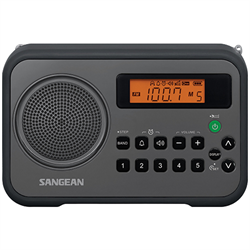
The Sangean DT-160 is one example of a very small AM/FM/FM Stereo tuner having both excellent sensitivity and excellent selectivity, according to its reviews on Jay Allen's website.
I have one, and can agree with that.
I reviewed the review, and it does look impressive. It uses DSP to achieve that selectivity.
However, the newer DT-210 (which was also reviewed), a non DSP model, had virtually identical performance, and also included a built-in speaker (which the 160 does not have). It seems worth consideration as well.
This one's good too.....

<p style="text-align: left;">The Tecsun PL380 under $50 on eBay is not a bad radio either very sensitive and can be very selective when you put the bandwidth on am at 3 kilohertz. It also has a DB UV meter which is very important 4 range testing.</p>
I get about a 40 DB signal at the end of my complex and at the Sunset Grill which is about a mile away I get barely above 15 DB to 20. I wish I had that radio when the engineer was here setting the antenna up in the transmitter because I think it would have been an essential tool to adjust the antenna.
I only hope with carrier current I can get to the Sunset Grill with a signal close to 30 DB as that is very listenable and would definitely get me an audience.
The sangean in the Tecsun Radio`s should be used in Range testing with videos of the dbuv meter and surroundings. Very very important.
The point of the thread was that listening, particularly with a bad radio, is not a great way to determine if you are legal with micro power FM. The selectivity of a radio, particularly in a crowded FM band area, makes a huge difference to range, more so than sensitivity, so even the 200 foot guideline for Part 15 is suspect. In my tests, I can barely get 100 feet on a Sony Walkman with BETS-1 FM rules!
The situation is different, of course, for Part 15 AM, as with 15.219, you can determine legality at the transmitter site. Having a good radio, with known characteristics, can be a useful tool in tuning up the transmitter for maximum range.
You should use a Tecsun PL 380, 660, 880 Grundig 450DLX
at 100 Ft your signal should be less than 20 dB uV. That is on a Whole House 3.0 with stock antenna and no lightning bolt. Plus don't expect good FM Stereo at 100 Ft. That should get you very close to legal. Better solution...forget FM!!
In Canada, FM is probably the best solution.
One small receiver, the Sangean PR-D18 is amazingly good(and good sounding too for it's size) and has no imaging of strong stations all over the band and selectivity like a car radio and also would be a good tool for using range as a indicator of ballpark compliance.
AM is very good too.
Unfortunately you and I are the only people here that can do FM with some useful coverage.
Here's a pic......
To clarify: The Tecsun does not have a dBuV meter but a relative signal strength meter. The manual refers to it as a dB Unit meter. However it can be useful.
Don't forget our friends in New Zealand.