

I've been mulling this in my brain a while, as I read something a few years ago, a sort of hack, about someone who transmitted a tv signal through some 2.4 or 5.7 ghz equipment, and used some of the demodulated signal, to control frequency and phase of the transmitter, and the audio as well. They basically injected the entire AM signal and used a simple amp on the other end, as a transmitter... I THINK. I could be wrong.
I can't find the reference to it anymore, and I haven't a clue where it was. But the purpose was to use be able to use diversely located transmitters around a town or area, all on exact frequency and stable phase relationship to each other as well, and all transmitting the same precisely synced audio.
Has anyone else come up with a smilar idea?
I also had a brain fart the other day and wondered if you could use a very large diameter pipe or column (12 to 24 inches) as your radiating element instead of just a wire 3m long. Not sure about "tuning" to it.

MLR/Rick along with his engineer Jack Gittings Did it. MLR was the guy who started his site and jack gittings was a college professor who helped him engineer it all.
i don't know what happened to both of them.
I was just trolling through and noticed the 13 mhz discussions, and so looked up the rules on it. THAT would definitely let you get a synchronized audio feed.
However, I don't know what kind of distance you can go...
Anyone?
There is a side-link on our Big Talker pages, located on my website, posted by member PhilB and giving a lot of detail about antennas and results for 13.560mHz.
http://kdxradio.com/bigtalker.html
If you, mkoskenmai, can design a modification for the transmitter for synchronicity, you will be the next Part 15 Man of the Year
There is no way to operate two or more transmitters on the same frequency with or without synchronization and separated by a large fraction of a wavelength or more which will not produce nulls in the combined radiation pattern. Considering this and the need for audio synchronization to prevent anomalies if both signals are received it makes more sense to me that if one wants to cover a large area one could use transmitters on different frequencies. Then there is no need for any synchronization at all and audio delay will not be a problem.
Discuss?
Neil
here in denver multiple frequencies could pose a problem (synchronizing makes sense here) due to congestion but hback in NJ where i lived two frequencies could easily be located so dual frequencies would be better arrangement. it makes it a little more difficult from a announcing standpoint because now you have to announce two or more frequencies instead of one.
What Radio8Z says is unavoidably true, but I wonder something about the methods of "locking" multiple transmitters in synchronous operation from a central key signal.....
Could the audio be transmitted inside of the synching signal in some way, so that a single synch control could combine audio with the synch...
If there is a way of saying that without saying "synch" 3-times, go ahead and touch it up.
I built a 13 MHz transmitter, but
haven't had a chance to range test
it yet. I think the general consensus
is that about 5 mW into a dipole made
for 13.560 MHz is about right to achieve
the legal field strength. I'm supposing
you'd get a couple of thousand feet of
range with that, but I don't know what
the audio quality would be at the far end.
I have never heard about anybody getting
a cluster system running - at least - from
anyone who has been on
this board in the last few years. I have the
parts for a 49 MHz STL link and a nice solar panel
(thanks to a really really good guy) that can
power a remote AM or FM transmitter. But
I have never been able to find
a remote site. I thought I had
one, but the arrangement fizzled.
I think the first step is to a get the remote
transmitter going on a different frequency
and then once that is going you can start
thinking about how to sync it with the main
transmitter. (I don't have a clue.)
I think somebody asked about thicker
transmitting antennas. A copper pipe
should work better than a wire because
of the RF "skin effect," right? Doesn't
the RF want to stay on the outside surface
of the radiator?
Just my two cents.
Bruce, The Dog Radio Group
What Radio8Z says is unavoidably true, but I wonder something about the methods of "locking" multiple transmitters in synchronous operation from a central key signal.....
Nothing could provide more "locking" of multiple radiating sources on the same frequency than is produced by a licensed AM broadcast station using a directional array, and a single transmitter.
Yet the radiated fields from such arrays can be highly directional, regardless of program modulation, and regardless of the relative phases of the program audio at each radiator if those r-f carriers are modulated.
The link below shows the net radiation pattern from two absolutely synchronous MW radiators separated by 2 km.
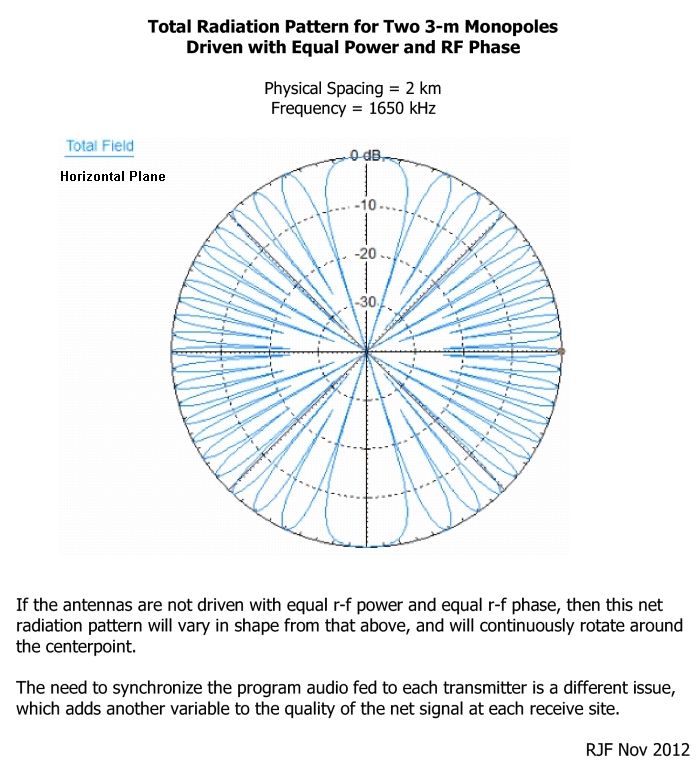
I think this jives with what Rich is saying, and what Radio8Z said as well...
The difficulty encountered with multi-antenna/transmitters on a same frequency is one of both space and time.
There is space separating all the transmission points, and it takes time for the signals to travel, thus space interferes with time and the advantage of "single point transmission", which exists at higher power levels, cannot be achieved.
My name for the result of numerous transmission points spead around in space is the "smear factor".
There is space separating all the transmission points, and it takes time for the signals to travel, thus space interferes with time and the advantage of "single point transmission", which exists at higher power levels, cannot be achieved.
Good reply, Carl.
An elaboration to it would be that the directional pattern produced by such multiple radiators is the same regardless of power, for the same relative r-f power and r-f phase at each radiator in a given array.
The following only applies to Canada, but here you cannot have 2 unlicensed transmitters broadcasting from the same source. So multiple transmitters playing the same thing are definitely out. That is one of the restrictions, not from Industry Canada, but from our programming regulatory body, the CRTC. It is one of the conditions exempting an unlicensed broadcaster from obtaining a CRTC license.
But there IS a technology that effectively allows you to legally extend your Part 15 range. It's ubiquitous and the cost is coming down all the time - smartphones, capturing an Internet stream. Wherever there's a cell phone signal, you can listen to your radio station.
You can put your radio station into TuneIn or some other such app. Or you can do as I'm doing (sloooowwwwly, unfortunately) and develop an app that will capture your signal, put up a customized screen and play your station. The Iphone will be the first to host the Artisan Radio (or whatever I'm calling myself at the time) app, soon to be followed by Android. When? The best I can say is, when it's done...
Well, in my case, the reason for wanting them on the same frequency, is that I would expect my listeners to be mobile, not stationary and I would want to cover quite a few miles, and there's simply no way to prompt the driver to jump to the correct next frequency when he hits the edge.
In any case, I was looking at a pdf that shows the rules and spectrum sizes available, and I suddenly had a flash of ignorant enthusiasm. Or brilliance. Or dumbness, not sure which. But, here's how it works:
The target spectrum is the 900, 2.4, or 5 ghz spectrum, which have 25 to 110 (? not sure of the 5.7 mhz size off the top of my head ) mhz of spectrum available.
So, what I suddenly flashed about, was using an analog AM transmitter at one of those frequencies, and modulating it with the ENTIRE AM transmitter carrier. Heck, 1.71 mhz rf carrier with 10 khz audio modulation, being entirely broadcast at 900, 2.4, etc, and the demodulated signal being the entire, modulated AM carrier. Since you'd need less than 3 mhz wide carrier, you can be almost gauranteed of finding enough reasonably clean space - especially in 900 or 5 ghz. However, your distance will likely be limited. I can easly run 30 mile 2.4 DSSS network links (and have) while staying under the 36dbm power limit for 2.4 ghz. 900 will go FARTHER, but is subject to a horrific level of interference, so it might be difficult.
I noticed that there are already 900, 2.4 and 5 ghz transmitter modules. I dunno if they can be modulated with an AM signal.
I vaguely recall reading something a long time ago about there being a way to put up multiple Rangemasters, appropriately phased to be additive in power and give you more range. I dunno if that was wishful thinking or reality. It sure seems doable to me.
If only I were an engineer, instead of a relatively ignorant hobbyist.
I'm not an engineer, so I don't really
understand it all, though.
Bruce, The Dog Radio Group
have had the idea for a very long time of using a 900 mhz DSSS hop fromm my residence to a local fm station than using the fm stations SCA carrier to distribute audio and use the 67 or 92 khz sca carrier as a reference clock for locking the oscillator of the part 15 am transmitter. transmitter would be spread out far and use solar power to run the translator nodes.