

On December 28th, 2007 WEAK-AM wrote:
On December 28th, 2007 WEAK-AM wrote:
Rich says: "Other things equal, the field strength of any monopole within the the first kilometer or so of the antenna site is not much lower over paths of average ground conductivities than it is over a perfect ground."
This is a very interesting remark. I am curious to know if you can substantiate it? Note, I am not disputing it, merely wanting to understand why this would be true.
____________
Groundwave propagation losses begin at the boundary of the r-f ground used with a vertical monopole, but these remain fairly low at short ranges. Losses accumulate as the path lengthens, so the field deviates more and more from the inverse distance value at those longer distances.
Brown, Lewis and Epstein of RCA Labs conducted a series of careful experiments in the 1930s proving this. Groundwave fields were measured 3/10 of a mile from a monopole. The measurements were taken with constant applied power, for monopole heights of 22, 44, 66, 88 and 98 degrees, using buried radial ground systems varying in the number and length of wires used. Their results were published in the Proceedings of the I.R.E., and became the basis for FCC rulemaking for AM broadcast stations that is in effect to the the present day.
The link below leads to a pair of data plots from their I.R.E. paper. Figure 30 there shows that the groundwave field for monopoles greater than about 30 degrees in height using 113 radials each 0.41-wavelength long was less than 5% below the theoretical maximum field for such radiators, over a perfect ground plane. These measurements were taken in the sandy soil of New Jersey where earth conductivity is low (4 mS/m or less), so the data shows that even poor ground conductivities have a rather small affect on radiated groundwave fields, close to the radiator.
Very short monopoles, and those with few/short radials did not perform as well. That results from the higher r-f ground losses for fewer/shorter radials, and the fact that the radiation resistance of short monopoles is low. It is important to realize that the lower field strength those systems produced was due to losses in the antenna system, not to propagation loss for whatever signal WAS radiated.
The BL&E data shows why it is important to provide a good r-f ground for a monopole antenna, and what actually constitutes a good r-f ground. That can't be supplied by a few, short, buried radials, a ground stake at the antenna base, or a connection to a cold water pipe. The r-f ground system needs to collect the r-f currents entering the ground after radiation from the monopole, and for low ground losses in the antenna system, the ground system needs to extend in all directions to a radius of at least 1/4-wavelength from the base of the monopole in order to do that.
Other things equal, the quality of the r-f ground used with a Part 15 AM setup usually is the biggest determinant of the field strength it radiates.

//

I read the paper by Brown, Lewis, and Epstein with considerable interest, back when I was kid in college! I believe it was the same Dr. George H. Brown who wrote fascinating (and witty) stories for the journal of Eta Kappa Nu, to which I belong. A short piece on Mr. Brown appears here: http://en.wikipedia.org/wiki/George_H._Brown_(Engineer)
Anyway, the main issue with the figures you referenced is that all of the interesting stuff is in the very lower left corner, insofar as a Part 15 AM station is concerned. A typical FCC-compliant antenna is about 5.8 degrees at the upper end of the AM band, and most Part 15 hobbyists (myself included) could only dream of putting in a radial system of more than a few, SHORT radials at this wavelength (definitely MUCH less than 240 feet)! It also seems likely that the data in that region of the graph may have been extrapolated, since those conditions were outside the main focus of the work at hand.
In order to gauge the expected differences in field strength due to ground conductivity, it would be instructive to see a family of curves, with smaller numbers of shorter radials, across a range of ground conductivities. This, of course, would be a formidable task if it were not for the availability of antenna modeling software (which unfortunately, I don't have). In any event, one must be very careful to understand the modeling requirements and limitations, which implies a significant learning curve (GI=GO).
Questions of interest include, for example, whether or not it really matters to have extremely long radials if you have such a short radiating element, as well as the perennial question of how many are worth installing. Ray tracing would suggest that long radials may not necessarily be that important. And, you can somewhat see from those plots that the difference between say, 15 and 113 radials may not be all that significant with a 5 degree stick, but it is hard to tell with good accuracy. Another question that the data doesn't address is what effect a fairly dense (but electrically small) ground screen right at the base of the antenna might have. For example, what if you installed a 3 meter radius dense screen (e.g. a metal sheet) right under the antenna and augmented it with a few longer radials? We don't have any good answers on how much that would help. The paper didn't address that situation.
Much has been written about how "bad" it is to bury radials in lossy earth, which suggests that using elevated ground systems would be a great way to go. But this invokes the problem of FCC interpretation, an area where fewer and fewer experimenters are interested in going these days (and with good reason). Now, it seems to me that all ground is not necessarily equal from a loss tangent standpoint. For instance, in Michigan my ground is 100% sand, which has very low conductivity, but which I suspect behaves very differently than the kind of lossy ground one encounters in excavated urban areas. I once tested a horizontal full wave 40M loop on 1' high supports mounted over this sandy ground, and it tuned up very nicely and worked effectively for high angle polarization. I suspect that a buried radial system in sandy soil may not be as lossy as people might think, because the sand has properties that are more like an insulator. The same might be true of certain types of rocky soil, but I have no measurements to support this.
Back in the 80's, there was a very informative article on ground systems for vertical antennas for the ham bands in QST, in which the author expanded on the work of the RCA engineers to focus on the frequencies and conditions applicable to a typical ham radio station. I wish I had this article handy, but I don't. But even if I did, I'm not sure the conclusions would be exactly the same at 1.6 MHz as they are at 14 or 28 MHz. Based on this article, I built a system of 16 radials 0.1 wavelength long for my 40M quarter-wave vertical at my cottage in Michigan. As I recall, this particular configuration was supposed to be only about 4 dB less efficient than a "perfect" ground system. I don't know if that's true, but it did work well.
There must be somebody out there who has EZNEC or MiniNEC and who could do us a favor and model some of the most common situations faced by Part 15 station operators.
WEAK-AM
Classical Music and More!
WEAK,
Eta Kappa Nu and Tau Beta Pi here.
Sorry for the hijack....just don't run across many "brothers".
Neil
And guess what? I remembered the callsign of the gentleman who wrote the QST article; it is John Stanley K4ERO/HC1. Here is a nice photo of John at HCJB, standing under an antenna system we could all aspire to:  .html
.html
And here is a page that summarizes the results of John's 1976 QST article: http://www.hamfesters.org/chiTechhelp.htm
Scroll down to the section: "Your Grounding System: How Many Radials Do You Need?" (It is most of the way down the page).
Very helpful!
Regards,
WEAK-AM
Classical Music and More!
A search for John Stanley K4ERO on the Web turned up several interesting links with good articles on antenna and ground systems.
This is an excerpt from the ARRL Antenna Handbook (20th Ed) that includes material from John's 1976 QST article. It will take awhile to download: http://yb1zdx.arc.itb.ac.id/data/OWP/arrl-books/arrl-antenna-handbook-2005/03.pdf
This link will take you to an article by Rudy Severns, originally published in QST for July, 2000:
http://rudys.typepad.com/ant/files/antenna_ground_system_1.pdf
The last link will take you to an interesting article on selective fading by John Stanley, published in QEX for Jan/Feb. 2007: http://www.arrl.org/qex/2007/01/stanley.pdf
This article is not about antennas per se, but should be of interest to AM DX'ers and Part 15 stations.
WEAK-AM
Classical Music and More!
"NEC-4 allows modeling of monopoles with buried wires, but so far I haven't been able to justify spending the money for it. However if anybody wants a calculation for any set of Part 15 AM antenna system parameters using the methods I described I'll be glad to do that."
Rich
It would be cool if you posted links to some of your calculators if they are online jave html or downloadable?
Dan
On December 29th, 2007 WEAK-AM says:
Anyway, the main issue with the figures you referenced is that all of the interesting stuff is in the very lower left corner, insofar as a Part 15 AM station is concerned. A typical FCC-compliant antenna is about 5.8 degrees at the upper end of the AM band... It also seems likely that the data in that region of the graph may have been extrapolated, since those conditions were outside the main focus of the work at hand.
Sorry, but you misunderstood my post. Your question that prompted it concerned substantiation of my statement that ground conductivity has only a small affect on groundwave fields within a kilometer or so of a vertical monopole. Figure 30 in the link I posted proves this, and the data that shows it is seen for radiators greater than ~30 degrees using 113 buried radials each 0.41 wavelengths long, not for radiators less than 6 degrees.
The reason it does is because those radiators above 30 degrees with that ground system approach 100% efficiency, and the fields they produced at 3/10 of a mile were within 5% of the theoretical maximum for the applied power for a perfect monopole over a perfect ground plane. So it is clear from this that ground conductivity could have had little affect on those measured fields at that distance -- which was my point.
In order to gauge the expected differences in field strength due to ground conductivity, it would be instructive to see a family of curves, with smaller numbers of shorter radials, across a range of ground conductivities. This, of course, would be a formidable task if it were not for the availability of antenna modeling software (which unfortunately, I don't have).
Changing the number and length of buried radials would change the efficiency of those antenna systems, and hence the fields they could produce for a given applied power. But other things equal, the affect of a given ground conductivity on whatever those fields were would remain a constant.
Better first to determine the efficiency of the antenna system to find its theoretical maximum inverse distance field near the radiator for a given applied power, where those fields are ~unaffected by ground conductivity. Then the distance to a given groundwave field strength value can be found by use of the FCC's MW propagation charts for that frequency and path conductivity. This is, in fact, the process used in the broadcast industry.
Ground conductivities over most of the US vary from about 2 mS/m (such as in the western lower peninsula of Michigan) to about 30 mS/m (much of Kansas). Higher conductivities produce less loss over a given groundwave path.
But the reality of legal Part 15 AM radiated power is that the signal is affected more by the inverse distance law than by the accumulation of losses due to ground conductivity. By the time conductivity has a large affect the field tends to be unusably low due to the distance, alone.
Questions of interest include, for example, whether or not it really matters to have extremely long radials if you have such a short radiating element,...
The r-f resistance of ~120 buried radials each 1/4-wave long is about 2 ohms. I can't think of any reason why it would not still be 2 ohms when used with a monopole 6 degrees or less in height. Likewise, fewer/shorter buried radials have progressively higher r-f resistance, which is likely to remain the same no matter what monopole height is used with them. A 1/2-wavelength is still a 1/2-wavelength no matter how tall/short the radiator.
A 2-ohm r-f ground sounds like a low value, but it is large compared to the radiation resistance of a short monopole. With no other losses, the radiation efficiency of a monopole with a radiation resistance of 0.1 ohm using a 2-ohm ground is 0.1 / 2.1 = 4.8 %, approximately. If the ground resistance increased to 25 ohms as with fewer/shorter radials, a ground rod etc then the system efficiency would become 0.1 / 25.1 = 0.4 %. The importance of a good ground is easily seen.
The BL&E paper states, "Close to the antenna, the earth currents of a short antenna rise to large values. It would thus appear that the earth within the 0.3 wavelength radius should be a very good conductor in order to operate a short antenna efficiently. This situation may be roughly approximated by a buried ground system consisting of many radial wires."
There must be somebody out there who has EZNEC or MiniNEC and who could do us a favor and model some of the most common situations faced by Part 15 station operators.
Actually I have done NEC-2 studies of typical Part 15 AM antenna systems using the FCC approach I described above. This yields a peak gain figure in dBi for the modeled system, which can be compared to the known gain of a reference monopole such as a 1/4-wave vertical used with a typical "broadcast" radial ground system (which is about 4.9 dBi).
The field produced by a 1/4-wave broadcast monopole system at 1 km for 1 kW of applied power is known by calculation and thousands of measurements for the last 70+ years. From that value it is possible to calculate the field that the Part 15 AM system will produce at that distance for the difference in antenna gain plus the difference in applied power.
It is also possible to do this directly, using standard equations in a spreadsheet (see 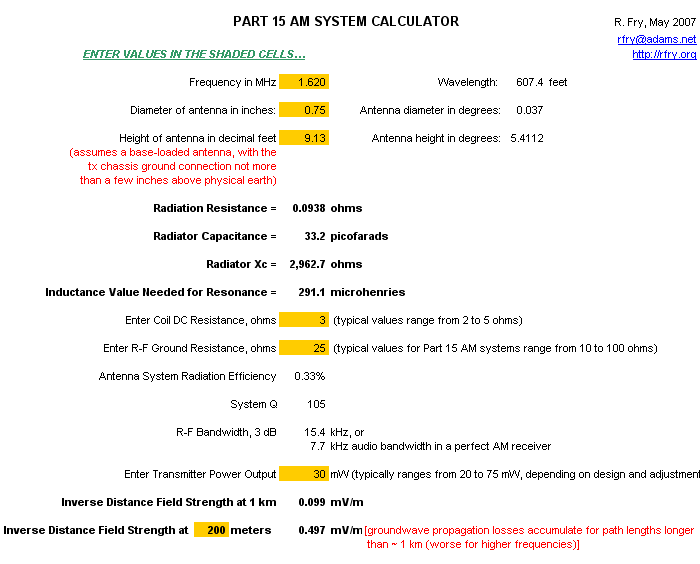 )
)
The big problem in all such calculations is having accurate knowledge of the r-f ground and matching coil resistances, and the applied power.
NEC-4 allows modeling of monopoles used with buried radial wires, but so far I haven't been able to justify spending the money for it. However if anybody wants a calculation for any set of Part 15 AM antenna system parameters using the methods I described I'll be glad to do that.
Rich
//
If there is enough interest I will look into converting the Part 15 AM system calculator into an applet that can be run from my website.
//
Electrically short antennas are used for licensed AM broadcasting primarily for "Class C" stations, which are used for short range, and have between 250 watts and 1 kW of power. If antennas shorter than 1/10 wavelength are used, the RF field strength at the base of the anenna is very high, and the high electric field interacts with the soil, causing the ground resistance to be higher than for lower field strengths. The usual remedy for this situation is to shield the soil in the vicinity of the base of the antenna with sheet metal.
Part 15 AM hobbyists have noticed the high field strength of short antennas when they get a mild electric shock from touching the antennas of their very low-powered transmitters. A Part 15 AM transmitter might generate 100 VAC, or so, at the antenna. The short antennas produce high voltages because of their high capacitive reactances. When tuned to resonance by a loading coil, the resonant circuit produces a high RF voltage. The much higher power applied to the antenna by a licensed broadcast station produces a very high voltage.
The ground current of a short antenna tends to be concentrated near the base of the antenna. Some people have thought that this means that the ground plane of the antenna does not have to be very large. This is not true. Beyond the solid sheet metal near the base of the antenna, long radials should be attached to the sheet metal.
For a Class C station, the FCC requires a field strength of 241 mV/m at a distance of 1 km when 1 kW is applied to the antenna. This requires an antenna efficiency of more than 64.5%. It is this field strength requirement that has prevented licensed AM broadcast stations from using antennas that are very short.
The "Class A" clear channel stations are required to have a field strength of 362 mV/m at a distance of 1 km for 1 kW antenna power input. This makes electically short antennas out of the question for these stations. Even a quarter wave tower can't produce this much field strength. This is a job for a more directive antenna, such as a 5/8 wavelength monopole.
On January 2nd, 2008 Ermi Roos says:
If antennas shorter than 1/10 wavelength are used, the RF field strength at the base of the antenna is very high, and the high electric field interacts with the soil, causing the ground resistance to be higher than for lower field strengths. The usual remedy for this situation is to shield the soil in the vicinity of the base of the antenna with sheet metal.
Much good information in your post, Ermi, to which I'll add (being picky)... earth resistance is a function of soil characteristics rather than radiation from the monopole. Ground system losses near the monopole can be higher for very short antennas, but that is due to the relatively higher current flowing through that earth resistance from the greater induced r-f voltage there (greater I^2R loss).
This is also true for monopoles around 1/2-wavelength high, which have very high base voltages. Typical broadcast practice in such cases is to bury a 48 x 48 foot copper grid mesh centered at the tower base, which is connected to the usual buried radials. Another approach is to intersperse the 120 x 1/4-wave (or longer) buried radials with another set of buried radials about 50 feet long.
These techniques don't act to shield the soil near the monopole, but to improve the conductivity encountered by the high r-f earth currents induced in that region.
Probably the average Part 15 AM operator isn't too interested in this minutia, but some readers here may be.
//
Rich,
I needed some help answering your last post, so I contacted someone with outstanding expertise in short antennas for licensed medium-wave AM. Prof. Valentin Trainotti was kind enough to answer my questions.
In 2006,Trainotti finally extinguished all hope that the Crossed Field Antenna (CFA) has any special properties by proving theoretically that the CFA does not work any better (and is actually worse than) a short cylindrical antenna with the same outside dimensions. In 2001, Trainotti already demonstrated the non-workability of the CFA by using an NEC program, but a theoretical proof is stronger evidence than a computer program.
A very important thing that Trainotti pointed out to me is that a short medium-wave antenna does not necessarily have to have high voltage at the base. The dimensions of the capacitive hat of a short top-loaded antenna can be selected so that the antenna is resonant. In that case, the tuning circuit of the antenna does not need to provide a high voltage, and it is only necessary to match the antenna resistance to the impedance of the transmission line. Even if the the tuner does provide high voltage, Trainotti said, the primary purpose of a ground shield near the base of the antenna is to reduce the resistance of the ground plane to improve the antenna efficiency to compensate for the low radiation resistance of the short antenna. Avoiding an increase in the resistance of the soil is not a serious concern.
Trainotti, did agree, however, that very high field strengths do increase the resistance of the soil, but only in the immediate vicinity of the base of the antenna. One of the uses of the ground shield near the base is to prevent this from happening. Ground conductivity depends upon the moisture of the soil, which means that the primary mechanism of ground conductivity is ionic conduction in water. Very high field strengths and current concentrations can cause the soil to lose its water, and even become a kind of ceramic insulator. This effect has been observed most dramatically as a result of lightning strikes.
I recently found out why the the number of ground radials used in the experiments reported in the classic paper by Brown, Lewis, and Epstein was the peculiar number, "113." According to someone who knew Brown personally, they just ran out of radial wire! They intended to use something like 118 or 120 radials.
Such a prosaic reason seems unlikely when talking about this important paper, but looking at the photographs in the article, the experimental setup appears very primitive.