

I tell you what. I've really been happy with my little Marburo power station. It's so fricken convenient, and more capable then I ever expected it to be, even the little spotlight on front has proved useful numerous times. I just love it. But next time I'm going to aim for a Bluetti like Mark's with the safer and apparently replaceable batteries.
But the reason I'm posting is to mention that recently I've been hearing about the new sodium batteries that are supposed to start appearing.. and now they have...
World’s largest EV maker unveils new sodium battery electric motorbikes
"...The newly unveiled electric scooter uses Yadea’s recently introduced sodium battery technology, offering what the company says is outstanding performance in range, charging speed, and safety. Using the HuaYu Sodium Superfast Charging Ecosystem presented by Yadea, the battery can reach 80% charge in just 15 minutes, ...Yadea’s sodium battery has successfully passed more than 20 safety tests, many focusing on its resistance to fire and explosions under extreme conditions like punctures and compression..... offers an energy density of 145 Wh/kg and a lifespan of up to 1,500 cycles at room temperature, with the company rating it for a five-year useful lifespan.....With excellent low-temperature capabilities, the battery retains over 92% of its discharge capacity at -20°C, making it well-suited for colder climates...."
You know sodium power stations are just around the corner!


@richpowers Correction...the Bluetti batteries are not replaceable, or not intended to be. It says call Bluetti in the event there is a battery problem. But here's the thing. The liFe po4 batteries last for so long...between 3000 to 4000 complete discharge/charge cycles and you still have 80% of original capacity so way longer than that till the run time gets down to needing batteries. Most of the time you are charging from 40% to 60% which isn't near full cycles and if using as a UPS the batteries are used once in a while and never drained to 0%. Once every three months the instructions are to discharge to 0% till it shuts off and then charge again to keep the meter calibrated. So think how long this can last....almost indefinitely. The company says 10 years but that's figuring average use will be charging and discharging full cycles a lot more. 10 years to 80% capacity. It can last you much more than 10 years. 80% of original capacity is still perfectly good. So once every couple of months I unplug it and let it power my station till it shuts off at 0% then plug it in again and it is charged in 1 and 1/2 hours as it's running the station from the electrical grid with pass through not from the battery at the same time it's charging. It can run things as it is charging though. Just takes longer to charge if there is power out at the same time.
But the battery packs *may* be replaceable by the company but not intended to be by the user.
@mark Ahhh.. I see now, I saw the battery expansion units for the Bluetti power stations and misinterpreted that info to mean replacement batteries.
So I guess only the old style power stations like the Yeti with lead acid batteries are the only ones that are made to easily replace.
I still think it's wrong to manufactures them as disposable units, same with the phones. Use them up and buy a new one when the batteries die. Doesn't seem environmentally savvy at all.
@richpowers I agree. I hate intentional built in obsolescence. No matter what it is. Thing is the batteries could cost as much as you paid for the power station. They are quite elaborate battery packs made up of many cells. Regular UPS's like APC, Cyberpower, and Triplite are the 3 main makes and they use lead acid batteries and are all replaceable by the user and you can get the replacements easy. But that is because lead acid batteries don't last that long, only a few years. But they aren't near as good as the power stations. For my station the 1000VA 600W UPS models will last at 10 watts or so about 9 hours in a power outage, not bad for running my station. A TV using 25-30 watts would halve that, and over 100watts not long at all, only 7 or 8 minutes at half the max wattage. They were meant to have time with a desktop computer to safely shut down or finish what you were doing and you only have minutes. So if you were downloading something you would have to abort download and just have time to shut it down.
The top of the line UPS's weighs close to 40-50 lbs! My little entry level Bluetti is way better than even the highest capacities top of the line UPS's.
But also consider that the replaceable lead acid batteries in the UPS's are not good for the environment and a waste as they are constantly being replaced and discarded and replace the battery more than 2 times and you have spent more than the whole UPS cost you. It's like buying a printer with cartridges and then buying the replacement ink.
The Bluetti, Ecoflow, Jackery, Ancher, power stations that double up as a UPS is a much better deal and the LiFe PO4 batteries will never need replacing unless you discharge it completely and recharge daily.
For a moment I began to think since the battery is the most expensive part of a power station then it may make more sense to just get a brand new unit when the old one dies... but thinking again that doesnt seem so because besides the battery there's still the inverter and the better ones use sine inverters - those aren't cheap, plus you have the nput charge controller, also not particularly cheap, also the components that step down the usb connections porp whatever, the digital displays etc.. there's a lot more to a power station than just the battery- and ap that is built to just discard when the battery dies? And the ph OP nes are essentially full fledged mini computers, just dispose of them when the battery dies? Seems ridiculous.
I dont know, maybe I'm not factoring in something. As you point out the Lifepods are supposed to last forever.. maybe the batteries do outlast the other components.. I kind of doubt it though.
Well... it's not the only thing in this world that doesnt make sense
@richpowers You know you are starting to make me think your way! There is a lot going on electronically, mini computer chips, to manage all the functions as you pointed out. There could be an electronic malfunction and this would be toast and it would be discarded with a good battery. The battery could outlast the whole thing!
You know, it's just to run my station nothing else and a regular UPS with replaceable battery probably would work nicely also. The simulated sine wave will not affect transmitters, the processors, computers, lights, TVs, except motors may run a bit noisier.
There would be nothing wrong with this... https://www.cyberpowersystems.com/product/ups/avr/avrg900u/
Would run my station for the better part of a day at 10 watts total power consumpton. And the replaceable lead acid battery can be replaced with a similar size liFe PO4 also as they are readily available. And this is much less money. Should have considered this.
@mark I think you may be thinking beyond "my thinking"! - I was thinking.. pondering really, in a rather vaque way, but I see where your going.. at least I think I do..
After I had bought my Yeti 1250 for use on my sailboat (my first one), I later realized I should have just bought all the components separately and installed the system. The Yeti all-in-one solution is excellent for many applications, but it's a huge box that weighs about 100lbs, it does have wheels, but its still awkward and you need to find a space for it.
If I had simply bought all the needed parts separately, not only would it have been hundred of dollars less expensive but I also could have put the battery over there, and the inverter in that crevice there, the charge controller mounted by here.. In other words the whole system could be installed compleatly in a manner that it didn't take up any usuable space at all, and for about maybe half the price.
I guess I can still do that by simply disassembling the Yeti and throwing the case away, or possibly repurposing it. - it's a thought.
You said you can run your whole station for a whole day and only use 10 watts??? I really doubt that.
I realize all this talk power stations and batteries might seem irrelevant to Part 15 broadcasting, but in reality it is quite relevant. The more we know of alternate power sources, then the more we know about keeping our stations on the air for extended times during power outages or for othe off-grid situations. But maybe it would be better to shift back into more direct part 15 topic like ground leads or something.
Or not.
@richpowers Yes it's related to part 15 broadcasting as it was originally about keeping your station on the air in a power outage.
@richpowers Yes it's related to part 15 broadcasting as it was originally about keeping your station on the air in a power outage.
Yeah, but you wouldn't know it from reading this thread alone, as this thread is actually a branch off from a separate thread, which was kind of a branch off yet another thread...
But often I do catch myself here just talking about whatever.. but when I do it usually does somehow branch from, or into, a part 15 related topic (at least in my mind.
But sometimes I do tend to wander without any relevant point at all, and find myself wondering if other members are thinking: "what has all this got to do with the part 15 hobby?" !!!
And sometimes t yuh ope so fast that I miss letters an put jibberish on th er screen
What's most interesting about this product comparisons review is not the winning products, but the hands-on test she had put each unit through..
https://www.outdoorlife.com/gear/best-portable-power-stations/#bestforhighwattappliancesbluettiac180
The Best Portable Power Stations of 2025, Tested and Reviewed
This was an interesting article that also talks about the waste of non replacement battery device waste... Heres the main excerpts:
Applying 'extreme heat' to lithium-ion batteries reportedly restores their capacity
https://www.techradar.com/audio/earbuds-airpods/applying-extreme-heat-to-lithium-ion-batteries-reportedly-restores-their-capacity-and-i-think-it-could-be-the-sustainable-tech-breakthrough-of-2025
Would you heat your lithium-ion batteries to over 300F / 150C to make ‘em charge like new? Research suggests there might be some benefit to doing so – but also, please don't do it... ...Because while new research suggests that extreme heat could completely restore your tech’s onboard (and decidedly planet-unfriendly) lithium-ion batteries, it could also make them burst into flames in a state called thermal runaway...
The heat's on for a sustainable future
...thousands of the things end up in landfill. But replaceable batteries have yet to arrive in Apple products – and I'm worried they never will... ...suggesting that it's focusing on iPhones that ‘never fail’ rather than being ‘super-easy to repair’ – spoiler alert: as sure as eggs is eggs, your portable tech's batteries will fail after around three years, depending on usage.
We didn't start the fire…
There's method to the (seeming) madness of this latest research; it's not actually about becoming a fire-starter... ... but the research does raise the possibility of fixable, revivable portable audio devices. Imagine if your phone's battery needn't even be replaced – because it could be revived.
Incendently, I bought one of these last week and I couldn't be happier. And since my 200w of panels wont be sufficient I ordered 2 more 100w Renogy monocrystaline panels todat - They're only $89 each now (they were about twice that price about 6-7 years ago)
EcoFlow DELTA Portable Power Station 1260Wh Generator Certified Refurbished
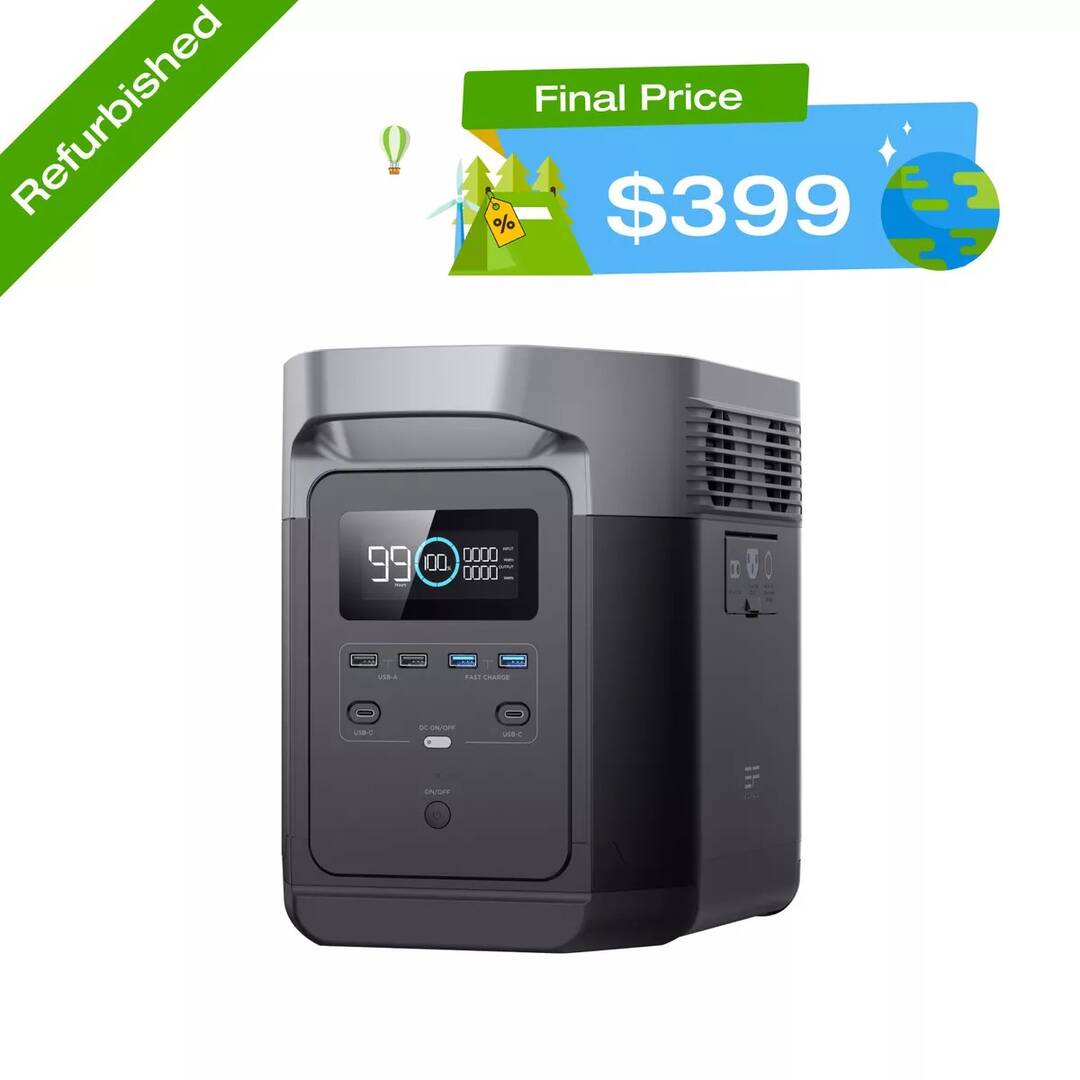
https://www.ebay.com/itm/144167340763?chn=ps&norover=1&mkevt=1&mkrid=711-166974-028196-7
Truth be told I was actually aiming for Bluetti but also really needed the best bang for buck, cause it's not just for the station, I'm actually off-grid out here. 1260wh is fairly substantial, I would have gone more if I could have afforded it, but it was neccessary to get a few more panels too to bring it back to full everyday or I'll end up abusing the batteries to death like I did the last two or three I've gone through... but those weren't lifepo like this one.
Excuse me, I like to talk about this further for a minute.. It's been on my mind, and maybe can advise.. So, as I said, ordered a couple more panels which will bring me up to a potential 400w (300w more likely) input from panels.
It's because I'm having the same problem with this EcoFlow 1260 I just as I did with the Yeti 1250... By late in the evening it might getcdown as low as 40-50%, sometimes even lower, - no problem, next day it charges pretty quickly with 200w of panels.. untill it gets to around about 80%, but from there it takes forever trying to top off that last 20% - and it rarely is able to before the sun goes down.. So by night it's not fully charged and gets run down even more, and again next day enough sun/time to fully recover. And this keeps repeating.
That's exactly how I destroyed my 1200amp Renogy AGM batteries and I dont want to do the same to this one. Its important to charge to a full 100% everyday to maintain the life/stregth of the battery- So I'm doubling my solar input this time.
I guess I'm just thinking out loud. I thought I was going to ask something, but I'm not even sure there's a question..