

Well I've been contemplating getting one of these cheap Beofengs for awhile, since I don't really need one.. but today when I saw them for $12, I went ahead and bought two of them.. Grand Total including tax and shipping on Temu came to $31 - How can I lose?
It's the 5RM which is an upgraded version of their very popular 5R models (which are also cheap.
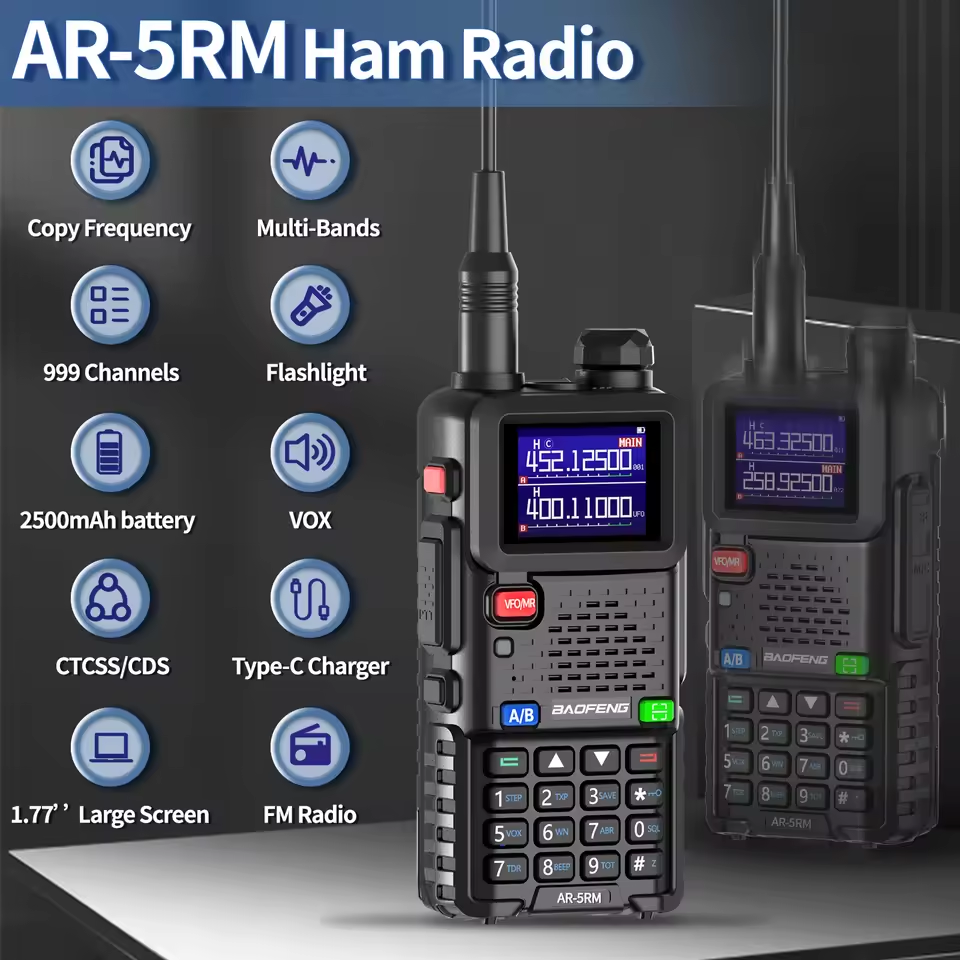
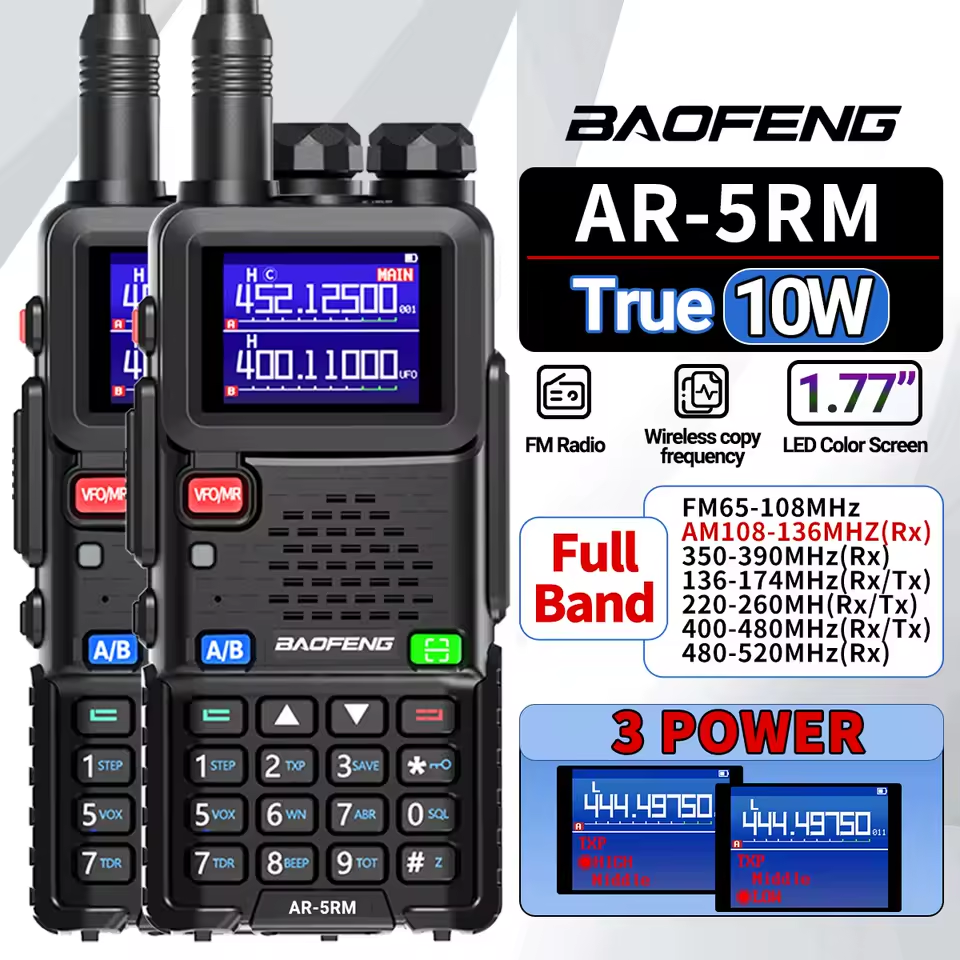
It hasn't arrived yet but last night I realized I made a goof... I had previously eyed the Baofeng UV-5R for its licence-free GMRS capability (and cheap prices) and when I saw the promotional $12 price for the UV-5RM which is supposed to be an upgrade to the 5R.. well I just presumed it too had unlicensed GMRS too, but it doesn't, this model can only be used with a ham license.
Oh well, I have been occasionally contemplating getting a ham licence. I had began studying for one as a teenager, even signed up for a local class, but quickly lost interest after realizing I would only be permitted to transmit in morse code (once I got up to speed) for the first couple years before being eligible for voice communication --- That just squashed any interest I had in getting a ham license.
But now days it appears you can get a Ham licence basically for the asking (and a multiple choice test). So I'll probably be taking another look at getting a ham licence now that I'm an old man

@richpowers That US$12 equates to about C$20. For just a few dollars more I purchased several Quansheng K-5's. They're similar to what you bought, but the big difference is that the firmware is open source. As a result, many hams have made custom firmware(s) to extend the capabilities of the radio.
The firmware that I flashed allows the radio to receive down to 18 Mhz in AM, FM and Double Sideband modes (SSB with an additional sideband). You can also transmit in those modes on the VHF ham bands. Some firmwares that allow transmitting on the HF bands also exist.
It's not recommended to transmit on non ham band frequencies, as there are no filters and power output is very low (so you get lots of harmonics and spurs). But even getting DSB capabilities on a 2 meter handheld for a few dollars is just amazing.
There is even a successor to these radios, the Quansheng TK-01 (I believe that's the mode number), whose stock firmware allows you to receive all the way down to the AM broadcast band. I was just listening to my station on 1620Khz. It also supports SSB receive.
Work is already being done to create custom firmwares for this radio. The cost for the base radio without accessories is about double that of the K-5, but you really do need the programming cable (to flash firmware). It's also cheaper to order the radios with accessories, rather than purchasing them after the fact. Sometimes only a few dollars more.
@richpowers That US$12 equates to about C$20. For just a few dollars more I purchased several Quansheng K-5's. They're similar to what you bought, but the big difference is that the firmware is open source. As a result, many hams have made custom firmware(s) to extend the capabilities of the radio.
The firmware that I flashed allows the radio to receive down to 18 Mhz in AM, FM and Double Sideband modes (SSB with an additional sideband). You can also transmit in those modes on the VHF ham bands. Some firmwares that allow transmitting on the HF bands also exist.
It's not recommended to transmit on non ham band frequencies, as there are no filters and power output is very low (so you get lots of harmonics and spurs). But even getting DSB capabilities on a 2 meter handheld for a few dollars is just amazing.
There is even a successor to these radios, the Quansheng TK-01 (I believe that's the mode number), whose stock firmware allows you to receive all the way down to the AM broadcast band. I was just listening to my station on 1620Khz. It also supports SSB receive.
Work is already being done to create custom firmwares for this radio. The cost for the base radio without accessories is about double that of the K-5, but you really do need the programming cable (to flash firmware). It's also cheaper to order the radios with accessories, rather than purchasing them after the fact. Sometimes only a few dollars more.
@artisan-radio Is it the Quansheng UV-K-5? I see them as low as $14 and the UV-K-6 for $10
Anyway, I had meant to simply get another radio with GMRS capability, which these don't, but from a quick glance around it looks like those Quansheng K-5s are popular devices.
Those are the ones. The K5 & K6 have nearly identical hardware internals; there are a few differences in the packaging (i.e., case) but that's about it.
You can get a version of the upgraded K5 (the TK) with GPS & APRS. The only thing is that the radio is so new that they haven't come out with custom firmware for it yet.
I just ran across another one of these types of radios and it looks really good. It's the Bajeton BJ-7800, and similar to a line of radios from better known Radtel.
It supports the usual ham bands 2m & 73cm, but is also being marketed as a CB walkie talkie. In a review I read, it puts out about 5 watts, but harmonics are horrible (so it's usefulness is questionable - it obviously needs hardware filters for that band).
But on the good side, it will receive SSB, CW, AM, FM, etc. from 2Mhz and upwards, as well as the AM Broadcast band (and I believe, even longwave, but not sure about that).
All for about C$40, or US$30. Pretty amazing. It achieves most of this functionality through software, of course, making is a transmitting SDR with an on-board user interface. There was a problem with the initial firmware it was shipped with with SSB reception, but an update to that firmware solves the issue.
Unfortunately, there are some physics laws that you can't solve in software, such as harmonics, and to transmit cleanly, these radios need the appropriate hardware filters for the frequencies they transmit on. That's one of the places where they skimp to get the low prices.
I do believe I'm going to order one of these, however. The price performance, even for just reception, is pretty amazing.
All I've done with the Baofeng since I got it was to open up one of the boxes, clip in the battery, screw in one of the attennas and listen to local FM stations - which sounds really bold and clear! Didn't even know it had FM broadcast It has some kind of AM capabilities too, but not the broadcast band.
I was surprised they both came with two different antennas, both nearly the same length but one is thicker, seems more robust, so I put that one on, but it's only supposed to come with 1 ant, 1 battery and 1 charger - I'm guessing the heaver antennas are an upgrade or something that they added to the box without removing the other, but I don't know.
Mine do not even have part 15 walkie talkie capability nor unlicensed GMRS, which is actually what I was wanting originally. . . My fault of course for buying the wrong thing, but the $12 price tag distracted me.
The thicker antenna might be for the air band, usually is anyway.
The thicker antenna might be for the air band, usually is anyway.
Maybe, but the manual nor the "list of included items" make any mention of it. The thick one is ever so less shorter, like maybe 1/4 or 1/3 inch. I don't know much of squat about this radio except that it was the bargain price and apparently extremely popular. I gave the other one to the guy in the houseboat today and showed him how to listen to the FM (last week gave him one of those portable AM radios I got on eBay).
No regrets, it's seems a great radio but I had meant to just get a basic GMRS
Well this is interesting, he essentially figured a way to hack one of these cheap Baofeng transceivers into a kind of web server of sorts... Not the same model as mine but it's just as inexpensive...
Budget DIY radio hotspot uses the Beofeng UV-5R for email, SMS, and more
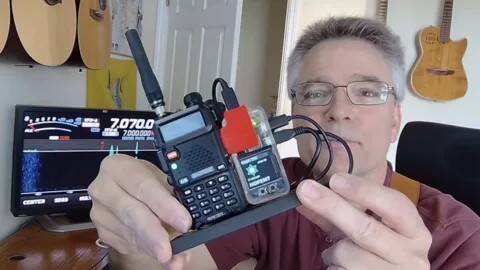
.. Ham Radio operator KM6LYW recently shared his latest budget build for a simple radio transceiver capable of handling a variety of data modes for multiple communication solutions. Built on the ever-popular Beofeng UV-5R, this project takes the capabilities of the radio and combines them with a handful of components to create a hotspot setup complete with its own web interface. ...