

Hey all,
Thanks for having me on the forum. I apologize in advance if any of what I'm about to ask is obvious stuff. I have been in music/pro audio for several years but this is my first forays into radio.
I am looking to start my own LPAM station in my local area. I live on an island in southeastern NC, there are few stations here and lots of water, both of which seem to bode well for me. I have a some questions as to what is best/recommended by those who are more experienced and knowledgable than I.
My goal would be to provide community radio with a mix of talk, programing, live stuff and music. I know there are several outlets out there to get people's LPAM programing for free. In my thinking I believe I would have 2-3 mics, a CD/tape player, a turntable set up running through a mixer (for one output instead of two), phones (how does one do multiple callers?), a computer for the automation/etc...
1. I know you need a transmitter and antenna (looking at Rangemaster). But how do you get the signal from your console into that little box (not like plugging in a guitar cable I don't think, lol)?
2. I keep reading where an Innovonics processor is best to have also to keep your signal nice and clear, limit any peaks and such. Is this true or does just your audio signal into your board into the antenna pretty much do it? I would prefer to have a good, solid signal if I can get one.
3. The antenna lead being 3meters... with the Rangemaster being all in one, you can put the antenna at any height? Not just 10ft from the ground level? Just the lead and all that can't be longer than 3meters?
4. Is using multiple Rangemasters easy to link and operate?
5. For simulcasting or internet broadcasting... is it easy? Costly? How is it done?
6. ASCAP/BMI/SESAC - is it a problem? I read that only BMI supports LPAM and obviously I would like to see that the artists are compensated correctly for their music but how does all that go if only BMI is on the cool?
7. For automation and all that: what are the recommended programs (I will likely be dealing with Progressive Concepts for my equipment needs)? Mac or PC?
I've been looking at the Arrakis gear as it comes bundled with some things. I was also looking at Radiologik. I would assume brand matching with gear doesn't matter (like using a Fender amp with a Marshall speaker)?
I guess I will stop here for now and keep investigation the forums. Thanks also to Scott Clem, I read your book once I heard about Part 15 and it was inspiring.
THANK YOU for whoever helps me out. I am very excited but this idea and I mean to make it a reality.
-kc

First, welcome to the Forum.
You're asking great questions. There is a lot of information here on the site that you should be able to dig up, but I'll make an attempt at answering some of them.
1. The Rangemaster, as purchased, includes an adapter that will take a 3.5mm unbalanced audio input and convert it to 600 balanced that the transmitter needs. If you have audio processing that provides that balanced output, you can feed the transmitter directly (such as from an Inovonics 222 or equivalent) - I used good quality, shielded CAT5 cable.
2. The Inovonics is a nice box - I've used it. Some don't like it. You'll get a variety of opinions on it. But it doesn't do everything in terms of audio processing that you might want (such as compression).
3. The Part 15.219 rules state that your antenna system (comprising antenna, ground lead & feedline to your transmitter - the Rangemaster doesn't have the latter) must be 3 meters or less. That means that if you're sticking to the letter of the Part 15 law, you should mount the Rangemaster at ground level, with a short ground lead to your grounding system. A minimal grounding system would be one or more copper stakes driven into the earth. A better grounding system would add radials. Since the intent of limiting the length of the antenna system is to limit your field strength, and equal in length and opposing radials don't radiate (they do, however, increase the efficiency of your antenna radiating elements), you should be OK. The FCC rules don't say anything about radials, but then, they don't specifically restrict them either.
4. Multiple transmitters are problematic (unless they are on different frequencies) and deserve a separate discussion (there have been many here)
5. If you are using outboard audio processing, you would need to capture your analog signal with a computer, convert it to a stream (there are multiple programs that can do it), and then either send that stream to an external host (such as Live360) or run your own server. Again, this deserves a separate discussion.
6. For over the air Part 15 radio, currently only BMI requires a license (for the music). Sesac & Ascap aren't interested. Currently, performance rights are free for over the air radio. It's streaming that can be expensive, as you have to pay for both, based on the number of listeners. Obviously, running your own server would required complicated accounting for copyrighted material. Virtually all hosting sites include licensing fees in their overall fees (but you may have to interject commercials, etc., depending on the service and the cost). Many Part 15 stations get around the streaming problem either by not streaming at all, or by only streaming public domain material, or material for which you have been given permission to air, such as indie music.
7. Many Part 15 stations use Zara, as it's free, but there are plenty of others which are not costly. This is an area that you can explore, based on your automation needs.
My advice would be to do a bit more research, and then to come back, if necessary, with specific questions relating to exactly what you want to do (but I do recognize that to some degree it's difficult to know where to even get started). You seem to have a leg up there.
Experimentation is the key to Part 15 broadcasting. My general advice would be to start small, try things out, try not to spend too much money at first;as you learn and get some experience with the technologies involved, you can grow and spend your money in a much more directed fashion.
Even assuming that you'll be using a certain transmitter, particularly the most expensive one (and arguably the best), can sometimes be a mistake. There are many good transmitters, audio processors, etc. out there. The trick is to get the best ones for what you personally want to do.
In rereading over my reply, I realized I didn't answer a few things.
2. The basic purpose of the Inovonics 222 (and it's successor), at least for Part 15 stations, is to increase its apparent loudness; in other words, give your signal more 'punch'. This will increase the listenable range of your station, as the signal won't drop into the noise nearly as much, particularly in fringe areas (and with a Part 15 signal, most areas are fringe). It won't, as some mistakenly think, increase the overall range of your signal. It's not absolutely necessary if you are looking for the best possible sounding signal, and don't care much about range. It can be a real nice to have, almost a necessity, if you're looking for the absolute, best possible range.
5. My previous comments here were for 'live' radio. If you are running automated, you will need to capture the digital audio stream 'inside' the automation computer and route it to the inputs of a stream generation program. There are multiple ways to do this - I use a utility called Virtual Audio Cable (there's a free version which is somewhat limited, and a commercial variant, which costs a little) to accomplish this. You can also, of course, split the analog output that you are sending to the transmitter, and route it to another computer for conversion.
Re brand matching. You just want to ensure that what you output on one box (such as balanced 600 ohm) can be easily input on the next box down the line. Converting between balanced & unbalanced inputs and outputs can cause signal degradation and loss. That may or may not be an issue for over-the-air AM, but it could be for streaming.

About Virtual Audio Cable
Awhile ago my station (KDX) was having trouble accomplishing everything I wanted.
Artisan Radio told me about Virtual Audio Cable, and I gave it a try.
It has so perfectly solved my situation that I have used it ever since.
By the way, there is an upgrade available right now.

My installation is ground mounted over radials and to give some idea of how I did this I have attached two pictures. The radials are #12 insulated solid wire and there are a total of 12 each being 10 feet long. They are soldered together at the base of the antenna and are connected to a two foot long stake driven in the ground.
I used wire I had on hand and would definitely not recommend white wire...it takes forever to become invisible. Black would be a better choice.
My transmitter is a home brew unit operating on 100 mW input power and it requires an external loading coil which you can view in the pictures. The same radial setup can be used with transmitters with internal loading coils.
Before using radials, using only a ground stake, my range was a few hundred feet. With the radials the range using a car radio is 1 mile listenable and 1.3 miles recognizable but noisy.
Range is one of those issues that always plagues a new Part 15 broadcaster. Exactly how much range can you hope to achieve?
Unfortunately, there are no easy answers. There are a huge number of factors that go into range with Part 15 AM, including, but not limited to, ground conductivity, background interference and/or signal absorption, field strength, etc. Most of the time the transmitter site is predetermined by where you live, so the only thing you can really control to any extent is field strength. And most of the available Part 15 transmitters don't vary all that much in terms of field strength. Sound quality - big differences. Field strength - not so much.
So you might purchase the 'best' transmitter available, with the strongest field strength (the Hamilton Rangemaster), you might have the best ground possible with multiple ground stakes and radials, and you still only get 1/4 to 1/2 mile range because of poor ground conductivity. That happened to me on Bowen Island, basically a small rock sticking out of the Pacific Ocean. It was even a very quiet RFI area. But with the same setup, installed in an area of high ground conductivity (on a river bed flood plain), in a suburban subdivision, I got well over a mile in all directions with a reasonably strong signal, and in one almost 2 miles with a weak one.
We have a member who gets close to a mile and a half of strong signal, in a rural area with very little background RFI.
If you're in an urban area, you're not going to get these kinds of ranges.
So you see, one size doesn't fit all. That's where experimentation, and the fun, comes in. Finding the best solution for your particular needs.

Hello, and welcome. For some background on your questions:
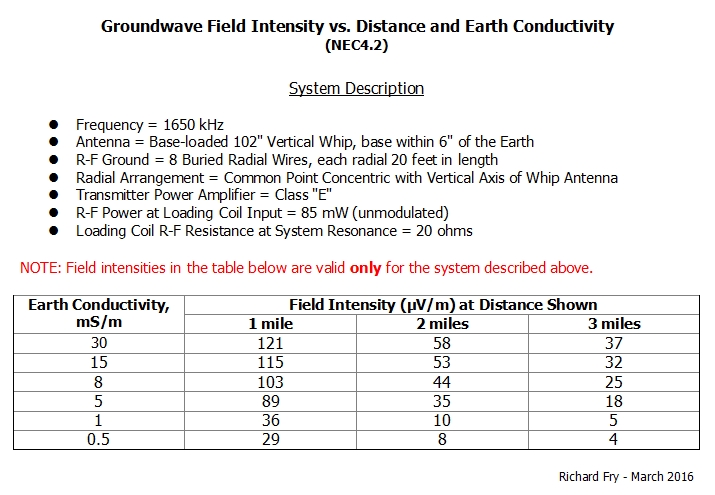
Below is a table showing the field intensity vs. distance from an FCC §15.219 compliant (legal) transmit system in the U.S., for the conditions shown on that graphic.
A very good radio receiver operating in receive locations with low radio noise and low co-/adjacent-channel interference from other stations might produce useful listening in fields of about 100 microvolts/meter (µV/m), or somewhat less. The table shows the relationship of Earth conductivity to received field intensity, other things equal.
If you can post approximately where in the U.S. such a setup is installed, that will lead to the table entries most likely to apply to that setup.
Hope this info is useful.
- Rich

Hello Keith.
I do not have any tech advice for you but I would heartily encourage you to be LIVE as much and as often as possible. I realize that is a huge time-suck, but putting up a signal and then plugging the transmitter directly into a computer makes us no better than the sanitized commercial stations we are trying to combat.
If you cant be live as often as you would like to be, at least try to SOUND live. Look for an audio management system ("automation") that is capable of doing voice-tracking. You can spend an hour cutting little slices of deejay chatter that the computer will drop into the broadcast to make the whole rest of the day sound as if you are live and on the air.
For a free education in what makes local radio successful, I would sign up for as many free newsletters from radio consultants as you can: Tracy Johnson and Fred Jacobs come to mind. It took a long time, but consultants finally got off that 10-in-a-row kick and realized that LOCAL is where its at. Where the big corporate behemoths drone endlessly about the Kardashians and American Idol, you will be all over your own local scene. And that is what matters.
Good luck.
THANK YOU ALL!!
So much good replies and information. I am taking some more time now to research and dig in here to the forum. I will get back to you all here with more questions and ideas soon.
I can't tell you how great this is, thank you!
Alright... so I got my ringmaster and antenna coming in the mail. I know I still gotta test it and all that, but I have been doing lots and lots of more research and checking things out in the forums here and elsewhere.
According to all net sources, in my area no one broadcasts from 1600-1700 AM. In the daytime, this is true, I hear nothing but good ol' static! However, at night, all those frequencies have audio coming through. I know that at night AM has the power to skip and that's why this is happening. There is only one band (1640) that seems mostly silent. I say mostly because occasionally... maybe twice an hour, some audio will blurt through. Otherwise silent.
My question: if there is 'technically' no on broadcasting on the channel (day or night) can I still use the band at night even though it gets blips? Or should I assume that what I am hearing is a licensed and legal station and I need to curtail my broadcast times?
Also, the area I am trying to cover would require (down the line anyway) multiple, sync'd transmitters. I would assume that a Barix unit would let you sync 2 or 3 transmitters even if they're not within range of each other? Could I have transmitter at my main place and then another one 4-5 miles away but linked and broadcasting the same? Or do they need to be overlapping in broadcast range for them to sync up? I hope I said all that right.
THANK YOU!
kc
No you don't need to stop for the intermittent station coming from maybe across the country as you're station is not strong enough to matter and no one could listen to that anyway. You are nowhere near their target coverage. Interference from other stations at night happens to the commercial stations also even in their local areas and many stations coming in on one frequency is normal and expected with AM. You don't have to cease and desist as soon as sunset comes. But because of all this you are trashed at night.
Don't know the answer to your second question as I'm not familiar with the system you are referring to but as for having 2 or more transmitters broadcasting the same thing check the rules to see if anything is mentioned about that.
In Canada, where I am, programing regulations are separate from the technical ones and you can have more than one transmitter but each one has to have it's own programing.
Keith, synching distant transmitters to air on the same frequency is going to be problematic, especially if the signals overlap. The Barix box is going to introduce some latency which will cause the audio to drift to the point where its going to sound like a Memphis-style slap echo.
A few years ago, one poster suggested putting a signal up on two different frequencies for two different parts of town, with the on-air imaging and ID reflecting that: "W(xxx)...at 1460 on the East Side and 1650 North of the turnpike. We OWN this town!"
Not everyone liked the suggestion. I thought it was grand.
If the signals from the multiple transmitters overlap, Billyburg's suggestion of using two frequencies is probably the best. If they don't, which you also mention in your post, then there's no issue with running those transmitters on the same frequencies, as their signals won't interfere with each other due to latency.
Y'all are the greatest!
Thank you again!
kc
I have a feeling that this is going to be an ever increasing, long thread. Ha!
I got my Rangemaster delivered today and I didn't get a power supply... unless that's what this is in the Lenovo box. Or it could just be a Lenovo computer power supply, which it looks like, not wall wart. I would assume that I need the proper power supply?
I'm gonna be super honest here: I really don't know what I'm doing. I've read the manuals twice over. I feel overwhelmed because I really have no idea what I'm looking at. This is a far cry from plugging in a distortion pedal or microphone. I feel like a total lummox. I also didn't get any kind of adaptor(s) for my signal.
The transmitter came automatically tuned to 1610 (the manual recommends that or 1620 as the best frequency). I had planned on using 1700, seems the best where I am. Is there any truth to the 1610/1620 claim?
I think I under-estimated all this. I thought this would be a little more like a "plug-n-play" and, obviously, it is not that. LOL!
My box came with an antenna (certainly seems to be longer or as long as 3 meters, which makes me wonder about the 3 meter rule), a disc, 100' or so of coax cable, an adjustment tool and some manuals, and the aforementioned Lenovo computer power supply. In the manual, there is a photo of a transmitter on the top of a guys house. That isn't 3 meters. Any thoughts?
My girlfriend's dad is an electrician, a very, very good electrician. We're gonna try to tackle all of this over the weekend. Is this really as difficult as my novice mind thinks it is, or is it much simpler? I really just don't understand anything I'm looking at.
This could really be a giant benefit to my local, small community and this endeavor of radio is a dream I've had in my life for sometime. Don't count me out or down, but candidly speaking, I have to say I am maybe not as confident as I was prior to getting this box. haha.
Thanks in advance to all replies. Everyone on here has been super supportive and helpful. I really appreciate all of you!