

The greater majority of the cheap Chinese AM radios only go up to 1600. Apparently same goes for their AM transmitters.
These are only $31 with free shipping.
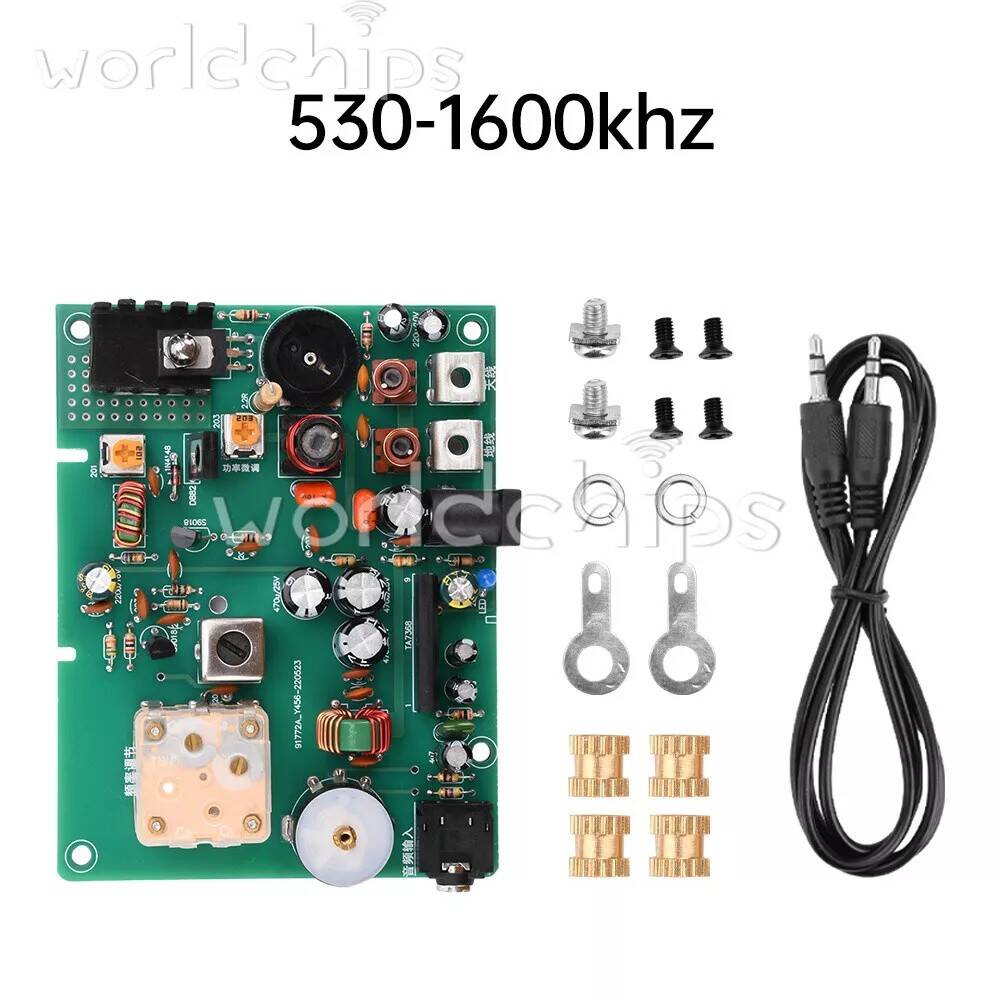
530-1600khz AM Radio Transmitter Experimental Micropower Medium Wave Module USA https://www.ebay.com/itm/335711841068
Power supply: DC9V/2A
Power supply interface: DC 5.5 interface, internal positive and external negative (need to provide their own power supply)
Transmission frequency: 530 ~ 1600KHZ (radio medium wave band)
High-frequency transmit power: adjustable 20 mW ~ 500 mW, adjust the power in 5 ~ 10 meters to use.
Antenna: 1.5 or 2.5 square millimeter diameter household wire can be used, the length of 2~5 meters (need to be self-provided)
Audio input: 3.5mm at both ends, attached with the board
Audio source: CD, desktop computer, cell phone, etc.
Size: 92mm*71mm
Applicable: medium wave radio enthusiasts, for students to study wireless signal generation, AM transmitter audio modulation principles.
Note: Use and experiment with radio transmitters need to comply with local radio regulations, adjust the amplitude knob to minimize the power adjustment.
1 x Module
1 x Audio Cable
1 x Accessory kit
These are even cheaper at $25 and looks cool, but Intended specifically for near feild it doesnt boast any range like the other
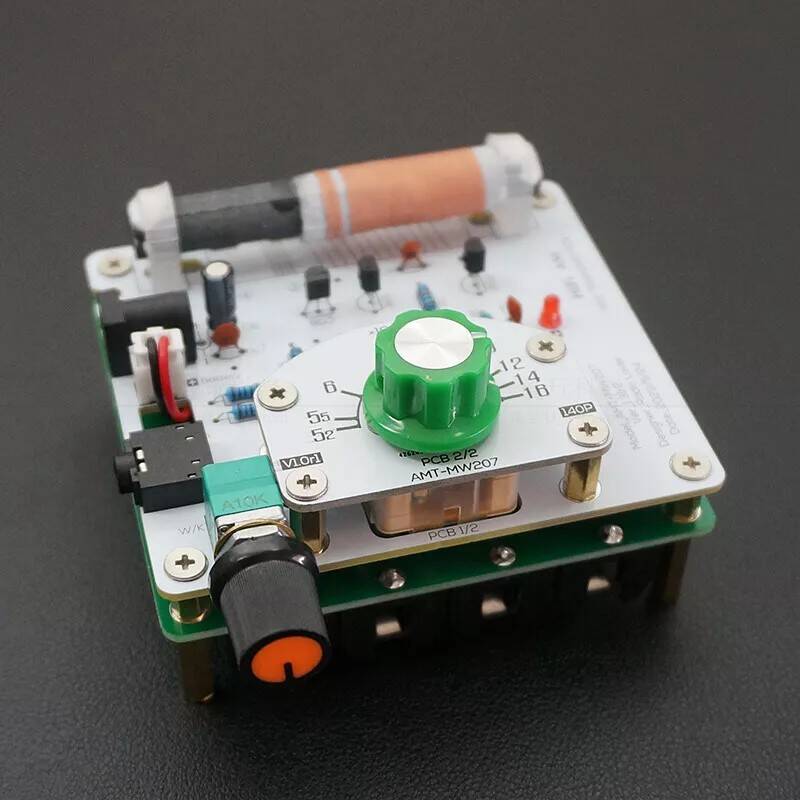
AMT-MW207 Medium Wave Radio Transmitter AM Radio Transmitter 525-1605kHz 6V https://www.ebay.com/itm/225672484680
- AMT-MW207 medium wave transmitter is a simple AM signal source suitable for amateur electronics enthusiasts and radio enthusiasts. It uses a magnetic rod to transmit electromagnetic waves without an external antenna. It can be used to test ordinary medium wave radios in places where the radio signal is insufficient. As well as ore radios, it can also be used as an instrument for debugging medium wave radios.
- This kit adopts full discrete circuit, which is especially suitable for students to learn the working principle, practice production and test.
- The variable capacitor uses a double-connected variable capacitor, and the two-connection parallel connection can obtain sufficient capacity.
- Using double-sided circuit, the board base is glass fiber material, the thickness is measured about 1.5~1.6mm, the pad is sprayed with tin, and it can be directly welded without grinding.
- This product has been revised for n times so far (mainly to modify the wiring of the circuit board and the circuit remains unchanged), and it is still in the process of continuous improvement. Usually minor and insubstantial modifications, such as slight movement of component positions and minor adjustments to wiring, will not change the version number, nor will they not be re-photographed and uploaded, hereby declare.
- The manual contains circuit schematics and circuit board diagrams, as well as debugging methods and experience under amateur conditions. If more information and professional debugging methods are needed, please download or refer to relevant professional books online; mainly changes in component positions, circuit The structure remains unchanged.

It's a little hard for me to get excited about a transmitter that, in this day and age, uses a free-running LC circuit to determine the frequency. OK for use around the house, but I wouldn't try any kind of semi-serious broadcasting with it though - especially as the first one can be set to higher than the allowed power, and doesn't conform to Part 15 and BETS-1 regulations. I suppose the first one could conform to Part 15 if it was set for the DC input to be below 100mW, but you'd need to be able to demonstrate to a visiting FCC Field Agent how you did that. Seems easier to either build or buy something that is already set to 100mW DC input or, preferably, is certified.
I guess the parts for an LC oscillator are cheaper to source than those for a PLL synthesizer. Sorry to sound like a Debbie Downer but for a few extra bucks, the signal from either of these transmitters could be a whole lot more stable.
@rugster Wasn't a downer at all, it was good input. I was contemplating getting one to play with cause it was so cheap, but after you put a knowable eye on it I know it's not worth the bargain.
Thought it looked too good to be true.

I wanted to mention also, as Rugster posted that with those without a frequency synthesizer chip and just an LC circuit to select frequency there is no stability. As the battery voltage changes, any ambient temperature change and the frequency goes off. The only way you can select a frequency is to have a radio and set it to a blank spot and then causing all kinds of interference turn the adjustment till you find where you are. The one that goes to 500mW and tuning like that is a no no from my perspective. It's not so much a big deal with something that goes 30 ft around the house but with some good power like 100+ milliwatts and no stable selectable frequency system is not good at all.
Oh I saw it needs a power supply so stable source voltage but still....
I'm not saying not to get it @richpowers. Sometimes these things can be fun to play around with. I'm mainly saying two things -
1) Discussion of the first one is probably somewhat off-topic in a forum intended for legal unlicensed radio, unless there is a robust technical discussion on how to set it for <100mW DC input, and to verify that no significant spurii or harmonics are being radiated - and even then, the conversation would only apply to Part 15, and not BETS-1. (It might be OK to discuss over at HFU though! 😆 )
2) The second one is almost certainly fine under Part 15, so OK for discussion. Not sure about BETS-1 though, as the antenna is a ferrite rod or, as Americans seem to call it, a loopstick (I'm British, but living in the US). I mean, the loopstick is permanently attached, so perhaps it's OK? In the US, I'm thinking it would be fine under 15.209.
Folk who are very "by the rules" may not agree with this, but I think that when it comes to the law, there is the letter of the law, and there is the spirit of the law. If your micropower signal can't be heard beyond the bounds of your property, who is it hurting, and who is going to care? The only exception to this might be if, say, you have a very large property, and your transmitter is throwing out spurii that interfere with overhead aircraft. That's probably a bit of a stretch, but it did occur to me.

Might be good to learn to solder on, assemble a kit. I don't know I'd use them for Part 15 radio, at least longer than for laboratory purposes. I see a lot of these on Amazon and elsewhere.