

Ok.. ok ok ok ok ok...
I give up. You're right, line of sight plays no part in part 15 AM whatsoever.

All I can do to interject into this is to ask why do you think my broadcast engineer friend spent the extra time and money to mount my antenna so that the tip was above the houses and trees as possible?
On top of all of this he had to build a remote control so I could tune the ATU from ground level since I'm legally Blind and it is not safe for me to climb heights that surly would cause injury or even death if I were to fall. If line of sight did not matter I would think a broadcast engineer would want to go the cheapest way to get me on the air with Album Rock right? So knowing this alone he has experienced this too for he has the same exact transmitter as I do at his house.
We were even considering a 75-100 wooden pole to mount the antenna on top of with coax going to the ATU and then I'd get my signal to the Deltaville market without issue. I've been discussing this with him as I read this and he just laughs at all of this silly nonsense and otters the phrase "Its not the wattage in the cottage, but the power in the tower!" So I learned from him that I need to get this antenna up HIGH over all the houses and trees, metal objects so my signal will rain down on my little town of Deltaville, VA.

Doubtful Claims
Virtually all respondents to the opening claim in this thread, "There is very little difference between ground-mounted vs. elevated monopole antennas", doubt the conclusion advanced by the claimant based on our own individual ACTUAL experience in the physical world.
We as a group say that THERE IS VERY MUCH DIFFERENCE between performance expected from full-power stations licensed by the FCC compared to the micro-signals of intentional radiators allowed under FCC part 15.
It would be prudent for our doubt to include the reliability of NEC Analysis, the principle mechanism cited by the claimant for his adamant conclusion.
Certainly the NEC software is formulated based on power levels in the range typically licensed by the FCC and is very likely not gradated to the microscopic hair-splitting RF power levels experienced with short-monopole part 15 systems.
Therefore it would be my recommendation to consider this entire discussion inconclusive and little more than a novelty.

Agreed, Carl.
Rich Fry is quite adept at ignoring arguments that don't conform to his beliefs.
He has no experience in actual use of Part 15 AM and FM broadcasting systems, and the tiny signals that they generate.
When pushed, he doesn't quite call people idiots (i.e., ad hominem attacks) for not believing what he's saying, but he gets close, by hinting that they don't understand and/or haven't read what he wrote.
And finally, he sometimes deliberately 'misunderstands' what has been said and attempts to take the thread off on a tangent. Case in point - I stated that raising my antenna above the roofline (about a foot total) doubled the FIELD STRENGTH since the range doubled. He came back with "As a “heads up, ” doubling the radiated power of a transmit station does NOT double the radius of its useful coverage area — even for free space path conditions." - I clearly did not state that I doubled the power.

RE: ... Certainly the NEC software is formulated based on power levels in the range typically licensed by the FCC and is very likely not gradated to the microscopic hair-splitting RF power levels experienced with short-monopole part 15 systems.
Therefore it would be my recommendation to consider this entire discussion inconclusive and little more than a novelty. ...
Think and do as you wish, however an accurate investigation of the capabilities of NEC software will show that its calculations of the _relative fields_ radiated by any given antenna system are independent of the transmitter power applied to that antenna system — as defined by the proven, measured principles of physics upon which NEC software is based.
RE: I stated that raising my antenna above the roofline (about a foot total) doubled the FIELD STRENGTH since the range doubled. He came back with “As a “heads up, ” doubling the radiated power of a transmit station does NOT double the radius of its useful coverage area — even for free space path conditions.” – I clearly did not state that I doubled the power.
I was/am pointing out that doubling the field strength at some distance does NOT double the radius of the useful coverage area, which is true.
Actually, you weren't merely doing that. You attempted to bring power (which I never mentioned) into the equation to obfuscate the situation.
The NEC software has been proven to not work (or be inaccurate) in many situations. That conveniently has not been mentioned in the discussion.
We keep hearing about all these mysterious 'other factors' that could be influencing experimental results. No one has of yet talked about any of them.
The bottom line is that you can talk theory all you want. Real world results trump theory any time. I would welcome a test where a field strength meter is used to measure Part 15 installation field strengths at ground level and at height, as well as with obstructions. Measurements of a licensed radio station just don't count, and that seems to be what you're basing your real world results on.
I wonder if Bill DeFelice would be interested?
RE: ... We keep hearing about all these mysterious ‘other factors’ that could be influencing experimental results. No one has of yet talked about any of them. ...
Did you overlook (or reject) the info in my earlier post, linked below?
I wonder if Bill DeFelice would be interested?
He actually has commented something to the effect of taking measurements at both ground level and comparing to an elevated install under the conditions of battery power with MP3 player all with short leads to the transmitter to eliminate any possibility of additional radiation occurring (as I alluded to previously in this thread), but as of yet no such test have took place.
I think it would be a very interesting experiment.
Again, I do not see how an elevated install could possibly increase field strength under such conditions, but I feel certain it would substantially assist in overcoming any obstructions in the surrounding area that can block a signal, and thus in that respect would prove to result in an increased range.
If you were to transmit in a desert where there was no obstructions I'm sure your range would be equal rather or not your transmitter was elevated. The reason for height on the MW band is to avoid obstructions. 100 mW is 100 mW (even less with losses caused by long coax especially if its not high quality).
We even had a gentleman who put a Rangemaster inside a church steeple and achieved great range. Joe the Ham dude was called a Pirate when he demonstrated better Range when putting his Rangemastter on top of a wooden tower with no ground. All of these Real World experiments done by several different individuals came up with a conclusion that getting your transmitter away from obstructions does make a huge difference. In some areas you have no other choice but to elevate the transmitter in order to be FREE of such obstructions. Makes perfect sense to me and also may show me why I'm having so much trouble in one direction of my signal verses the other.
Until such time as someone can accurately measure the effect of height (and obstructions) on a Part 15-compliant system, this will obviously remain an open topic. The NEC software has been shown to deliver inaccurate results in many scenarios. And comparing a signal generated by a licensed kilowatt station to one generated by a Part 15 station is simply not logical. - particularly since the top of the antenna system of a licensed station is, by definition, well above any potential obstruction.
The reason that AM broadcast stations produce greater coverage areas than a legal Part 15 AM station for the same applied power is related to the superior gain of their antenna systems — not because their towers can "see over" nearby obstructions.
Note the 20+ dB advantage shown for the broadcast station antenna system gain in the graphic below.
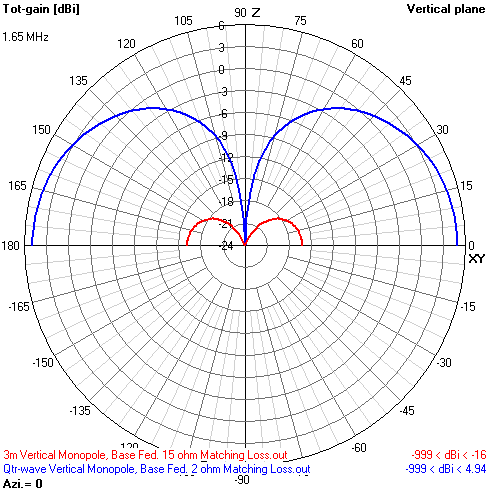

@ All: I have to agree with Rich with regard to a 1/4 wave broadcast antenna not "seeing over."
From Artisan: "Rich Fry is quite adept at ignoring arguments that don’t conform to his beliefs."
From me: That's because many times he uses a "straw man" defense. It's good to see the Old Rich is back in form. 🙂

Artisan,
I have been thinking a bit about your observed increase in range gained by elevating the end of your antenna above the roof line. One thing came to mind, namely, near field effects, which could be one of the mysterious other factors alluded to.
Did a bit of reading about this and in the near field much of the energy is contained in the magnetic and electric fields which are out of phase and hence reactive and which can cause induction effects which transfer energy back into the antenna and can influence the current in the radiating antenna. One effect is to change the impedance of the antenna system and another is to cause energy loss in the nearby material. You changed the spacing to a dielectric, presumably the roof materials or perhaps a gutter, which could have resulted in a change in the antenna current, impedance, and perhaps power delivered to the radiator and hence the radiated energy. I never doubted your observation but perhaps this is a technical explanation of what caused what you observed. If you are interested, search for a Wiki article using "antenna near field". Long read with math but about two thirds down the author mentions these effects.
I have observed that while tuning my base coil that the measured impedance (antenna voltage, current, and phase angle) all change significantly when I am near (less than three feet from) the antenna. I have learned to move away at least twenty feet to check the readings after an adjustment. Once out this distance my movements seem to have little effect on the readings. The most sensitive to my proximity is the phase angle between the antenna feed point E and I, shifting as much as twenty degrees as I approach the radiator.
Neil