

I've changed frequencies again (modifying the AM Profile in OpenWebRX+) to AM 1410. I know that frequency is clear, as Bell Canada had a station close down last year, and there would be no adjacent signals as it was a flamethrower (50K watts).
I did this so that I could receive the signal with several older receivers I own that don't cover the X Band.
In particular, this one:
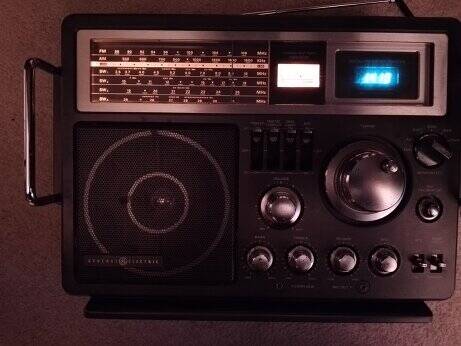
It's an older GE radio, a cut above their Superradios in that it can also receive shortwave, and has a digital display. It has a Wide/Narrow bandwidth switch, and bass/treble controls. It's probably closer in quality and functionality to the Panasonic shortwave portables such as the RF-2800 (or its cousin, the RF-2200, which doesn't have the digital display).
Quite simply, the AM signal from the Talking Sign sounds fantastic.
While the radio's size dictates its portability (not great), you can still move it around,
The other radio I listen to is a Sony AV470, a CQUAM AM receiver that was only made for the Canadian and Australian markets. I hope to put a CQUAM transmitter on the air one day, but in the meantime, this thing (which can be looked up quite easily on the Internet) also does a good job.
But there's nothing like a good sounding portable to bring back memories of the way AM used to be
"But there's nothing like a good sounding portable to bring back memories of the way AM used to be"
100% agree! One of the best receivers that is available now that AM can sound excellent on is the Sangean MMR 99. Also Ccrane's EP Pro. Both have wide band settings and even on normal the bandwidth isn't muffled at all.
What I like about the MMR 99 is it's the best of all worlds...convenient size, great audio, superb sensitivity/ selectivity. I have the Procaster currently set up using the included processor and a Behringer 9 band EQ ahead of it for tweaking the audio to perfection. But yes those radios Artisan mentioned and others from the 70s and 80s set the standard of how good AM could sound.