

I saw a reference to Part 15 FM signal loss elsewhere today.
Unfortunately, this topic is subject to much misinformation, used by those who are biased against this form of Part 15 use.
Field strength is linearly proportional to the distance between the transmitting antenna and receiving antenna. 250uv/m at 3m (the Part 15 limit) becomes 25uv/m at 30 meters. That's in free space (i.e., outer space, a vacuum) with nothing between those antennas.
In the real world on Earth, there are tons of factors that enter into play when calculating or estimating (not measuring) field strength. Obstructions are one obvious factor. Others include, but are not limited to, reflections from the ground, the atmosphere, weather, etc.
Now, the sensitivity of the radio receiving your signal is obviously another major factor in determining range for a given field strength. Sensitivity can be anywhere over 100uv for crappy radios, all the way down to 0.5uv or less for some car radios. This sensitivity is usually stated with some noise reduction, such as 20db.
What complicates matters even further is that radio sensitivity doesn't refer to field strength per say, but the voltage induced at the receiver's antenna terminals by a given field strength. Calculations have been done in this Forum in the past, and it takes a field strength of slightly over 2uv/m to generate a voltage of 1uv at the antenna terminals of that receiver.
So, what does that all mean? Given ideal conditions (i.e., in outer space), with no space station in the way, you should be able to hear a Part 15 FM compliant signal 300 meters away with a radio of sensitivity 1uv. Probably further. If that radio was top of the line, with a sensitivity of 0.5uv, you can double that distance to 600 meters or so.
Here on Earth, the atmosphere will play a part in diminishing that distance, particularly with high particulate counts (and/or high humidity), even if you locate your transmitter and receiver far enough from the ground to reduce reflections. Add in walls or buildings and your range really starts to diminish.
You can, of course, use a directional antenna at the receiving end to bump up your effective sensitivity. But these calculations give you some idea of the maxcimum ranges you can hope to achieve with a Part 15 (U.S. certified) compliant FM transmitter.
As I've experienced, anywhere from about 50 feet to well over 1000 feet, depending.
Canada allows 4 times the field strength (roughly) as the U.S., so expect correspondingly greater ranges.
Hope that makes it as clear as mud.

Taken from an article on RF/ electromatic radiation travel in space as opposed to on earth....." In empty space, the wave does not dissipate (grow smaller) no matter how far it travels, because the wave is not interacting with anything else. This is why light from distant stars can travel through space for billions of light-years and still reach us on earth."
Based on this 250 uV/m at 3 meters outside the earth's atmosphere in the vaccum of space could travel indefinitely and would always be 250 uV/m@ 3 meters.
To communicate with astronauts on the moon, from here, would need just a few uV/m.
Interesting. On the moon with hardly any atmosphere a Procaster and a good receiver and your station would be heard ... anywhere!
What you're saying doesn't make much sense.
If that were true, then the sky would be uniformly bright with the light from stars. After all, light is a wave (as well as a particle).
A Radio wave expands (much like a wave in water), and there is a fixed amount of energy in it. The field strength would therefore decrease as the distance from the transmitter increases and the amount of space it 'occupies' grows.
You can see light from stars many light years away because of the enormous, almost unfathomable, amount of energy contained therein. However, given two stars emitting equal energy, the farthest one away will be dimmer.
And even if that were not true, space isn't really empty. It contains light, other radio waves, matter (dark and anti - albeit in relatively tiny quantities), gravitational waves, radiation; all sorts of things that will interfere with a radio wave over large distances (astronomically speaking).
What is true is that in space, you'll get far more range from a Part 15 transmitter than on Earth because the radio waves won't have to contend with Earth's atmosphere, buildings, reflections from the ground, etc.

Below is a graphic page that can be useful in the discussion of this topic.
The concepts posted earlier sound simple, but much complexity exists when they are more fully evaluated.
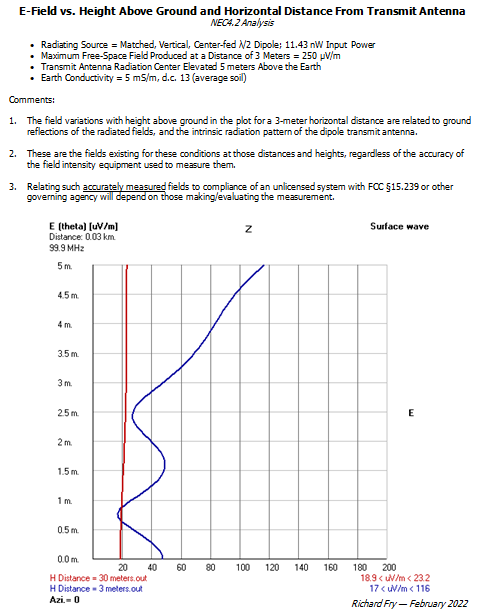
It took me a few minutes, but I believe I understand this graph.
It is giving field strength readings at various antenna heights at a distance of 3 meters (the blue line) and 30 meters (the red line).
First, a couple of comments.
This is theoretical, and the values will change based on ground conductivity (if there is one) and potentially other factors, particularly the 30 meter values (where atmospheric conditions and even obstructions might play a bigger role).
The system being modeled appears to not truly be a maximum legal strength Part 15 station, as the largest field strength value is 116uv at 3 meters (you're allowed 250uv). FCC contracted labs measure the field strength with the transmitter 1 meter above the ground (what I've gathered from knowledgeable sources), and a resonant antenna would be around that same height. The field strength value in the presented graph at a height of 2 meters is approximately 40uv/m at 3 meters. Just sayin'. Maybe that 1 meter measuring is for AM and not FM.
Perhaps the field strength approaches 250uv/m at 3 meters with larger antenna elevations (which makes sense - the graph is trending upwards linearly).
There are huge variations in the field strength measured at 3 meters. The field strength measured at 30 meters is relatively constant (give or take 20uv/m). It appears Canada has the right idea for BETS measurement, allowing a field strength of 100uv/m at 30 meters.
If the graph truly represents a maximum legal Part 15 station, the field strength values at 30 meters are in line, being inversely linearly proportional to the field strength at 3 meters (250uv/m becomes 17-23 uv/m, depending on antenna height).
Again, in the real world, things may be different the further you go from the transmitting antenna and other factors come more into play.

Bottom line, all this just demonstrates that FM continues to be a poor choice for broadcasting, where you want to reach as many potential listeners as possible. As mentioned above, under perfect conditions, maybe 600 meters to a radio with 1uV sensitivity. That's just shy of 2000 feet. So, you need perfect conditions, and you need to convince people to buy radios with 1 uV sensitivity to reach that potential. And then place those radios in spots for optimum performance.
You more than double coverage area (when FM is under complete, scientifically perfect conditions, and listeners have purchased the proper radios) by simply choosing AM. Only real disadvantage with AM is dramatically reduced coverage at night - and of course that depends largely on your local conditions. In my small and rural area, I get solid 1.3 miles during the day (yes, that's to a typical AM radio indoors) and maybe 6 blocks at night.
I did a quick search and can't even find modern radios for sale that even list FM sensitivity in the specifications. However, my 47 year old Realistic stereo receiver does list an FM sensitivity of 3 uV. Doubt that after all these years it's still performing to spec.
TIB
Here's what you have to get to get 1uV sensitivity on FM(mono) and really one of the few companies that still make tuners. It's as good as you will get on FM and equaled in some cars. The specs are shown in the manual.
https://ca.yamaha.com/en/products/audio_visual/hifi_components/t-s500/index.html#product-tabs
Other than that you have to go to ebay and look for older ones in good condition like the Carver for example... https://www.ebay.ca/itm/144293536834?hash=item219890a442:g:7m8AAOSwYCRhk~sI
Tim is right. How can you convince someone to get something like this so they can get your part 15 FM station listenable more than 600ft. away. In the real world not in space. And even still the wire or dipole used has to be in the exact right position not just hanging behind the wall on the floor.
Now it's also true that the quality of the AM receiver has a lot to do with how far you will go but with the typical radios AM will be received quite a bit farther than possible with FM...legally. If someone really wants to listen to your hobby station it's more likely you can get them to get the Sony I mentioned which works better than average on FM and AM. Ebay is full of them and majority are in good to like new condition and can be had for $30 to $50. Nice sounding also.
I really have to disagree that Part 15 AM is better than FM, or even vice versa. There is no one absolute right way or better way. Like most things in life, it all depends on what you're trying to do, and where you're trying to do it.
Those kinds of statements are similar to ones I've run into in the computer industry. 'Experts' saying that UNIX or OSX is better than Windows. Or that programming in an object-oriented language such as C++ or Java or whatever is better than C or Assembler. It all depends on what you're trying to do. I've seen plenty of computer projects fail because of built-in biases that were never challenged from the start.
If you want to do Parking Lot Radio (say, a church), then there are plenty of reasons to use FM. Flat, open and limited space. Existing, sensitive car radios. And much better fidelity.
If you're the primary listener, then why not go FM? Unless, of course, you want to listen to OTR on antique AM radios.
AM with the right conditions and with the right receiving radios can potentially go farther than FM, no question about it. But AM building penetration is worse than FM, and most consumer AM radios are not all that sensitive (I don't think people will carry that Sony around on their shoulders), so whether you'll get more listeners is open to debate.
You can see what I mean. No one solution fits all.
I also have to laugh at those that talk about broadcasting professional quality sound using Part 15 AM, and using expensive equipment to do so. First of all, even FM isn't all that high quality sound, just much better than narrow broadcast band AM (I'm excluding CQUAM here). But with FM, at least your sound stays relatively noise free for most of its useable range. Static gets introduced to a Part 15 AM signal early on, and gradually becomes more pronounced until your content just fades away into the noise.
When I started up my radio station on Bowen Island, my primary over-the-air listening area was the shopping area in which it was located, and the nearby ferry lineup (similar to Parking Lot Radio). I wasn't attempting to reach as many listeners as possible - I knew it couldn't be done. I also knew that people wouldn't buy special radios. Nearby stores generally had radios capable of picking the station up - I just had to let them know about the new, local radio station. Cars in the ferry lineup for the most part had good radios, and they had to informed about Artisan Radio as well. All other listeners were targeted using streaming over the Internet. And yes, I had music licensing.
AM on Bowen Island had several issues. First of all, ground conductivity sucked (it's just a rock sticking out of the ocean). And there was a hydro substation right in the middle of the ferry lineup, which drowned out any AM signal within it's noise range.
The most range I ever got on AM (with a Hamilton Rangemaster) was 1/4 mile or so, and that was well away from that substation. A similar installation on the mainland (where there was much better ground conductivity) got up to 2 miles (in certain spots).
So, in this case, FM was really the only choice. Admittedly, range was helped to some degree with Canada's BETS rules (100uv/m at 30 meters, as opposed to the 20uv/m or so from Rich's graph in another post). Even if I was operating under Part 15 rules, I still think I would have gone FM (and found some way to transmit the FM signal right inside the ferry lineup).
My advice to those who are considering starting a Part 15 station. Carefully consider all factors before deciding on an approach. And then experiment. You'll never really know what will happen until you try it. I never would have predicted my AM results on Bowen from reading posts in these Forums alone.
Even 1/4 of a mile is not bad. You may have done better than that with the internal artificial ground I posted with the Procaster as the Rangmaster is similar in design.
That's 1320 feet/402 meters you still got. You can't do any worse than that.
The Decade adjusted to exactly with a meter to BETS specs I would question whether you would get that far on a "normal" radio.
Yes we have it better but the biggest problem for me here in Toronto at least is unless I move 150 Km north or north east of here there's is no space on the band to go. And the one remaining spot to go(89.9) with no strong station on each side of you is not clean space really. There's a repeater station of a country station in Oshawa there for the Kawartha lakes and Muskoka regions that weakly comes in here in Toronto on a good radio and also a Buffalo station mixes in with it too. Now if I go there which I was before I switched back to AM, even though no one would be listening to those very weak stations they are there and some days come in better than other days, fighting with each other and interfere with me and I don't get near the range I should get with the decade. To get the best on FM there has to be absolutely clean space to go which in any major city with other cities around like Toronto the band is full. Same as it is in the whole eastern part of the USA. Then bring in the translators. The only spots with clean white noise/absolutely nothing there are adjacent to a local or other moderate to strong station and the average radio can't separate the two frequencies like the car can. If I went there no one would get me as the strong adjacent station would just wipe me out on a normal radio. No good! For FM there has to be clean space on each side of you also. As with AM too. That's the big problem with FM...space on the dial. If you/I sit in the car and go from end to end there's a station from somewhere on every frequency and the few isolated spots are not suitable if they are adjacent to a strong station.
On AM there's space. no field strength limits and generally you get more coverage. Timinbovey gets 1.3 miles to a normal radio with no ground as he has said. As for nightime even the commercial stations range is drastically cut when the sun goes down. Unless they have clear channel which only a few stations do. AM is more hobby friendly. Less restrictive. And since I grew up with it I miss it. I would have stayed on FM had I had clear space to go. For me to switch back I have to move far away from here.
For now I am "making AM radio great again" on 1630. My listeners don't care where I am. As you once said if it's something someone wants to hear they will listen.
Oh yes.....As I discovered and posted awhile back Long and Macquade music stores with stores in all major cities in Canada....well, in a good many....are selling, in the stores, Chinese CZH transmitters and anyone can buy these 500mW to 6 watters and away they go. If someone decides to do it here in my area and they will go to the one place on the FM band to go.....89.9 ... I am screwed as nowhere else to move to. I was thinking of this also. No one is going to do this on AM! And if they did there's lots of space. When I saw this that they are selling these it finalized my move back to AM.
You're missing the point.
I'll say it again. AM is not inherently better than FM or vice versa. It all depends on what you're trying to do with your Part 15 station. Who your listeners are (if any other than yourself). And where you're located.
Sometimes AM is the right way to go. Sometimes FM. You have to do the research, and then, even more importantly, try things out. Your budget has to take experimentation into consideration. Theory doesn't always cut it, as you don't always know, say, the ground conductivity. Modeling can't take into account obstructions, or RF noise generators (at least not easily).
I also don't think that you're going to convince Joe Public to go out of their way to purchase any sort of special radio to receive your station. It would take a very special situation, such as a friend wanting to hear the station, or a close knit community (such as Bowen Island).
Biases and prejudices are often responsible for failure and/or disappointing results. In Part 15 broadcasting, one size doesn't fit all.
I know what you are saying. I just went off on an explanation as to my location not being the good choice for FM due to no space, which is a problem in and around major cities. Especially when there's stations from other cities from everywhere around.