

Ermi writes: Rich, The coil losses you reported are much too low. In practice, it is very difficult to get a loading coil Q higher than about 350, or so.
Very well, then here are the results for a Part 15 AM setup on 1650 kHz with a ground-mounted, 3-m, 1/2" OD monopole using a coil Q of 100 (coil AC resistance = 29.7 ohms). The r-f ground resistance was set to 100 ohms, and the matched transmitter output power to 5 milliwatts, to use values you suggested earlier in this thread.
ERP = 0.0044 mW, inverse distance groundwave field at 29.6 meters = 0.669 mV/m.
The distance above is at the near field limit for this system defined by Kraus/Balanis as lambda/2*pi. So for greater distances the field will be ~inversely proportional to that increased distance ratio.
The 0.669 mV/m field at 29.6 meters is just a little above that which you defined earlier as being marginal for urban environments.
The performance of a system with these parameters seems much worse than reported by many Part 15 AM users, even those using ground-mounted antennas, so possibly these assumptions are not typical.
I am presently studying loading coils, and I will be posting in the future on Radio Joe's loading coil thread.
Great, that will be good reading.
Have you measured the Q of Miniductor™ coils made by Barker & Williamson? I have read online references to the fact that some of them have measured Qs in the range of 500-700.
In any case, coil Q doesn't have a large affect on Part 15 AM antenna system efficiency when its effective R is ~swamped by the r-f ground loss, as in this scenario.
//
Rich,
Sorry for interrupting this very important thread by not replying earlier. I was not able to get the use of a computer for about a week.
The reports of Part 15 AM operators, like the reports of ham radio operators, are not particularly useful for system evaluation because of the lack of field strength data. Such reports are much better than no information at all, but field strength readings are imperative for troubleshooting. As I mentioned in a previous post, I am working on constructing something to get at least some rough field strength readings. I started by looking at the design of David S. Forsman, WA7JHZ, which is linked on Weak AM's blog. This design appears to me to be reasonable, but I decided on a different approach. I have an old Motorola AM-only car radio which I am adapting for use as field strength meter. So far, I have disconnected power from the audio amplifier and installed a headphone amplifier. This greatly reduces the current consumption from a 12 V battery, making portable operation feasible. I have wound a coil on a ferrite rod to make a pickup antenna. I will connect the output of the coil to a buffer amplifier, and the buffer will go to the antenna jack of the car radio. The loading coil inside the radio will be disconnected.
Unlike the Forsman design, I will be using a tuned antenna. There are formulas for predicting the output voltage of a tuned ferrite rod antenna for a given field strength. I have a calibrated signal generator for calibrating the receiver.
The major weakness of my concept is the output reading. At first, at least, I will be using the AVC voltage, which is available from the high side of the volume control potentiometer. The AVC voltage does not change a great deal with changes in signal stength, making the output reading coarse. I am reluctant to change the receiver circuit much because these old radios were designed for absolute minimum component cost, which makes it likely that a reflex design was used (using the IF amplifier as the first stage of the audio amplifier). Such designs don't tolerate tinkering much. Even minor changes can cause a perfectly-functioning receiver to produce whistles and birdies, which are hard to eliminate.
In the March, 1990 issue of Wireless World, there is an article by a ham, Bryan Wells, G3MND, who had constructed an HF CFA. He reported, "I managed a contact in Western Connecticut [from England] in relatively poor conditions, using 350 W PEP to maintain a Q5 signal." In the November, 1989 issue, Wells said, "...results were almost as good as my double zepp and an 82M circumference vertical loop..." These are examples of the kind of reports that are obtained from hams. This is to be expected, because of the lack of test equipment among amateurs. More quantitative data is needed for system evaluation.
Incidentally, The CFA was first reported to the world in the March, 1989 issue of Wireless World. March, 1989 was the same month that another scientific wonder, Cold Fusion, was disclosed.
I have tested a type 3062 B&W Air Inductor on an HP (Agilent) Q meter. It is 2" in diameter and 10" long. It has 160 turns of #16 wire. The inductance measured to be 326 uH, with 10 ohms of RF series resistance at 1 MHz. Wheeler's formula, which is reasonably accurate, gives an appreciably lower inductance. Coil capacitance results in a higher measured inductance. Coil capacitance also reduces Q. The measured DC resistance is .4 ohms. This is an inductor that can be used as a Part 15 AM loading coil. The Q at 1 MHz is 205.
Ermi wrote: There are formulas for predicting the output voltage of a tuned ferrite rod antenna for a given field strength. I have a calibrated signal generator for calibrating the receiver.
If you can locate a commercial AM broadcast station close to your Part 15 frequency that uses a directional antenna system, maybe the station engineer would tell you where some of his monitoring points are, and the fields existing there.
Then if you set up your FSM system at that/those locations you would have a known field or fields that could be used to calibrate your complete antenna/receiver/metering system at such frequency and field strength(s).
How your FSM would react at different frequencies and field strengths still would be open questions, though.
If you used a calibrated, low VSWR, step r-f attenuator at the input of your receiver then you could adjust it to produce a reference reading on your meter, and calculate what the field must be from the change in r-f attenuation needed. This would also remove the effect of any non-linearities in your FSM system.
A communications-type receiver with an "S" meter might be useful here, as probably the "S" meter indication will be more sensitive than what you described for your Motorola car radio.
Good shielding in the receiver will be important, so the voltage that the meter reads results from r-f entering the antenna terminals, only.
//
Ermi wrote: A typical urban atmospheric noise level in the AM broadcast band is .15 mV/m. This is a S/N ratio of just over 3 if the signal is at .5 mV/m. This is very noisy. .5 mV/m might be good enough in a rural setting if the receiver is of good quality.
This may be true in some regions, but I live in a small city just beyond the 0.010 millivolt/meter groundwave contour of WHO, and, while my daytime reception of WHO is quite noisy, I can listen to a talk or news show on WHO without missing a word, using just a cheap, indoor GE AM/FM clock radio with its internal loopstick antenna.
The link below leads to a groundwave coverage map for WHO, which takes into account the effect of ground conductivity in this region. WHO is a 50 kW Class A, 24-hr, omnidirectional station on 1040 kHz.
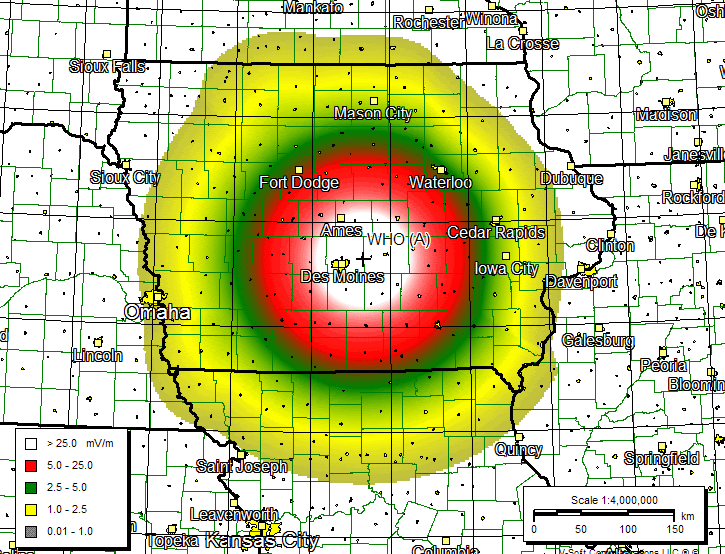
"FWIW..."
//
While the urban MW noise level on the AM broadcast band can be quite high due to manmade noise, the daytime atmospheric noise is quite low. This is particularly true at the upper end of the band. In a rural area, an AM station can be heard at a remakable distance if a receiver with an RF amplifier that allows connection to an external antenna is used.
As for using an ordinary receiver with with an internal ferrite rod antenna to receive a signal with a field strength of only 10 uV/m, getting good reception is remakable. Where the sensitivity of such a receiver is specified, it is in the region of 400 uV/m. It may be that the actual field stength is appreciably higher than 10 uV/m, despite the contour.
I have already mentioned the limitations of reception reports in evaluation a radio system. While reception reports are fine as far as they go, and they are frequently the only information available, they do not supply enough data for evaluating a radio link.