

Lately I've been working on an Excel spreadsheet to calculate the performance of Part 15 AM systems (click here).
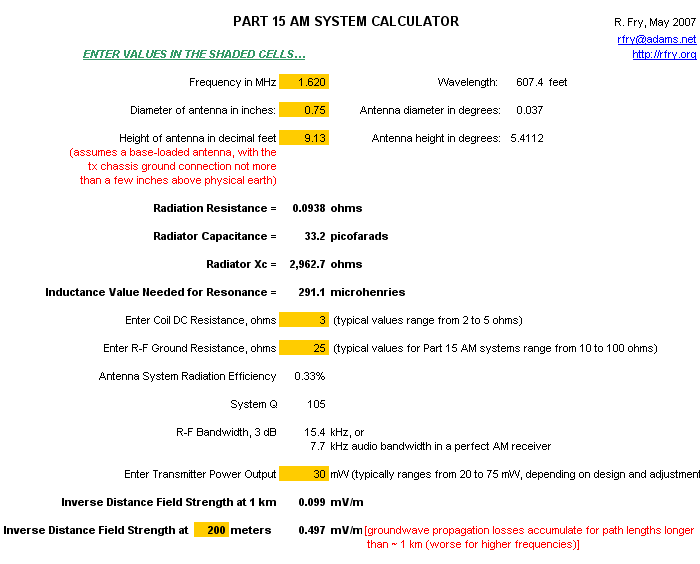
If anyone would like to have a look and let me know if there are any suggestions/comments, I'd appreciate it. My email address is shown in the upper right corner of the linked image.
If there is enough interest I can post the spreadsheet for downloading when it is done.
Thanks,
Rich

Rich,
Your project is a great idea and will be appreciated by me and I trust many others who like to dig into the theory and practice of radio technology.
One great benefit to the part 15 hobby community will be to be able to compare calculated performance with experimental performance and if, as I suspect, the two methods substantially agree, will provide a reliable way to predict performance of a given installation in advance of construction.
I hope you get many useful comments as you develop this. I am certainly interested.
Neil
I would like to suggest that the range for the transmitter output should be able to go up to 95%.
If you're interested, I'll e-mail you some info.
WEAK-AM
Classical Music and More!
Please do.
As the spreadsheet is constructed right now, any tx power output power (in milliwatts) can be entered. It needs to be the unmodulated power output of the tx, which probably most operators won't even know accurately. But for those who do, or can live with their estimate of it, the spreadsheet will show the theoretical field strengths that apply to the system.
//
How hard would it be to add a input feild to allow the user to estimate system performance using an elevated mast installation.
Thank You,
Rev. Robert P. Chrysafis
Universal Life Ministries
http://www.ulc.org
Moderator Hunterdonfree
http://groups.yahoo.com/group/hunterdonfree
The gain of a 3-m Part 15 AM antenna mounted with its base very near the physical earth can be predicted based on standard equations.
But when a Part 15 tx + 3-m radiator are installed above ground, and include other radiating conductors (the "ground lead," flagpole, billboard etc) then those standard equations do not apply.
NEC (Numerical Electromagnetics Code) can be used to model such systems, and calculate their radiation pattern gain and field strength -- but that is beyond the capability of a simple Excel spreadsheet.
//