

Hi guys! Well, it doesn't look like I'll afford a Belar any time soon. So, I figured a simple way to monitor modulation levels. This works with FM or AM. First, you need a tuner. My Denon goes up to 1700 on the AM. Then you need a cassette deck. A broken one can be repurposed for this. I just got one on the 'Bayster for $60! Like this:
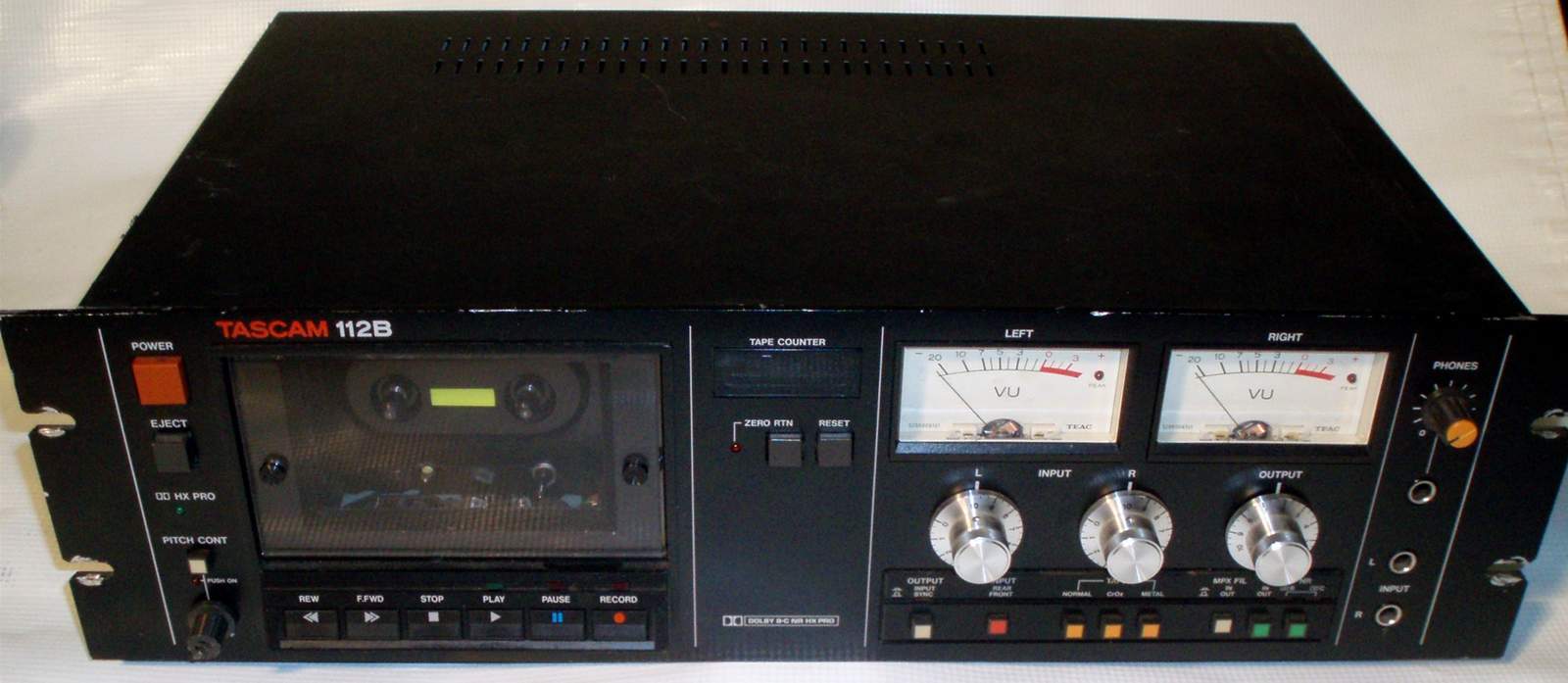
You find a local station, and set the input levels on the cassette deck right at 100%. Then dial back to your frequency and set your levels! It's not a $1000+ Belar, by any means. But can you think of a better way to do it?
Doug

Pretty much what I do when I'm setting the levels, I'll bump it up from there until it starts to distort then back off.
Coincidentally I have that same cassette deck, though it needs a belt.
Tascam is great gear when it is working properly, if i had the room and $ there'd be a couple reel to reels sitting in the studio.
Tune in a strong local AM station. Turn the audio down where you can just barely hear it. Adjust YOUR AM transmitter to the same level.
Good looking in the studio, it's nice to have analog meters, and it's easy to teach your DJs where to peak on them. If your station is all on a screen, you can even get a set of retro analog VU meters for that too! That could work if you have your station's level all set from the computer to transmitter.
I've done something similar, using the LED meter on a boom box to watch levels, but at best I've found it to just be an average guide, since that's what true VU meters are based on, average levels, the ballistics of the mechanical meter movements can't follow peaks.
There are other factors at play, such as how your sound is EQ and processed compared to other stations, and the receiver is a factor too, because if its narrow band, it won't be letting in all the modulation that you need to view, on a VU. This is all stuff I found out through trial and error.
As well, receivers can cause distortion of the audio waveform from using ratty, poorly designed detectors, which would affect what a VU meter reads. Even pro modulation monitors can have a certain amount of distortion, as Tonne found out in his paper, where he did simulations of the circuits in different commercial monitors.
http://tonnesoftware.com/appnotes/demodulator/EnvelopeDemodulators.pdf
Commercial monitors would be fine for monitoring though, with wide bandwidth detectors, and should have a VU meter with a peak flasher. Once you get your modulation adjusted on a scope, then use the monitor for day to day.
That might seem to be a lot for a P15 station, but if you can keep Tascam in your station, maybe it's not a lot after all. 🙂
I've got a Tascam 32 thats got warped motors and an intermittant recording problem, playback is absolutely amazingly flawless however. My Main R2R is a TEAC 3440.
Back to the topic, I've found EQ does a lot for percieved loudness.
About Reply 4: Tune in a strong local AM station. Turn the audio down where you can just barely hear it. Adjust YOUR AM transmitter to the same level.
The "level" of the audio heard from an AM radio receiver during such a comparison depends (at least) on the source material and processing used when recording and transmitting those programs, the frequency response/flatness of the transmitted r-f waveforms, and the operation of the AGC circuitry in the receiver.
The modulation processors used at most AM broadcast stations are capable of, and adjusted for more legal loudness (level) at the output of an AM receiver than those used at typical Part 15 AM stations.
So trying to match those two perceived, acoustic audio levels that way might result in overmodulation/distortion transmitted by a Part 15 AM setup.
The Belar for example. On FM, what do they use to determine 100% modulation? An antenna/receiver inside? What reference is used? How about AM? I don't get why these cost $3000+...
Doug
Nice idea on how to check your modulation. Thanks for sharing.
Neil
About Reply 8 above: ... On FM, what do they use to determine 100% modulation? ...
The use of Bessel functions.
The $3K price tag for a commercial mod monitor IS overblown....companies can get this kind of $$ because they're catering to a "niche" clientelle...I own a Belar FMM-2....there isn't $200 worth of parts in this!! Even factoring in accurate (lab) calibration, it SHOULDN'T run more than ~$500....BUT....a mod monitor is a required piece of gear in commercial stations.....so....it's pay up or stay off the air!!:(
Most mod monitors work off an RF sample taken from either a low-power stage of a transmitter OR an RF amplifier tuned to the station frequency.
Modulation is referenced using math formulae....for THIS old noggin.....I look 'em up in a book!!:)
To Ballparking modulation levels. Looks good right now. Sounds awesome! And Bessel functions...I Wiki'ed that...HOLY SH...my brain just exploded! GACK!
Yeah, Oldie, I kinda figured that price was over-blown...sad what greed can do...
Doug
For frequency modulation, the r-f carrier goes to zero (a null) when the amplitude of a given modulating frequency increases from zero to various different values.
Using an accurately-known, sinewave modulating frequency and finding the correct order of the carrier null (1st, 2nd etc) for that audio frequency accurately determines the frequency deviation of that transmitter.
For example, an FM broadcast transmitter is deviating exactly ±75 kHz (arbitrarily defined as 100% modulation) at the 2nd carrier null when modulated by a sinewave of 13.5870 kHz.
This technique provides the data needed to calibrate an FM modulation monitor.
The paper lnked below has more information.
https://www.fmsystems-inc.com/manuals/BESSELart.pdf
The funny thing is I know of several commercial radio stations that don't have a mod monitor at all.
Our LPFM transmitter has one built in.