

Ok gang lets start some chat about syncing Multi transmitters.
For my station I want to cover all of Santa Cruz Ca.
but to do this I will need at least three transmitters.
Ok gang lets start some chat about syncing Multi transmitters.
For my station I want to cover all of Santa Cruz Ca.
but to do this I will need at least three transmitters.
I feel this is the right patch to challenge the NAB Gang.
However many issues will come up with this type of thing.
I plan to use the internet to do this and hope that my signals don't run over each other.
That may be hard to do 🙂
Any of you have any ideas on how to do this and not spend a zillion bucks doing it ?
All of you're thoughts are welcome.

You may have to have the transmitters on different frequencies to avoid interference.
It's great you can do this in the U.S. It's not allowed in Canada - the CRTC specifically restricts one audio source to one unlicensed transmitter. You can have another transmitter, but then it has to have a separate audio source (i.e., different programming).
Thank you Lefty for starting this new thread.
I just want to mention for the sake of reference that this topic stems from the discussion originating from the second half of the thread at: http://www.part15.us/node/4387
You may have to have the transmitters on different frequencies to avoid interference.
That appears to be the only feasible (or at least affordable) solution Artisan. Although I would rather it wasn't true.
What about using pulsed IR or modulated IR for the sync and audio?
RFB
Lefty,
Here is some information from the Hamilton Rangemaster site regarding synched transmitters on the same frequency:
http://www.am1000rangemaster.com/zerobeat.html
I had to google that RFB. Has something to do with remote control devices?..
That might work, I go check under the cushions of my couch..
But really, what that you say?
We know that typical remote control IR is simply a modulated IR beam with the command pulses (old style) and actual pulsing of the IR diode itself in relation to the command data in the remote.
Perhaps it's possible to use the same technique to synchronize those Rangemasters and avoid the issues of audio and sync delays from running wires or the delays using the web or wi-fi links?
RFB
I'm still not getting you.. are you suggesting to somehow send modulated audio through an IR beam to a transmitter?
"are you suggesting to somehow send modulated audio through an IR beam to a transmitter?"
Yes, audio as well as the reference pulse for each extension transmitter to be synchronized.
Or just the audio if the extension transmitters are operating on different frequencies.
I experimented with this once using two mini-disc recorders with the optical in/out ports. On one unit I replaced the stock IR emitter with a high powered IR emitter with a lens to widen the beam. The other mini disc unit's "in" IR detector was also replaced with a more sensitive detector and both the send and receive IR diodes were mounted in external enclosures.
The distance between them was 2 blocks. This was only sending audio.
I believe that a digital encoder could be built to accept both the analog audio plus the reference pulse and convert those into a digital data stream modulating a IR emitter diode shooting a beam to an IR detector diode feeding a decoder, separating the audio information from the reference pulse, thus cutting down on the delay often encountered with running a long wire to those extension transmitters, or feeding them via the web or wi-fi link.
Or perhaps one of those other A/D-D/A converter units that was linked to in another thread discussion, can't remember where that link pointed, Amazon maybe?
Just tossing some ideas that might be a viable alternative.
RFB
You may have to have the transmitters on different frequencies to avoid interference.
The link below shows the resulting radiation pattern in the horizontal plane when syncing two transmitters on exactly the same carrier frequency with exactly the same radiated power from locations separated by two kilometers.
Note this is just considering r-f synchronization. Audio (program) phase at the two transmitters also needs to be synchronized.
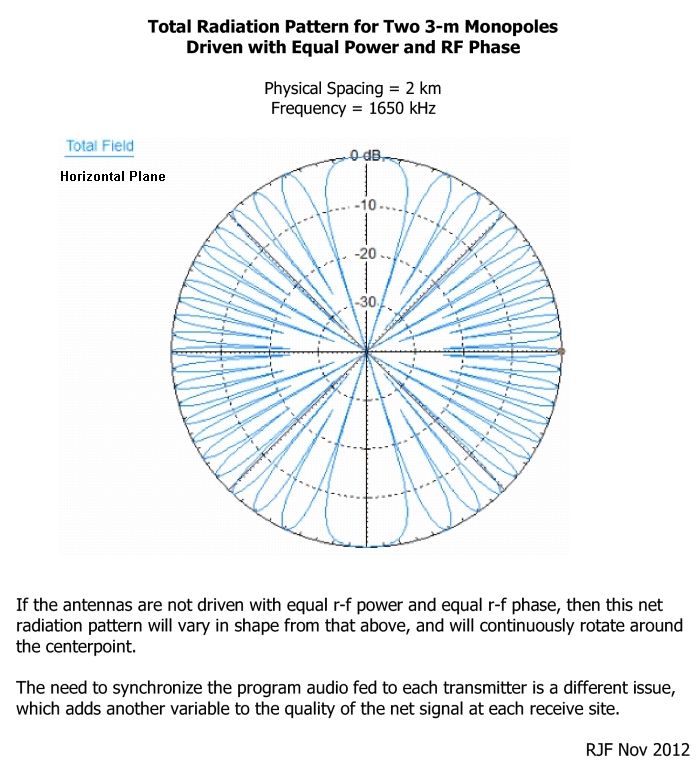
The internet is NOT a good mechanism to synch multiple transmitters. Not only are there delays, but the amount of the delay changes with time, use, etc.
A simpler way to distribute your signal to multiple transmitters would be point-to-point wireless. The technology is common, relatively easy to use and not all that expensive. I'm using some of it in my experimentation of building my own ether, so to speak, i.e., my own hotspot.
You could use 802.11a or n wireless bridges with directional antennas and those things can go for miles (the manufacturers claim up to 20 miles, at least some of them, but for what you want to do, even 3-5 miles would suffice). And the delays would be small and constant, so that you could adjust the transmitters for minimum interference.
Sounds like what I was looking at today - 2 Outdoor 24dBi Parabolic Grid wifi antenna's $130: http://www.ebay.com/itm/200712165689 on ebay, But I'm not certain yet what the total cost with required accessories would be, I'm not the least bit familiar with these entire systems.
However, before deciding on going this route I would need to climb on the roof and see where I might get a line of sight to the north end of the island.. might not be so easy..
I don't know.
Aiming down the straight path of hwy80 would be easy, but having a a place for the receiving antenna in that line might not
Elaborating on my above post; I was watching a few of the videos the above link provides, and they make it look so easy, and it's supposed to be capable of up to 8 miles.
It's from a company in Florida called "Simple WiFi"
Based on the way it's presented, this is the way I understand it:
You need the 2 Pack of 24dBi 2.4Ghz Outdoor Parabolic Grid Antennas $130
a Lynsys router,
a strong usb adapter,
a couple cables,
and a line of sight.
1.) You mount the antennas
2.) On the transmitting end you connect the antenna to a Lynksis router using a TNC cable.
3.) On the receiving end you connect the ant using an SMA cable to a ALFA 802.11N card (a high power USB adapter)
4.) You point the antenna's at each other
http://www.ebay.com/itm/200712165689
It looks like the whole thing can be set up for a couple hundred dollars.
Whadda ya think?
these are all you need. one pair per a link.
problem solved. cheaply!!!!
http://www.amazon.com/NanoBridge-Cost-Effective-5GHz-22dbi-MIMO/dp/B0055PKSCK