

By "mud" I am referring to interference within households which makes AM virtually unlistenable. Such is the case for the 8Z household where only the outdoor ham antenna can pull in listenable AM signals, even locals.
How bad is this interference? Recently I placed an old reliable Heathkit digital clock which has always worked perfectly next to our flat screen TV and noticed that it was gaining about 1/2 hour per day. Thinking perhaps the clock was just showing signs of age I checked the caps and power supply ripple and all was OK. Nonetheless, as a check, I installed another digital clock and it also gained time. Being suspicious that the TV was generating interference on the power line with its switching supplies I installed a filter cap in the Heathkit clock on the input pin which the IC uses to count the line frequency. The clock now keeps time correctly.
Most digital clocks derive the time base from the 60 Hz power line and this was the case for both of these clocks. It is apparent that noise was coming in via the power line and was interfering with the clocks' counting of the 60 Hz line frequency.
I and others reportedly have observed radio interference from wall warts, switching supplies, and lighting devices which interfere with AM radio but when it gets so bad that the clocks malfunction then it is time to ask what the FCC is doing to apply Part 15 limits on signals injected into the power line by such devices. They are all supposed to be compliant with Part 15 limits but this seems not to be the case. Either the limits are wrong or the monitoring/enforcement is lax.
The big threat to AM broadcasting comes not from the perhaps a few thousand AM hobby broadcasters but rather from the hundreds of millions of hash producing devices pervading most homes.
Neil

I have posted a few rants about this very subject in past posts.
It's the Hydro(a/c) in general.
If the power goes out or you turn off the power in your house see how good AM gets!....like it used to be.
Mark
For another perspective:
In my home I have three flat-screen HDTV sets powered by external power supplies, and numerous other devices using external power supplies/wall-warts.
Of those systems, the only significant source of interference to the reception of licensed signals in the AM broadcast band in my home originated when an HDMI cable was used to connect my Roku3 to one of my HDTV receivers.
It took me a good while to chase that down. For the time being I've just disabled that system.
Now using AM receivers such as the Sangean PR-D15 and Tecsun PL-880 indoors with their built-in loopstick antenna, I can again receive AM stations having very weak field strengths at my location (less than 100 µV/m).
It goggles my mind how the field strength of interference is higher than a complaint part 15 AM Transmitter.
In my new studio/shop room I'm putting together I noticed a lot of noise in the HF band around 10 meters in several spots.
I figured it was one of the several PC's I have running, maybe the USB hard drive adapter, numerous wall-wart switching supplies or the LCD monitor.
Turning off all the PC's and the most other devices I still had the noise.
Shutting off the Netgear 24 port LAN switch quieted the noise.
Turning it back on the noise came back and then disconnecting the network connection coming into the switch quieted the noise.
Haven't thought about how to eliminate that noise problem.
Interference clearly depends on a ton of variables including devices being used, and radio sets. Example:
I'm sitting in my home office with a 10 year old iMac running in front of me. On the desk with it are an Eye-Tv video converter, a wireless printer, a film and flatbed scanner, an external DVD drive, two external hard drives, and a few other doodads. There are 9, NINE "wall warts" running all this stuff on the floor behind my desk, all plugged in chugging away. There are two CFL's in the light fixture hanging from the ceiiling about 4-5 feet away from me, and another out in the hall about 10 feet away. I have a scanner radio running to my left, also with a wall wart. Behind me a two meter ham radio with a very oversized 13.8 volt power supply running it. I have the cable modem with built in wifi router behind the computer and a wireless weatherstation on the wall. To my right is a counter with a big power strip with wall warts and chargers for cell phones, camera batteries, and a Dremel tool. On the wall in front of me is a 40 year old light up digital clock probably from the late 70's. The clock keeps perfect time. That's a hell of a lot of electronics in a small space.
Yet the vintage Motorola transistor radio on the window ledge next to me pulls in a crap ton of distanc weak stations with no noise. The Hallicrafters S-40B receiver from the 1940's behind me pulls in a ton of short wave and ham stations with no problems and no noticeable noise floor.
There are CF"ls in the kitchen and living room. We have three computers running 24-7 in the house, plus two iPhones and 2 iPads either being used or charging.
We have FOUR flat screen TV's including the big one in the adjacent room. Each has cable boxes, wifi enabled DVD players, hell even a couple VCR's and a DVD recorder!
The ONLY interference I've been able to notice in my ham station is some clicking/buzzing when the heating element in our dryer turns on and off. I don't get that on any radio upstairs, but the station is in the basement not far from the dryer.
Not to mention our house was built over 100 years ago and most of it is still original knob and tube wiring!
I heave virtually NO interference on AM radio in the house. I do get a bit of static in one particular spot in my driveway, which has been there for decades and I assume is from the power lines. But again, I have to be stopped in just the right spot.
It's got to all depend on your particular situation and device.
TIB
Remember, being compliant in no way means that the FCC has tested the device. It's either self certified or done by an independent lab.
TIB
I wish I had a happy thing to post, but noise is everywhere.
There were several FCC actions for noise, but nothing in the MW band.
800MHz http://transition.fcc.gov/eb/FieldNotices/2003/DOC-337031A1.html
126 MHz http://transition.fcc.gov/eb/FieldNotices/2003/DOC-337032A1.html
Mess with cell phones, NOUO. Mess with airband, NOUO. Mess with MW; nothing. My guess is money. The effort it would take to track down all the MW noise would be massive. Quite a bit of money changes hands selling the electronics that cause the noise. Filtering the noise would increase costs of products which consumers would baulk at. Linear supplies would not have this problem but switching power supplies are smaller, lighter, more efficient, and cheaper.
This is similar to a problem users of the X10 home automation protocol deal with. There is tons of noise on the powerline that was not there in the 80’s.
So, yes AM is sinking into the mud. The recent AM actions did nothing to fix that problem. At least at the rate the FCC is going the mud will get up to the FM dial soon enough and that might cause some action.
Goggles? Is that like "Hoovering" over something?
In my original post I attributed my noise problem to devices in my home and this is still true but it appears there was another major source of hash.
This morning around 5:30 our power went out and it was just restored. The outage was accompanied by a loud bang and from the direction I deduced that the main circuit breaker for our neighborhood had opened since I have heard this before. The linemen replaced something in the transformer a few doors down the block from me and now the noise on AM is a lot less than before. Perhaps there was some arcing for a long time and something finally shorted and this arcing sourced noise.
Anyway, there is still noise from devices but happily it is now much quieter on the medium wave bands.
Neil
Lots of toroids might be the only way to fight the constant noise.
Toroid Tutorial
I had a myriad of power line fixes in my neighborhood. Bad lightning arrestor,(20 over 9) loose ground connexctions and missing or wrong hardware. Noise level on 75 and 40 is now around S7 to S8.
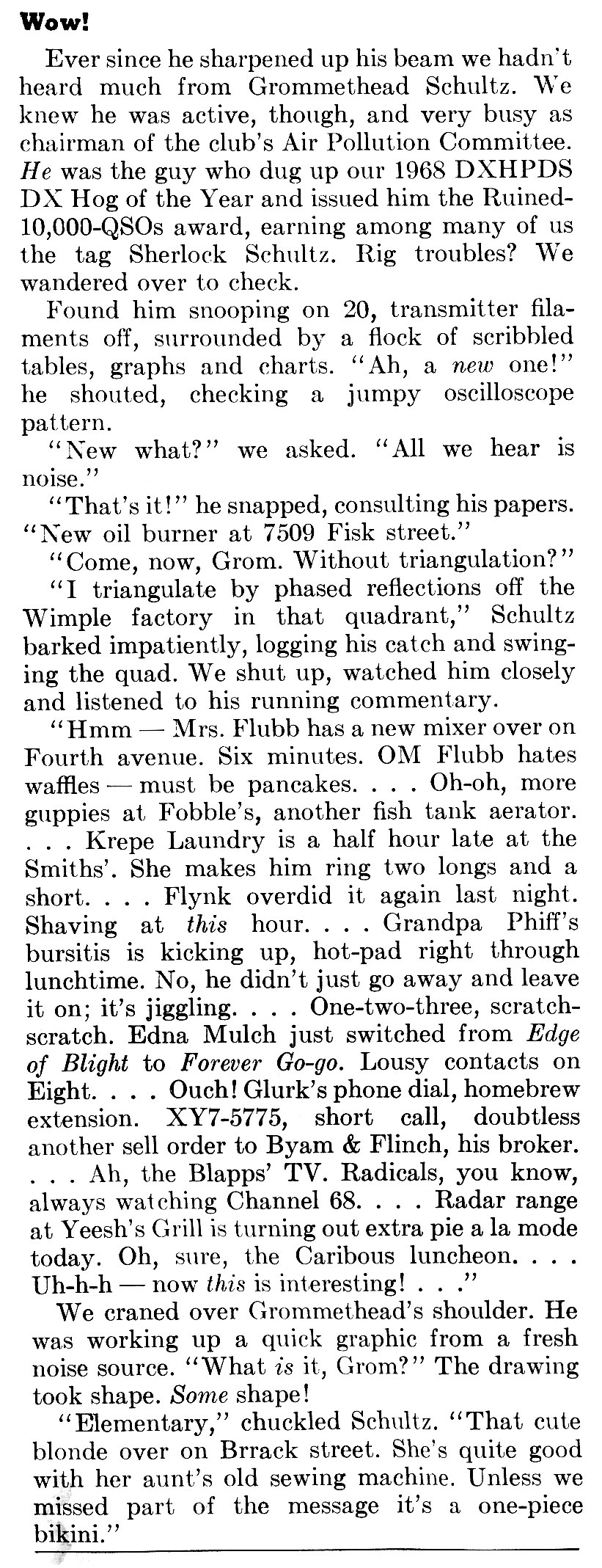
Interesting, after this discussion of noise on the radio. I was reading a a nearly 48 year old article in an old ham radio QST magazine and stumbled upon an amusing column about noise on the bands. Thought some of you might find it amusing -- if you can get past the ham radio lingo that is. I scanned it and kept the image pretty big so it should be easy enough to read. It's at:
TIB
...they are efficient but they come at a different cost. A cost that AM and HF band enthusiasts get to pay for.
It will be interesting to see how the power companies around the country will deal with power factor correction as more and more fluorescent- and diode-lighting goes into service (vs. filament-based lighting).
I like the torroid tutorial link above.