

For curiousity I visited the Prometheus website, which helps people apply for LPFM licenses, and their sophisticated search tool told me that 92.9 mHz is available in my location and even presented a contour map showing the coverage area that would be achieved. What caught my attention was mention that the outer ring of the circle showed the "60dBu Contour."
Inspired, I next visited radio-locator and looked at coverage maps for several stations, noting that three rings are shown, including "local (60dBu)", "distant (50dBu)" and "fringe (40dBu)."
"Hey," I thought. "My TECSUN reads dBu, as does the "Compliance Appliance radio from I.S.S."
That's why today I will be drawing contour maps for all my Part 15 stations showing the local, distant and fringe rings.
A bit of labor for Labor Day.

Repeating from a post I made on Part15us last August (bolded font now added):
"Earlier posts here and elsewhere have identified DSP-based receivers displaying a relative indication of the received r-f voltage at a sample point within the receiver, shown as XX "dBµ" on the front panel LCD display on such receivers.
While this indication is not an accurate measure of the field intensity arriving at the antennas of such receivers, still it can be useful in the process of maximizing the fields radiated by a "Part 15 AM" transmitting system.
One example of such a receiver is the Tecsun PL-310, which has been available via links through E-Bay (and others) from direct exporters in Hong Kong for about $50, US.
These units are rather good receivers for LF, MF, HF, and analog VHF-FM (mono/stereo) transmissions.
They have good sensitivity on the MW band. Optimizing the loading coil turns/inductance used in a Part 15 AM transmit antenna system might require locating such a receiver several hundred feet away from the transmit antenna, and/or to physically orient the receiver so that either short side of its front panel is directed toward the transmit antenna."
As soon as I hang up from this post I'll start the map making, it's full daytime, the best time for local AM.
And thank you Rich for adding the above detail, and credit especially goes to you for making me first aware of the PL-310, opening the door on having a more useful than before tool for getting a decent field energy measurement for Part 15 radio.
I have seen coverage maps posted by some Part 15 stations, but I think they have tended to be based on average reception on an auto radio, and not compared to the dBu scale.
Even if my map won't be perfectly accurate, it will be a reasonable estimate of signal coverage.
Some parts of my "circles of reception" will be missing, because no doubt the key locations are in private yards and I have not roamed in neighbors yards since age 6 when I found apples hanging from Elsie Prysock's tree. She would yell, I would escape.
Almost 100-degreeweather, I was outside in a pyth helmut, marking down dBu readings from the TECSUN PL-310 radio, based on the contour maps described above, where 60dBu marks the outer edge of a circle around the prime signal area, known as "local" reception.
Important facts to include in the discussion come from the "Radio-Locator" definitions about their Coverage Maps, apparantly based on industry standards:
"Local" = 60dBu = red circle = 2.5mV/m;
"Distant" = 50dBu = purple circle = 0.5mV/m;
"Fringe" = 40dBu = blue circle = 0.15mV/m.
So far I've looked at the 60bBu field area of the AMT5000 and AMT 3000 transmitters, both of which drive "Wintennas," consisting of indoor transmitters, 2.5' wire from the baseboard vertical up to the lower part of a metal window frame facing outdoors, the window frame becomes a further vertical part of the antenna adding 6' with a wire attached to the top outside to reach a total vertical height of 10'. The grounding systems vary between the two transmitters, and will be discussed as we go along.
Quite conveniently the AMT5000 almost perfectly places a "local" footprint on the entire lot, except that the overall pattern looks like a drop of water, in the front yard the pattern gets narrower and comes to a point at the public street right below the power line. The reason for the pattern is an accidental consequence of the way in which the transmitter is grounded, and can be corrected later.
On the east and west sides the 60dBu line is about halfway in neighboring yards.
The AMT3000 puts out a footprint that keeps the local signal, the 60dBu boundary, within 10' of the building all the way around. It has much less range, even though it is resonant with the hand-made loading coil, probably because of the fact it is directly grounded to the I-beam which ties to electrical ground, but without radial wires.
The indoor signal levels of both transmitters fill the house 100% with dBu readings ranging from 72 to 91dBu.
See post #6
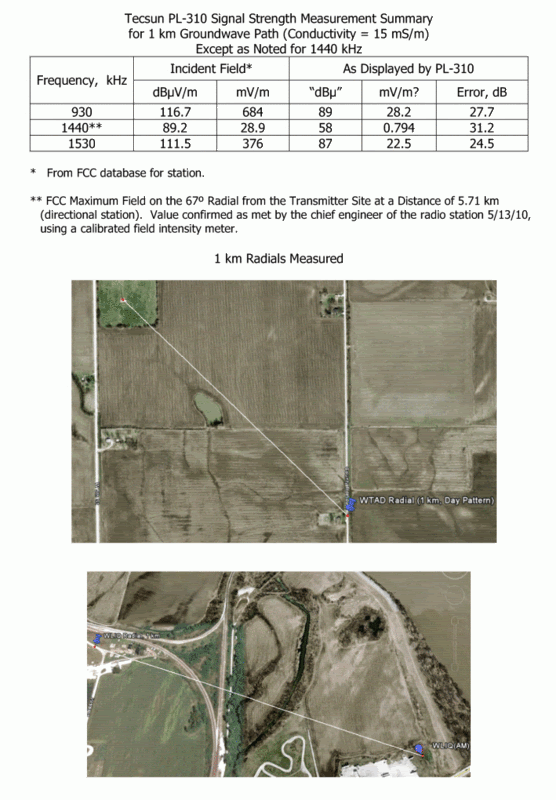
Sorry, but readers of this thread should kindly note that the "dBµ" value shown on the LCD display of a Tecsun PL-310 and similar receivers is grossly inaccurate as a valid measure of the true field intensity arriving at the loopstick antenna of such receivers.
Therefore, such dBµ values are not comparable to the field intensities for Local/Distant/Fringe coverage contours shown by Radio-Locator, which in reality are values of field intensity in units of dBµV/m.
This is apparent by a review of the data shown in the graphic below, which I first generated/posted over three years ago.
Your input, Rich, is vital to keeping tabs of the intricacy of accurate field measurement vs. approximate field measurement, and there is no doubt, and I'm glad you are giving this excursion the balance it needs to be of meaning.
What means something to me is that now I have a "sketchy picture" of what my transmitters are doing, made possible by this novel radio with the dBu readout.
It helps those of us who lack training in RF physics become slightly more familiar with what we are dealing with. As time goes by, we learn more.
Otherwise all we have is "driving around in a car listening for a signal."
Hey Carl, while you're out and about with your tecsun, it would be very interesting to see some readings on local AM broadcast stations that have one of the 3 contour lines passing over or near your property. The tedious part is bringing up the maps on radio-locator for the stations in your area to find one or more that have a line close to your location.
EDITED -- Sorry I didn't see posts 6 and 7 until after I posted this. Would still be interecting to see some results to supplement Rich's readings.
The Tecsun PL-310, and the Grundig/Eton equivalent, appear to have the potential of being very good relative field strength meters. Most importantly it is a tunable radio receiver. Other cheap field strength meters have no tuning. Even the ones with amplification are still not tunable, so you don't know for sure if you are reading your signal or some other signal on a different frequency.
Here are two very good uses for the Tecsun.
Electrical Noise in One Sector of Your Coverage:
Car radios have very good AGC. It's often impossible to tell if your signal has dropped off or some localized electrical noise source has overpowered it. The two cases are indistinguishable with a car radio. The symptoms are the same, static and hiss replaces your signal. If you have a good relative FS meter (like the Tecsun) you can determine if the reading is falling off indicating a dead area in your contour or the reading is the same or increasing indicating a local noise source.
Reduced Coverage of Your Station at Night:
Take a Tecsun reading during daytime at a fixed location a moderate to fringe distance from your transmitter. Go back there within a few hours after sunset when skip is significant and your signal probably sounds weaker on the car radio. Most likely the reading will be the same or even higher at night because you are actually reading the composite of your signal, several distant stations, and increased atmospheric noise. On the car radio, with its excellent AGC action, it just sounds like your signal gets weaker. It doesn't. The background signals get stronger and begin to swamp out your signal. You can use this evidence to bust the myth that Part 15 AM transmitter signals are weaker at night.
This field strength game is good fun and I like PhilB's new ideas, so I will be out doing them this week.
Spotting the maps for licensed stations is easy to do and in fact last week I printed out maps from a whole clump of FM stations that use the frequency I use, and many of them have overlapping "fringe" rings, and my frequency is exactly on the fringes of three of them!
Doing reception tests in preparation for noting the dBu readings based on contour maps published at radio-locator, I have verified confusion over the proper orientation of the radio. (verified confusion?) More about that in a minute.
While tuning around I have caught two stations asleep. The station at 850 went from insipid christian piano music to dead air, which I enjoyed for 20-minutes before somebody hit the restart button. Right next door at 920, a station which recently went all satellite sports, I am right now listening to a fluttering sound, with no program audio.
Back to business.... for a long time I have been baffled over how to aim the radio for maximum signal reception from a transmission from a known direction. This morning I confirmed there is good reason for confusion. Two examples follow...
1. A 5kW tower exists 1-mile north from here. Aiming the back of the radio toward the tower, the reading is 78dBu. But aiming the side of the radio the field reading goes up to 83dBu.
2. The exact opposite happens with a 50kW station NE from here. Back of the radio facing NE gives 62dBu, side of the radio 53dBu.
I am only guessing that the loopstick is mounted horizontally along the inside top-edge of the radio, but don't know.
... how to aim the radio for maximum signal reception from a transmission from a known direction. ...
The loopstick in the Tecsun PL-310 is mounted so that it will be oriented horizontally when the long sides of the case are horizontal. This is the orientation needed to maximize its gain for the vertically-polarized transmissions used by AM broadcast stations. Loopsticks respond to the magnetic field of a radio wave, which is rotated 90 degrees from the electric field (the polarization of a radio wave is defined by the orientation of its electric field).
The pattern of a horizontal loopstick in the horizontal plane is similar to a figure 8, where its two nulls are aligned with the axis of the loopstick.
In checking the readings I get on a local station, the Tecsun showed 78 "dBµ" while holding the case by the front/back bottom corners with the front panel vertical and facing me, and the long dimension of the radio rotated 90 degrees from the path back to the transmitter.
For that same location and station the radio read 48 dBµ when it was rotated horizontally by 90 degrees.
The null is sharp, i.e. finding the exact physical angle to minimize the signal takes some effort.
Re-radiation from conductors near the measuring location can make it difficult to get a deep null on MW signals, or the null may not be aligned with the azimuth bearing toward the transmit antenna. In such cases the reading should not be trusted, and another measuring location should be found where those conditions are met.
As with many things, what may appear to be a simple process could take more effort and understanding than first expected.
Good to know the antenna arrangement and properties.
My results make more sense after reading the recent post, given that I was sitting indoors in the center of a building, thus very much inside the influence of pipes, wiring and whatnot.
Now is about the time to go outdoors and gather the data suggested by PhilB.
I think I'll wear a sign that says OFFICIAL BUSINESS.
Choosing a point outdoors to set a stool, away from buidlings and obstructions, we began the process of comparing the published AM contour maps for area stations, using the digital field strength readings of a TECSUN PL-310.
Most local stations are located across the river toward the east, so I did them first.
To clean up the dial I turned off all KDX transmitters.
The two numbers of the display indicate dBu/SN (signal to noise), with dBu having the range 00 to 99 and SN a range of 00 to 25.
To start, I recalled that the spectrum analyzer shows the strongest signals from this location consist of 3 particular stations, so I did them first to collect a top reading:
850kHz from 1-mile away registered 86/16, with me wondering why the SN wasn't a full 25.
1010kHz showed 73/25, and 1120kHz was 66/25.
Of the remaining locals, most were above 60dBu, where they should be based on their maps, but there were 2 of them showing in the 50's despite my being within their 60dBu contour, mapwise.
Now the fun part, the "distant" and "fringe" stations.
730kHz shows their 50 - 60dBu "distant" range right on top of me per the map, but their reading showed as 30/02.
800 kHz also shows me in the D range, but I never get them and couldn't hear them today.
880kHz puts me exactly on the line between L and D, but the reading said 41/15, which is the outer ring on the map, at 40dBu.
980kHz map shows my location on the line between D and F, but no reception at all. I have heard this station during the critical hours just at sundown.
1080kHz on the map says I should be in the L range, but the radio said otherwise, putting me at 42/16, just at the fringe.
1220kHz on the map indicated D but no reception.
1230 kHz on the map also says D, and I read 35/02, outside of the F circle.
1260kHz map says L, but result on radio is 51/16, moving me to D.
1460kHz map says L radio says 42/21.
1510kHz map says L/D, right on the line, radio says 34/07.
1540kHz map says F but no reception.
Of course we don't know the status of these stations, whether they're on the air, operating at full capacity, or perhaps the hole I live in, surrounded by hills on all sides, is dampering the results.
The critics, including Rich and Bill Baker from I.S.S., have both said these radios are less accurate at lower field levels, which of course seems reasonable.
Of these readings 30/02 was the lowest signal detected, and it was barely listenable. I didn't see any radio signals down in the 20's.
I also noticed that on channels with no station the dBu reading never dropped below the 30's, so I would guess that ambient medium wave energy is biasing the RF input.
The "dBu" reading on the Tecsun PL-310 never will accurately/reliably agree with the "dBu" contour lines shown on Radio-Locator for AM broadcast stations, or as measured by a calibrated field intensity meter such as a Potomac Instruments FIM-41.
The contour lines on Radio-Locator are based on decibels with respect to a field intensity of 1 uV/m (dBuV/m) -- which is not the same calibrating/measuring unit used in the PL-310, and similar radios using that DSP chip.
On review of the graphic I posted earlier in this thread it will be seen that the signal strength value shown on the PL-310 is > 20 dB less the actual field intensity in dBuV/m.