

Hello all,
I have read where center loaded short (such as part 15 AM) antennas perform better than base loaded antennas. The theory given is that there is higher current in the element from base to coil in this design. I also notice that the TIS stations in this area use center loaded designs.
Does anyone have more information on this topic?
Neil
Hello all,
I have read where center loaded short (such as part 15 AM) antennas perform better than base loaded antennas. The theory given is that there is higher current in the element from base to coil in this design. I also notice that the TIS stations in this area use center loaded designs.
Does anyone have more information on this topic?
Neil

I found this information a while back and it made me think..
Quote from: http://www.northcountryradio.com/Articles/part15.htm
"This involves splitting the radiator into two sections and adding an inductance to bring the radiator to resonance at the desired frequency. Approximately enough inductance is needed to resonate with the self capacitance of the top whip antenna. For 1600 kHz this will be on the order of 400 to 1000 microhenries, depending on whip length and diameter, as well as exact frequency. A good RF ground system is required, and antenna bandwidth of 10 kHz is typical. Radiation resistances of 0.1 to 0.3 ohms are typical, and the radiation efficiency of a system such as this will be a few percent at best, assuming ideal grounding, and 0.5 % for the typical home experimenter setup. However, experience at 1880 kHz with 160 meter Amateur mobile operation, using 10 watts AM and a center loaded 8 foot whip mounted on an automobile, shows that 2 way contacts at 50 to 100 km (30 to 60 miles) are possible and fairly common. Extrapolating this data based on theory, with 100 mw, (20 db below 10 Watts) therefore, ranges of 5 to 10 km. (3 to 6 miles) would seem possible without violating FCC rules. However, noise and interference will be the main limitation. Its all in the location and antenna system, and how well everything is tuned and matched."
From all of the things I've read, this design sounds like a winner. I have a design (No prototype yet) of this type with variable inductance for tuning. (Changing the inductance of the center load from a distance) When I "Get-r-Done", I'll lay it out here somewhere..
The average current in the section of the radiator below the coil may increase when the coil is moved up the radiator, which would increase radiation from that section.
But the capacitive reactance of the radiator above the coil increases considerably, and its radiation resistance is reduced, because that section then is a shorter fraction of a wavelength at the operating frequency.
So more inductance is needed in the coil, which increases the losses in the coil. The net result is that there can be very little benefit to a Part 15 user in placing the loading coil in the center.
The best result of it occurs when there are very low/zero losses in the r-f ground path, but Part 15 AM systems typically don't come anywhere close to that.
//
Hi, Rich..
Again, Thanks for your input around the boards. I sure appreciate it..
I am curious.. What changes will be made in the radiation pattern when the coil is moved to the center of the radiator? (Assuming a good ground scenario)

My last post with this title (above) was based on a paper I have on the subject, but the data there is based on an 1/8-wave radiator over 16 elevated ground radials. I got to wondering what my own study specifically for Part 15 applications might show.
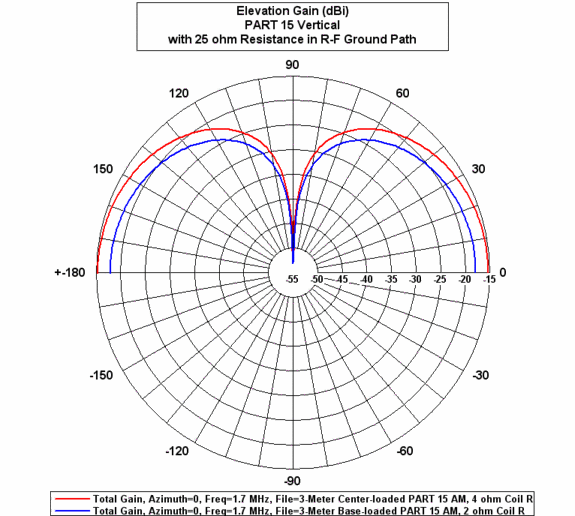
So using NEC-2, I modeled resonant, base- and center-loaded, 3-meter, ground mounted Part 15 verticals. The result is shown in the plot below.
Even though the coil losses are higher for center loading, the calculated results do show about a 2 dB advantage for center loading, for the conditions of my computer study.
A 2 dB improvement in radiated groundwave field is a step in the right direction, but wouldn't produce a large improvement in the coverage area.
//
Again, Thanks for your input around the boards. I sure appreciate it.
And thanks for saying so.
I am curious.. What changes will be made in the radiation pattern when the coil is moved to the center of the radiator? (Assuming a good ground scenario)
This can be seen in the NEC-2 study I posted here a few minutes ago (link repeated below).
The shape of the pattern is very nearly the same for the center-loaded antenna as the base-loaded antenna in my models, but except towards the zenith, the absolute gains of each are different.
//
Thanks, Rich.. Every little bit helps on these pea-powered units. I've noticed just the smallest adjustment makes a large difference. 2db isn't anything to sneeze at in my eyes. I believe it would be worth the effort..
Another difference in base vs center loaded Part 15 AM antennas is their VSWR bandwidth. The higher "Q" of the center-loaded coil means that that system will not radiate the AM sidebands as efficiently as the base loaded version. That can produce a "muffled" sound quality, because the higher audio frequencies are reduced with respect to the lower ones.
Below is a plot of the VSWRs across the r-f bandwidths of the two systems in my NEC-2 study, whose radiation patterns appear above.

//
Thanks, Rich, for the analysis.
It is discouraging to see the VSWR bandwidth is worse for the CL than the BL antenna since I have had problems with the BL audio bandwidth.
The solution is to include a resistance in parallel with the antenna output of the SSTRAN (R18 in this unit). Such a resistance would possibly negate the gain advantage of the CL antenna.
I tried a Ramsey AM-25 with the SSTRAN design BL antenna and could not find a coil tap which would work. I know from previous tests that the resistive component of the output impedance of the AM-25 is low (around 25 ohms) and suspect that this lowers the antenna system Q so a good peak is not seen. I am still pondering why the field strength with the AM-25 driving this antenna is much less than that I get with the SSTRAN using this antenna.
Anyone else tried this?
Neil
I also notice that the TIS stations in this area use center loaded designs.
This is a little odd, because the FCC limits the field strength of TIS stations, among other things (see paste below). So it wouldn't seem really necessary to squeeze the last bit of efficiency out of the antenna system.
From Part 90.242:
(4) For a station employing a conventional radiating antenna(s) (ex.
vertical monopole, directional array) the following restrictions apply:
(i) The antenna height above ground level shall not exceed 15.0 meters (49.2 feet).
(ii) Only vertical polarization of antennas shall be permitted.
(iii) Transmitter RF output power shall not exceed 10 watts to enable the user to comply with the specified field strength limit.
(iv) The field strength of the emission on the operating frequency shall not exceed 2 mV/m when measured with a standard field strength meter at a distance of 1.50 km (0.93 miles) from the transmitting antenna system.
//
Rich,
As I read your quote of the rules pertaining to TIS I interpret the parts to be AND related and not OR related. Part (iii), in itself, seems to imply that the 10 watt limit is in lieu of the others, but the context of all four parts is inclusive, not exclusive, of each of the parts. In other words, my read is that the 10 watt limit needs to be followed in addition to the other three parts.
The TIS installations I previously referenced as using center loaded antennas are: One is for the city of my residence, two are for the Ohio Dept. of Transportation on the I-270 highway, and one is for the CMH airport. All have the center loaded antenna design and are mounted well above the earth. The transmitters can be seen to be at the lower end of the tower at eye level so they are probably radiating from the transmission line as well as their antennas.
My fair city's antenna is mounted on a tower and I have received their signal at a distance of 20 miles Q5 (for those who don't know, Q5 means perfectly understandable). This seems, by extrapolation, to violate the 2mV/m at 1.5 km rule unless the factory stock receiver in my truck is of exceptional sensitivity.
I am sure that my city purchased the system installed and plug and play, but I wonder if the installers even bothered to check the signal field strength.
Neil
Hi, Neil -
Yes, this is a conundrum. Why would the FCC define the effective length (height) of a TIS radiating structure plus the maximum output power of a TIS transmitter when they also define the maximum permissible TIS field strength at 1.5 km?
And why would the FCC care what combination of TPO and antenna system height/efficiency might be needed to produce that defined field strength value for the terrain conductivity conditions and the operating frequency?
They don't define any of that for Part 15 "Campus" setups -- only that a certain field strength value cannnot be exceeded at a certain distance beyond the campus perimeter.
Likewise with Part 15 operations in the FM broadcast band, where nothing is stated about TPO or antenna length/efficiency/gain. The FCC limit applied to these systems is placed on the peak field strength they produce 3 meters away from their radiators.
Why this difference for TIS stations? I ask the question, but I don't have the answer.
//
Rich,
I don't have the answer either except maybe the rules were written by folks lacking technical understanding.
Since I don't operate a TIS I am going to leave it be.
Neil
Mram 1500 might have the answer to your questions Rich and Neil, he does after all look after the cities TIS. Perhaps when he has time he can chime in.
I can remember TIS stations dotting the Ohio map as I used to make many trips between Cincinnati and Cleveland, to avoid the mess in Columbus and because i never felt the need to fly down I-71 at 80+ mph , i would take the Hazardous Materials route then hit I-71 again and continue North or South towards my destination.
Seems those TIS signals would carry pretty far back then, never sounding very good as i recall.
Barry if BBR Yardwide Radio