

I was looking at the RSS210 rules for Canada, and came to the rules for wireless microphones in the 76-88 Mhz band.
It appears that the rules allow 50 milliwatts eirp here, but the kicker is that these microphones are not intended for broadcasting use. Any transmitter would also have to be RSS210 certified as well.
I remember that the internet was a-buzz with talk of wireless microphones a few years ago, but little appears to have changed, at least in Canada.

Several times I've itched to delve into Canada's RSS210 history. I've heard you speak snippets of it on numerous occasions. I'm still so tangled up in several individual decades here, lots of threads I haven't got to the end of that I just know are significant. - in a historic regard, perhaps other ways as well.
Although I've not dug into Canada's reputational history, I ido nvariably come across intriguing things. I first brought it up over at the HfUnderground forum, I'm intrigued on what the actuall relationship is and has always been between the FCC and... I sorry, Canada's Communications Commission (I forget). Theres an article that caught my eye from like late 1930s headlined about the FCC following Canadas lead in some regulations.. I dont feel like digging it out, but I've got several stories I've found. I guess one of my favorites was, and I will go dig this out..
Radio Beverlodge, his got the most press in 1959-1960. Not just in Canada, but throughout the US. This copy is a little rough but it's one of the earliest articles and one of the few having a picture.
St Joseph News Press Gazette ~ Sun, Oct 18, 1959:
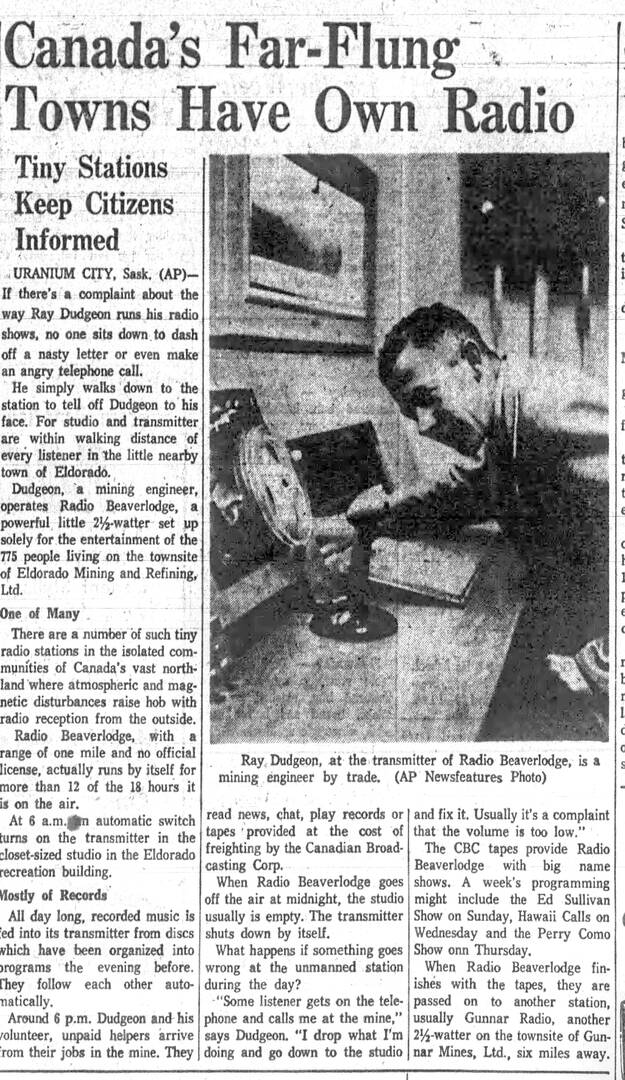
Well, I had compress it online 44% because the first time tried to upload it it gave me a no go sign, but it looks like it got compressed further to the point its unreadable.. So, here's a direct link https://drive.google.com/file/d/13OP7v0fiDzCLjr-uk4yIkTTDvEpriAkU/view?usp=drivesdk
Did I just derail the thread?
I just realized the first upload was fine. It just took a minute to load fully
In reference, I had first post about it: https://www.hfunderground.com/board/index.php/topic
And then you can resume here
I don't know if Canada had an official unlicensed rule on the books back then. Interesting you dug up that article. I looked but can't find out when the first RSS-210 issue was written but in the early 60s I remember Heathkit did have a couple of transmitter kits for AM to play radio station around your house.
I'm not sure - dont know at all actually when Canada's unlicensed rule began but would not be surprised if it had been created around the same time (I actually suspect it).
I missed part of the link in paste earlier, it should have been https://www.hfunderground.com/board/index.php/topic,131162.msg403719.html#msg403719
There you'll find the US following Canada's lead in mandating kind of radio silence, this was only months prior to part 15 being created. On a related note, theres an FCC press release not long after, addressing this issue saying all armature radio had to cease and so forth, but what was most interesting was the final sentence concluding that all forms of transmission traveled any father than "line of sight" was prohibited. I found that so striking!
What I'm getting to is that it seems the US and Canada were moving pretty much hand in hand concerning radio regulations, and I would just about bet the CRTC created RSS21s predecessor in 1938 or 1939. It just seems so likely.
Speaking speculatively.
Back on topic.. Artisian stated:
It appears that the rules allow 50 milliwatts eirp here, but the kicker is that these microphones are not intended for broadcasting use. Any transmitter would also have to be RSS210 certified as well.
Sorry sorry for not starting a new thread, you brought up microphones and all I heard was Canada.
Well a wireless microphone broadcast, that's what they do. So presumably the terminology "not intended fo broadcast use" is emphasizeing the difference between a wireless microphone and one like you use in a ham shack or a radio station.
I'm a little befuddled by the two rules, but what we have here befuddling too, we have two options too, one has a range of aprox 200ft with 15.209 (its actually 300 to 500ft by the way), or we can choose a mile or more with 15.219. Who's is the most befuddlest rules?
Interesting you dug up that article. .
I got at least 15 clippings on Radio Beverlodge stories, but several are AP or UPI stories and so duplicates from different papers and places, but there important to compare because the thing as bout the newswire stories is that the get edited for space, so say a newspaper in Ohio prints the i identical as one in say Nebraska, except that the ohio paper might omit one or two entire paragraphs to make it fit the edition, this was common practice, still is.
You know it would probably be appropriate, and considerate, or rather best, to spit these two threads if that can be accomplished with to much difficulty.
I still got Canada on the brain. Here's an interesting advertisement I came across in Calgary_Herald_Sat__Apr_19__1975

We're going all over the place with this thread. I have one more thing to add.
It's the confusion in the rules, particularly in Canada, that is the topic of the first new page of the website - A Simple Guide to Part 15 Broadcasting in Canada. The U.S. would be next, but I don't know if I'm the right person to author it, not living there and being subject to its rules.
Been poking around.. Keep coming across these "Canadian Wireless Standard RSS-210" updates, Issue 9, issue 10, it updates frequently, below is an excerpt from the beginning of Issue 11: --
https://www.linkedin.com/pulse/canadian-wireless-standard-rss-210-update-mars-wang-ma3pc
On June 25, 2024, the Canadian government released the latest radio standard specification RSS-210, Issue 11, which replaced the previous version RSS-210, Issue 10
Effective Date and Transition Period for RSS-210, Issue 11
The document will take effect upon publication on the ISED website. However, a transition period of six months will be provided from the publication date. During this period, applications for certification issued under RSS-210, Issue No. 10 or Issue No. 11 will be accepted....
These frequently updated issues seems to indicate RSS210 rules in a current state of flux.. I haven't delved into them, but that's the impression I get. What's going on here - or rather there?
For what its worth, I asked Spock about RSS-210 history, and he gave an interesting answer. It may even be accurate, but keep in mind that accuracy is not the primary objective of ChatGPT, but does at least provide a starting point to work with. If its correct then my hunch about it beginning around 1940 looks to be wrong..
What is the history of RSS-210?
RSS-210, Canada's standard for license-exempt radio devices, originated as Canada began adapting its own regulations for low-power, unlicensed devices. While the U.S. introduced FCC Part 15 in 1938, Canada’s first similar rules developed more gradually over the following decades.
The ISED (formerly known as the Department of Communications, or DOC) formally published RSS-210 in the 1980s, aiming to standardize unlicensed devices like remote controls, cordless phones, and early Wi-Fi equipment. It was designed to harmonize Canadian standards with FCC Part 15 to ease cross-border trade, given the close relationship between U.S. and Canadian electronics markets.
Since its inception, RSS-210 has been updated frequently to reflect technological advances. Updates introduced new frequency bands, refined power limits, and ensured compatibility with new devices, like Bluetooth and Wi-Fi. Today, RSS-210 remains a critical part of Canada's regulatory landscape for license-exempt devices and is periodically revised to support new innovations and harmonize with global standards.
Tell me more about its gradual development during the 1940s
During the 1940s, Canada, like many other countries, began seeing an increase in radio technology use for both military and civilian purposes, especially with the demand for wireless communication devices during World War II. However, there wasn't yet a formal regulatory framework in Canada dedicated to unlicensed, low-power devices. Instead, the Canadian government primarily focused on managing licensed radio services for critical infrastructure, military, and commercial broadcasting.
Canada’s Department of Transport, which handled communications at the time, issued limited permits for low-power, experimental radio devices, though this was often on a case-by-case basis. Because there was no overarching rule like Part 15, most unlicensed devices, such as early remote controls or basic cordless devices, weren't commonly regulated or commercially available. Regulations during this era were focused on preventing interference with essential services.
The 1940s were more about laying the groundwork for structured radio regulation, as the government saw how unlicensed device use in the U.S. was evolving under Part 15. Canada observed these changes and began considering similar measures to address the growing interest in non-broadcast radio applications, though concrete steps wouldn't happen until much later.
It wasn’t until the post-war years and into the 1950s, as consumer electronics became more widely available, that Canada began to consider regulations for low-power devices. This gradual development ultimately laid the foundation for the RSS standards that would formally emerge decades later.
Which document in 1983 officially published the initial official version of RSS-210 ?
The initial version of RSS-210 was published in 1983 in the form of a Radio Standards Specification document issued by Canada’s Department of Communications (DOC), now known as Innovation, Science and Economic Development Canada (ISED). This release represented Canada’s first formal regulatory framework for unlicensed, low-power radio devices, comparable to the FCC’s Part 15 rules in the United States.
Unfortunately, while I can confirm the year and the type of document, the specific title or document code used in this 1983 release isn’t widely detailed in public records. I can look further for you if you'd like, in case there are archival records that specify the document's formal title or any available updates from that time.
The thing is, RSS-210 doesn't cover broadcasting, only non-broadcasting use.
That's because Canada has another regulatory body, the CRTC, which handles the content of broadcasters. Unlicensed low power broadcasters have to follow the BETS rules. Interestingly, they're more liberal than the FCC for FM, more restrictive for AM (and there are no BETS-certified AM transmitters).
All broadcasters in Canada have to have a CRTC license, but there are exemptions for BETS devices (which restrict content).
So technically, anyone using a ProCaster (RSS-210 certified) to broadcast is non compliant.
As for the definition of broadcasting, good luck. It appears to be anything that is transmitted to a member of the general public.
What's nice about researching FCC documents is that they generally all provide a brief history of te developments within each update, so that gives you a reference to step back father in time and pull out the details of what prompted the chsges, the issues that were raised and so forth.
I haven't been looking long, but this is not the Case with the Canadian rules.