

I've never really researched into Part 15 FM much, but years ago I had picked up the impression from somewhere that it used to be strictly prohibited to broadcast under any power at all in FM without a licence -- in other words, once upon a time, there was no such thing as part 15 FM..
Later, I figured that I must have simply misinterpreted something along the way because other sources contradicted this notion, and it appears that it's always been legal ever since 1938 when part 15 had been created..
Though I felt certain I had read it in a FCC document somewhere, I brushed it off and concluded I had been mistaken. After all, I had misinterpreted documents before and only caught it later.
But evidently, I had not been mistaken at all, as it clearly says so in the rather well-known OCE 12 document..
Bulletin OCE 12 (March 1973)
https://docs.fcc.gov/public/attachments/DOC-335623A1.pdf
13.0
OPERATION PROHIBITED IN FM BAND.
Due to the physical laws of radio propagation on frequencies in the AM band, operation with low power and a small antenna is inherently short range. Thus, it is possible to set up operating conditions in the AM band that will protect the broadcast service and still provide a reasonable operating range for the owner of a low power communication device.
This cannot be done in the FM band (88-108 MHz). Conditions in this band are completely different and long range transmission is possible even with extremely low power, a fact that is well known and well documented. In the face of this physical phenomenon, the Commission has not found it possible to set up operating conditions on the FM band that would provide a reasonable operating range. Accordingly, operation without an individual license for low power broadcasting in the FM band is strictly prohibited...."

That's interesting. In a way, I suppose they had a point. Wavelengths are so much longer on the AM BC band, that a few meters of antenna (plus the ubiquitous ground lead) is, by it's very nature, a very inefficient radiator. By contrast, a full quarter wave on 88.1MHz is a mere 0.8 meters - far less than is allowed under 15.219 and RSS-210 B.2 for the AM band!
@rugster I find it interesting in a few ways. To begin with, the primary focus of the docket actually revolved around the issue of Part 15 AM. So bear with me a moment and I'll get back to this subject of part 15 FM..
There was a big controversy in the early 1970s over the new premium Part 15 AM transmitters being manufactured at the time, and they were what prompted this OCE to begin with. They were high dollar units ($1200 each), never before had anything like these been manufactured.
The problem was that although they were 100% compliant with the alternate rule their capabilities were defeating the primary purpose of Part 15 which was to limit its reach to no more than about 300ft... it was a predicament. So the FCC tried to correct it by emphasizing in this document the "ground lead" also was considered as part of the 10ft antenna limit, (and a couple years later actually wrote that clarification into the 15.219 rule itself)..
But that clarification didn't solve the issue because they found that regardless if these high-end transmitters were ground mounted or elevated without any lead used at all they still were achieving extended range without breaking any rule.
So the FCC had no choice but to ban manufactures from utilizing the alternate rule at all (which they did in 1974), but they had problems actually enacting that rule because by that time new manufacturers had sprung up and there were too many out there already in use..
Essentially what happened next is the FCC threw their hands in the air and said so be it!
So with all this in mind.. What ever prompted the FCC to follow that whole no-win fiasco by then creating Part 15 FM?
Doesn't it seem odd?
I haven't yet dug in to see exactly when Part 15 FM had been created, it shouldn't be hard to find it, it likely happened sometime in the 1980s.. probably connected with the use of wireless microphones or something.

OPERATION PROHIBITED IN FM BAND.
Due to the physical laws of radio propagation on frequencies in the AM band, operation with low power and a small antenna is inherently short range. Thus, it is possible to set up operating conditions in the AM band that will protect the broadcast service and still provide a reasonable operating range for the owner of a low power communication device.
And then came the invention Mr. Microphone, circa 1975 ...
@centinel And if you want to go into business with them today, you can buy the Trademark of the Mr Microphone for three years for $25,000.00 https://www.ebay.com/itm/355155213061
Which curiously states the "Mr Microphone" brand came out in 1970 marketed by Ronco (three years before the FCC said FM was strictly prohibited in the above document). And evidently it's true however, those original releases worked only on AM, according to https://mrpopculture.com/the-interesting-history-of-mr-microphone/ (There had been many through the years, the first wireless microphones were the "Mystic Mike" that came out in 1939).
Best I can tell the FM models Mr. Microphones didn't come out untill 1978, Although I havent looked, 1978 is probably when Part 15 FM was created.
@centinel And if you want to go into business with them today, you can buy the Trademark of the Mr Microphone for three years for $25,000.00 https://www.ebay.com/itm/355155213061
Look, don't give me any hair brained ideas. I found a winery that could go up for sale, has real production and not just a name. My wife begged me NOT to jump into another business after we just closed two. We're too close to official retirement! Heh, when I first heard the guy from SSTRAN would stop production I fired off a letter to him about negotiating its sale. But he, providently, didn't reply.
Hmmm.. Again I'm confused. This is from the JULY 1966 Popular Mechanics that details the plans to build this part 15 Wireless Mike - Yet the above 1972 OCE clearly states "...operation without an individual license for low power broadcasting in the FM band is strictly prohibited...."
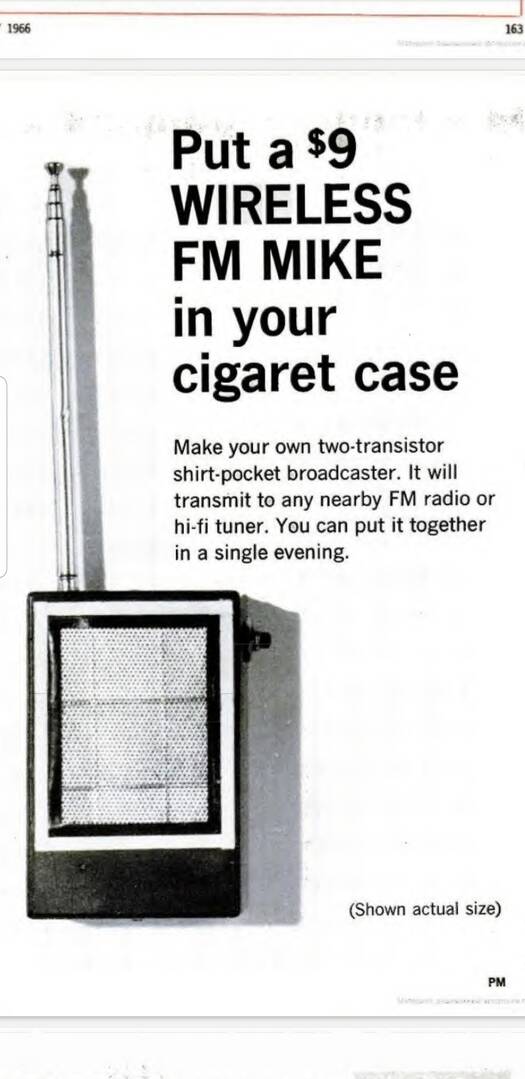
So what gives? This isn't the only example of OCE 12 being contradictory to concerning FM part 15 with other sources... in fact, OCE 12 is the only FCC document I know of which says FM use is prohibitted under part 15.. though my searches have been rather superficial on this matter.
Speculatively, it's of note that the 1973 OCE Bulletin in question also is the first to specify the "ground lead" as with AM three years before it was actually incorporated into the rule. At the time it was written there was great concerns with the NAB over the new part 15 AM transmitters which is what had prompted this document.
So my point it that perhaps this OCE was to suggest that FM be banned from part 15, same as it suggest the ground lead as part of the ten feet length, because at the time neither of the stipulated matters were in the rule books.
But the banning of part 15 FM never actually happened, it was apparently just a proposal, just as the banning of 15.219 never happened -- but both had definitely made it to the chopping block at about the same time.
That's the best I can make sense of it anyway. I'll leave it at this:...
Despite the wording of OCE 12 (1973), I'm reasonably sure Part 15 FM has always been legal (1938 to present), yet it seems quite odd how the document blantly said it was "strictly prohibitted".
@centinel And if you want to go into business with them today, you can buy the Trademark of the Mr Microphone for three years for $25,000.00 https://www.ebay.com/itm/355155213061
Look, don't give me any hair brained ideas..
I didn't have it in my watch list so dont know why I got an ebat email alert about it, but they just dropped the price from $25,000 to "Buy It Now" for $1.00 with free shipping for the trademark to "Mr. Microphone.
Here's your chance, all you have to lose is one dollar!
(I wonder whst the story is here, its so strange)