

That explains the 73 magazine title (from the 1970s)

The use of "73" in that context is a carryover from the days of using Morse code for radio communication, and was/is a shorthand way of saying "Regards."
Dammit.. it deleted my post upon edit for spelling (changed usual to useful)..
Repost:
Yeah, someone at the formerly ALPB forum mention that it was a Grundig receiver same as one he bought on eBay for $35.. He did not however have the conversion chart.
Addum: From a quick look about on the matter, apparently the precision and accuracy of AM radio S meters vary drastically and have different methods of utilizing one.. for example with some it's just an extension modification of the AGC circuitry, others use other methods.. It's all over my head but there's some talk about this at http://www.seed-solutions.com/gregordy/Amateur%20Radio/Experimentation/SMeterBlues.htm along with some external links of actual comparisons of certain receiver S meters.
I don't know one way or the other, but ISS seems to emphasize that particular model "is the first of it's kind" which enables the capability of a useful and accurate reading. Maybe he knows what he's talking about.. maybe it's just hype, but as far as quality multiband radio receivers go; $140 is really not an out of line price, so if it also has an exceptionally accurate SMeter (the common consensus seems to be most do not), then that's an added bonus.
Hell.. I paid $150 for a Panasonic RF-2200 in beautiful cosmetic condition on eBay a few month ago.. unfortunately I get better reception on AM with my pocket radio than I do with this $150 let down which has some problems.
Still kicking myself in the ass for that one.
Tim, this thread has given me an idea. Since you have a FIM meter you could take one of these Tecson/Grundig radios with the signal strength meter and on AM and FM do the conversion charts comparing the reading on the radio and the meter at various frequencies the same distance from the antenna converting the dbu to mV/M and that can be converted to uV/M and it would do us a great service and then sell us the conversion charts. I'm sure all of us would like this and would buy it from you, myself included in addition to getting the Tecson radio.
This could be done with a transmitter going through the frequencies.
Just a thought for a project?

Best Idea of the Week!
From Mark: "Could take one of these Tecson/Grundig radios with the signal strength meter and on AM and FM do the conversion charts."
Wow, that is a super idea!
Super idea if you disregard the consensus that a select few radios which employ S-meter are actually stable.
Nah
The radios we are talking about don't have S-meters, they have LCD screens with numeric readouts and seem to be very stable.
Mine is a TECSUN PL-310.
Unfortunately, the inexpensive receivers that show a signal strength value in "dBu" on their display screens are reporting only the conducted voltage that exists between the r-f input terminals of the receiver, not the field intensity value of the arriving radio wave --- which is measured in units or sub-units of volts/meter.
The field intensity of a radio wave normally is defined as the r-f voltage of its electric field vectors existing between two points in physical space separated by a linear distance of one meter. No receiver or receive antenna needs to exist for that field intensity to exist.
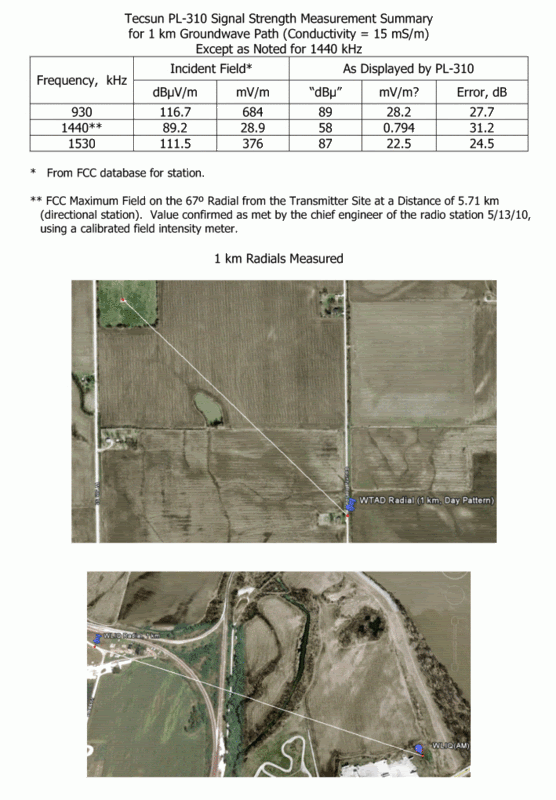
The dBu values shown on those receiver signal displays are highly dependent on the construction of their internal loopstick antennas on each frequency the receiver is tuned to, which varies according to the physical construction (mostly the length) of the loopstick, and other factors. So the calibration of any particular one of those receivers against the field intensity measured by a calibrated field meter most likely will not apply accurately to any other of those receivers, perhaps even another one of the same design and manufacture.
Below is a link to an example of the difference that a Tecsun PL-310 showed to the known fields it was "measuring." The errors shown in the far right-hand column are substantial, and non-consistent.
FCC Failing
The FCC did nothing for FM hobbyists with 15.239. It is written only to the benefit of certifying labs.
And Tim in Bovey has proven that certified FM transmitters are not reliable, some of them are well above legal power, others below.
The only useful yardstick is that FCC Document estimating that 200-feet would be the typical range of a compliant FM transmitter.
KDX-FM exists according to the 200-foot "rule".
In fact, we have found that when the TECSUN dBu reading shows 07 dBu the FM signal drops into the noise, which we established at only 100-feet, which means we do not use our full legal reach, most of which is out in a street intersection.

Why would the FCC care about FM hobbyists?
Apparently I had missed when this all already had been discussed when it first came out in 2013: https://www.part15.org/forums/topic/big-big-news/
Upon finishing reading the entire thread, still came away with no conclusion on if the Grundig SMR radio they sell fared any better with accuracy than a Tescun or any other radio featuring an S meter.
Just of note.. Radio Jay Allen compared the Grundig G8/Traveler II (the one ISS sells) against a Tecsun PL-310 (yours) he makes no mention of the S-meter but says the two perform about equal in AM, however he also compares those to the Eton Traveler III which says noticeably outperforms both of them.. maybe ISS should consider upgrading!
https://radiojayallen.com/eton-traveler-iii-compared-with-grundig-g8traveler-ii-tecsun-pl-310/

The suggestion posted earlier in this thread that Tim could produce and publish/sell a calibration chart for a particular brand of radio with a built in signal strength meter correlating the reading with field strength sounds good at first read but it is not workable.
The reason is that unless a chart is made for a specific radio (not brand or model) there is no guarantee that the chart is accurate. I studied measurements formally and worked in a metrology lab and the underlying principle was to calibrate each individual instrument against a standard of known accuracy. You cannot test one typical instrument and conclude all others of the same type are going to present the same accuracy.
One reason the field strength meters are so expensive is that each unit manufactured has to be individually calibrated against a NIST (in the U. S.) traceable standard if it is to be used in commerce or regulatory applications, and in addition, are required to maintain their stated accuracy for a specified period of time which adds complexity to the design. Typically, in industry, instruments require calibration each one or two years while in service.

The key words in the description for the ISS radio are: "estimate", "relative" and "rough". And lets not forget "not a calibrated device".
Now, this is not to say it wouldn't have value. You can indeed use it to determine relative noise levels on various frequencies when determining which frequency to use for your station. The meter will handily show noise floor levels.
And it would indeed give you a relative field strength indication of your station at a particular location, which could signal trouble with your system. For this to work you'd have to choose a place for the receiver to sit, and then every so often flip it on and note the signal strength. If you were to notice a substantial drop this might indicate that your transmitter or antenna has gone awry and needs attention. However, even the slightest movement of the radio, as well as your position standing near it, will also affect this reading. So you can't move it, or stand in a different spot while noting the readings.
I can promise you the tolerance in constructing these radios is not that good. Readings will vary from set to set under otherwise identical conditions.
You get a rough estimate of field strength with the chart. And you get relative information, that you can compare to it's own readings over time as to how they relate to each other.
I don't know of too many AM Part 15 folks who use the maximum field strength rule for their stations as this greatly limits range and is hard to measure without the right equipment. Most use the antenna/ground length rule coupled with 100 mW to the final input stage, things that are relatively easy to measure without buying expensive equipment. A radio like this only shows relative information, and nay radio with a FSM on it would do the same for relative readings. Communications receivers with sensitive meters have been available for decades and for these purposes would be just as accurate if not more so.
Note that this radio only references AM field strength accuracy and use, not FM, which is where it actually matters. Part 15 legality is determined ONLY by field intensity and these are not going to be accurate enough to determine if you're legal on FM.
I just realized that I HAVE one of these little Grundig radios. It wouldn't be to hard to determine my own field strength chart.
TIB
Dull Tools
As I view it the TECSUN PL-310 (the radio we use at KDX) is TWO (2) test instruments in one:
The AM & FM receivers being very sensitive and stable, the radio can be used in ordinary listening tests to walk the neighborhood and make estimates about the performance of part 15 signals.
We have taken the technique of using radios to judge compliance as common place even though it is an imprecise means of measurement.
KDX is fortunate to have a spectrum analyzer and here again we have a "dull" tool for making relative measurements of our signals compared to other signals at our reception location.
Therefore, as yet another "ballpark" measuring device, the strength readings on the display screens of the radios we are talking about serve as a 3rd way of grabbing a generalized idea of what our signals are doing.
Part 15 operators get closer to accuracy with these dull tools.