

There were no government agencies with an online presence until after 1994 (the White House was the first). it was around 1995 when I had began building vacation rental websites (it was good money back then, most people didn't even have computers, much less internet, but everyone felt their businesses just had to be online anyway!
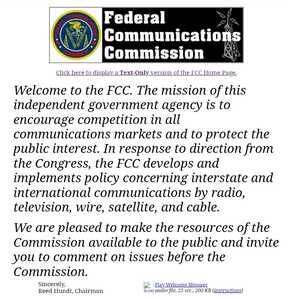
Anyway, I was just browsing around the Archive of the FCC which appears to have gone online in 1996 or 1997 and I found it kind of interesting.. https://web.archive.org/web/19970609215206/https://www.fcc.gov/
I was curious when the FCC first put up the notorious "200ft page" that gives us so much grief specified as "(still in effect)", which is blatantly wrong and quite misleading as it implies it's some kind of official rule:
https://www.fcc.gov/media/radio/low-power-radio-general-information
".. these devices are limited to an effective service range of approximately 200 feet (61 meters). See 47 CFR (Code of Federal Regulations) Section 15.239, and the July 24, 1991 Public Notice (still in effect). On the AM broadcast band, these devices are limited to an effective service range of approximately 200 feet (61 meters)... "
That meaningless "still in effect" phrase didnt appear until 2016 after a FCC website redesign, prior to that (since 1996) the low power page was found here:
http://www.fcc.gov/mmb/asd/lowpwr.htm l"> https://web.archive.org/web/19970724231642/http://www.fcc.gov/mmb/asd/lowpwr.html
It's the same stuff but it never refers to it as "still in effect".
So what?
Well nothing really, it just makes me wonder if all the controversy going on ten years ago with the what's constitutes a ground lead, and the KENC ordeal and RFry rants etc had inspired the FCC to emphasize on their website this invalid 200ft range stipulation.
What I do know is what had inspired the 1991 Public notice to begin with, it becomes very evident simply by exploring the newspaper and magazine articles of the era.
The mid thru late 1980s was the major heyday of the "talking house concept", but not just homes, also really big with banks, car lots, billboards - I'm talking the free-radiate method here (15.219), there was no less than 4 or 5 different manufactures of certified AM transmitters on the market at the time, but as the 1980s came to a close the taking house craze began to drastically falter as the internet began to become more accessible and a more effective means of communication for the realty industry.
But in 1990 we begin seeing many repurposing of those transmitters by a change of programming to now "serve the community" of the now sold subdivisions of homes. The nationwide publicity of such stations in resulted in a "massive influx" of inquires to the FCC from private individuals wishing to do something similar in their own areas - and that's what directly had prompted that hastily prepared published 1991 public notice to come into existence. Unlike all other fcc public notices this one put together by someone in the Media Department was a mess because nobody bothered to consult any FCC technicians before publishing it.
And that's how that document containing invalid information came into existence, and it's still clung to today as a means of discouraging such community stations from cropping up.