

I've mentioned before how the prices of the prices of lifepo power stations seems to have been going down, speculatively perhaps due to the companies wanting to unload them to make use of the newer technology sodium batteries, which have the notable ability of recharging in cold temperatures, incidentally Bluetti being the first has already released a model, it a 1,500W 900Wh US$799.00 https://www.bluettipower.com/products/sodium-ion-battery-pioneer-na

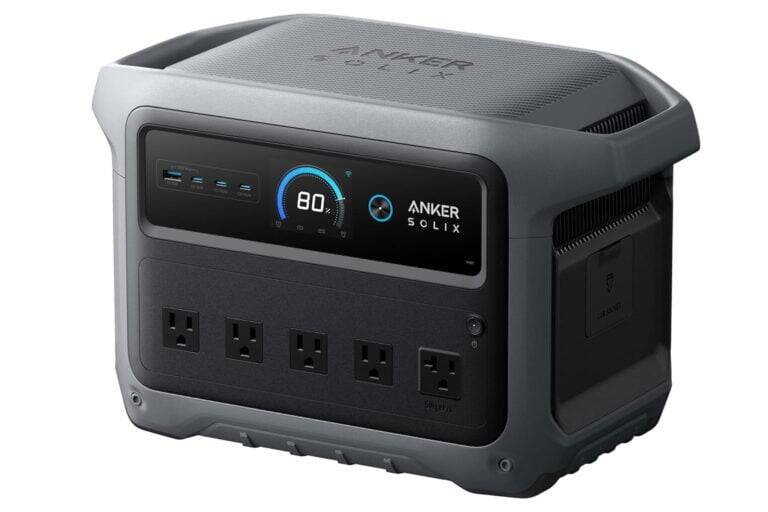
No, $800 ain't cheap, but that's the new tech ones. Anker is now selling their 2,000W, 1,024Wh LiFePO4 power station for only $349! That's less than I paid for my refurbished Ecoflow with similar specs earlier this year. I hope that price holds in December, I'd like to grab one.
On second thought I probably won't buy one, really have no need for another power station, I already have 2 Ecoflow units. My tv, computer, radio, lights, etc run direct 12v and a 1000wh lifepo battery only cost about $100. The only thing I really use my power stations for is my microwave and a few other occasional things requiring a 120v AC input.
But still, that $350 price tag makes it tempting.
Also the Anker has its AC outlets on the front, whereas my Ecoflow has 6 AC outlets on the back, making it kind of inconvenient.. maybe I will get the Anker . I donno

@richpowers That Anker with 2000W capability new is a fantastic price for that!
Usually that capacity is around $1000+. Most likely black Friday sales.
You also see how much we are ripped off by how retail pricing works. They can sell that power station at 1/4 the "regular price" and they are still making plenty of money on the item. They mark up prices 100s to 1000s of % over what it costs them so they can have sales and make you think you are getting such a bargain. All retail works like that. But yeah at that price for that power station with that capacity brand new is a good deal.
@mark Yeah, a power station is really nothing more than a solar controller, an inverter, and a battery. Albeit they generally do employ quality sine wave inverters and quality solar chargers in them, which is what your really paying for, along with the convience of a all-in-one package. I'm not sure how much cheaper it is to just buy the separate components and put it together yourself (many do), but I suspect you could save $hundreds.
@richpowers That Anker with 2000W capability new is a fantastic price for that!
Usually that capacity is around $1000+. Most likely black Friday sales.
The 1,024 watt hours is just as, if not more important that the 2,000w capability. My Ecoflows have a tad more with 1200 watt hour capacity, but they originally were around $800, I bought refurbished for about half that. Ankers 1,024 watt hours for that price is impressive I think.
Want to know how long it could keep a part 15 station without a recharge?
_________________________________
How long can a Part 15 AM station run on The 1,024wh/ 2,000w power station?
_________________________________
15 sites
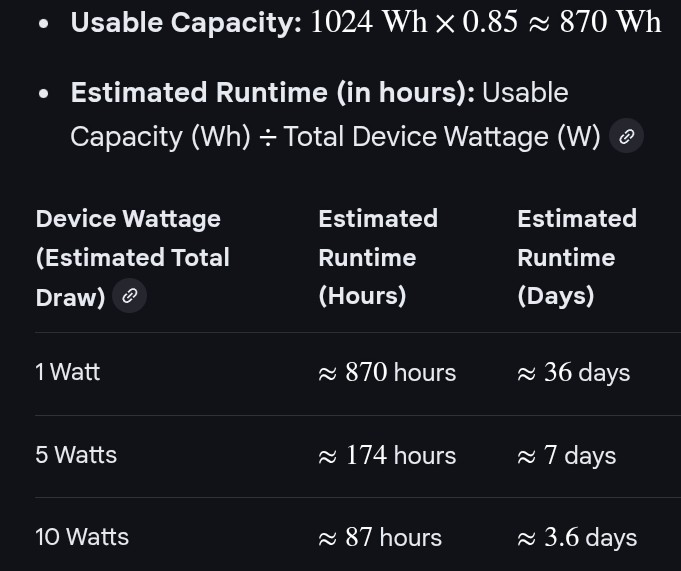
A Part 15 AM station transmitter would run for a very long time, potentially weeks or even months, on a 1,024 Wh portable power station.
Estimated Runtime
The entire setup (including the power supply for the transmitter's internal electronics and audio input) might draw a total of only a few watts of power, perhaps in the range of 1 to 10 watts total from the AC outlet of the power station. Using a real-world efficiency factor of about 85% for the power station's AC inverter, the calculation is as follows:
Usable Capacity:
_________________________________
Need to factor in a laptop and perhaps a processor
_________________________________
5 sites
When factoring in a laptop and an audio processor, the total power draw increases, but the 1,024 Wh power station will still provide a significant runtime. The main power consumer in this scenario will be the laptop.
Estimated Runtimes with Added Equipment
We can estimate the total power draw and then calculate the runtime on the portable power station.
Part 15 AM Transmitter: ~1–10 Watts
Laptop (light use/audio playback): ~10–20 Watts (can be higher if charging or under heavy load)
Audio Processor (small, typical rack gear): ~5–25 Watts
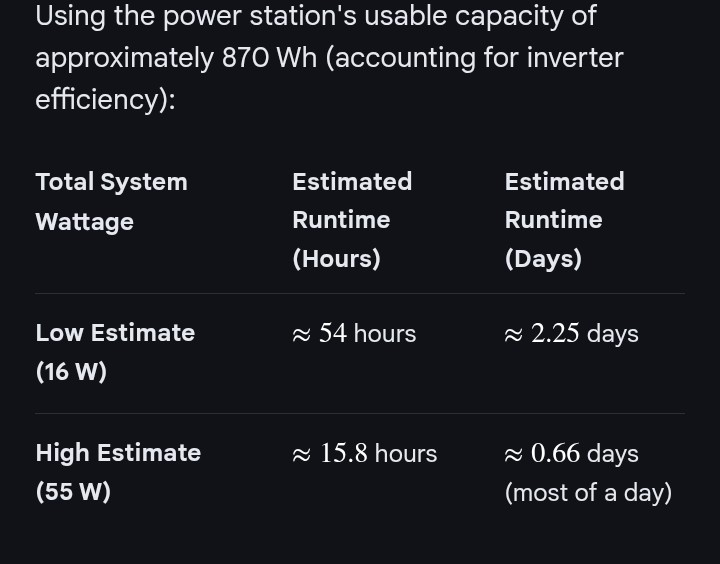
Total Estimated System Power Draw: ~16 Watts (low end) to ~55 Watts (high end).
Using the power station's usable capacity of approximately 870 Wh (accounting for inverter efficiency):
_________________________________
How did you figure the transmitter at 1 - 10 watts?
_________________________________
Total System Consumption
Circuit Efficiency: The 0.1 W limit is for the output stage. The total power drawn from the wall (or in this case, the power station's AC inverter) must also power the internal components like audio amplifiers, oscillators, microcontrollers, and status LEDs.
Reasonable Range: While the radio frequency output is tiny, the supporting circuitry might draw a few additional watts. Therefore, a complete, assembled commercial or hobbyist Part 15 AM transmitter typically draws a total of anywhere from 1 to 10 watts from its power supply. This is a very efficient total power draw, reflecting a total system efficiency that is appropriate for low-power operation.
_________________________________
Understood. Ok now let's presume the laptop, processor, and transmitter can all run on 12v?
_________________________________
4 sites
Running all equipment directly from the power station's 12V DC output is the most efficient method, significantly extending your operating time compared to using the AC inverter.
Efficiency Gains with 12V DC When you use the AC outlets, the power station must convert its internal 12V DC battery power to 120V AC power, which typically involves an efficiency loss of 10% to 15% (sometimes more). By using a 12V DC connection (often a car port or a specific DC output plug), you bypass this loss entirely.
Usable Capacity (DC): 1024 Wh (closer to full capacity, perhaps 90-95% efficiency within the station's DC-DC circuitry).
We will use the full 1024 Wh for a best-case estimate, as the conversion losses are minimal compared to the AC inverter.
Estimated Runtimes (All 12V DC)
Assuming you have 12V adapters for all devices (laptop, processor, and transmitter), the power draw remains the same, but the overall efficiency of drawing power from the station improves.
Part 15 AM Transmitter~1–10 Watts
Laptop (via 12V adapter)~10–20 Watts
Audio Processor (via 12V adapter)~5–25 Watts
Total System Draw~16 W to ~55 W
Calculation (using full 1024 Wh capacity):
Low Estimate (16 W): 1024 Wh 16 W≈64 hours (2.67 days)
High Estimate (55 W): 1024 Wh+55 W≈ 18.6 hours (≈ 0.77 days)
Summary Comparison:
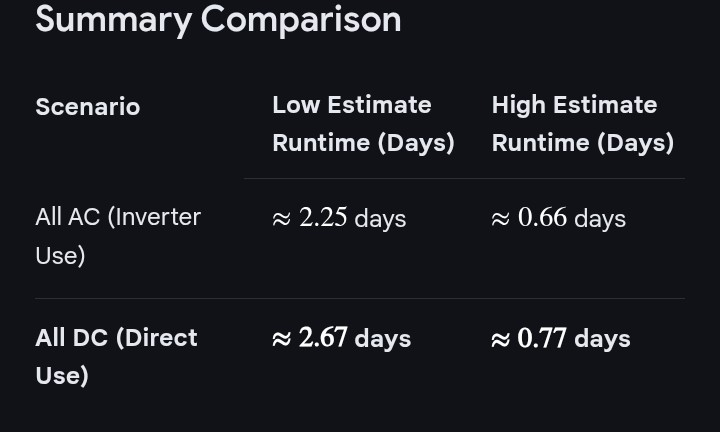
You gain roughly 4-9 hours of extra runtime by optimizing for direct 12V DC power over using the built-in AC inverter. Using DC power is highly recommended for off-grid operations to extend battery life.
_______________
Those estimates are based on not recharging the battery, correct?
------
- Solar panels (if outdoors during the day)
- A gas generator
- Grid power (AC wall outlet) (if you regain access to a power source)
My whole station currently as set up....small 10" Hebstore laptop with celeron 4025 processor, 8 GB RAM, with screen off (set to turn off after 5 minutes), Cuthbert processor, Procaster transmitter, all items running on 12 volts including the small computer(unlike the 19 or 20V of most laptops) uses less than 10 watts of AC power. If the computer screen light is on or the computer is charging that consumption goes up to 10-12 watts. But most of the time under 10 watts. The Bluetti display only shows the wattage out at 10 watts and up.
My small Bluetti which doubles as a UPS and everything is operating from it with direct pass through to the AC outlets on the power station and 10 milliseconds switch over time if power outage, at 230.4 Wh will power it for the better part of a day. Every couple of months I discharge and charge again as instructed for calibration of display of percentage left and battery longevity and what I did was just unplug it and let it run till it shuts off. So when at 12 noon I unplug it and it finally early the next morning maybe after 16+ hours it shuts off at 0%. If I had it all on the 12 volts DC outlet it would be longer, maybe a full 24 hours who knows. But I wanted to use it on the UPS function, so I use the AC. Then I plug it in again and it charges back while the station operates.
The watt hours is more important then the max watts it can power. The max watts is just the inverter capability.
@mark If it's feasible, inputting a solar panel and it might could run indefinitely, providing you have good days of sun. But it takes a lot longer to charge solar then it does to charge from a wall outlet.
A little off topic but you what other DC based things that have gone down in price are the 12v refrigerators. I bought one about 4 years ago, the cheapest I could find with usable interior space, it was about $430, now I see the same size going for less than jan half that price. Solar panels too, not only cost less than they did, but more efficient too. They even have 12v portable air conditioners now. Food has shot up in price but electronics seems to have gone down.