
@richpowers There's a lot there to comment on!
I don't quite know what you mean by transmitters use one channel. They transmit on the same bandwidth as a commercial station transmitter. You can't use the same processor for two different transmitters e.g. Cuthbert, Scklockwood, and the output from the computer would need an additional headphone amp and two outputs to drive the two processors.
As for paying royalties there has to be a licensing organization like Socan, Resound, BMI, whatever to manage collecting fees and licensing and doing what is supposed to be done with the money. They are responsible for enforcing the "law" of having to be licensed and pay royalties. If they have no provision for a "part 15 or BETS-1 in their sites and therefore don't require any licensing or payments for such an operation and don't even know what it is then in Canada such operations can be considered as not needed and I was verbally told that years ago when I did get replies and could talk to someone and therefore not illegal to operate with no license to play music, unlike the USA which has BMI which does have part 15 in their requirements and DO know what part 15 is. If I was in the USA I would be paying with BMI.
You mentioned I should stay on AM because some die hards will be listening on an old radio?
But you are missing that I can't broadcast on AM, and I do know that this isn't understood in the USA and it's crazy I know, but if I am having listeners on an antique radio I am broadcasting. And we have had discussions on this with me, you, and artisan here in the past. Putting that aside, very few, I mean very few if any, is even listening to a radio in their houses let alone even have a radio in their homes in 2026 so that being a reason to do both simultaneously is pointless. At least I know that here where I am no one is, and my listeners I had to give them radios. What I did years ago was put a little flyer in the mail to around 60 or 70 homes is this area addressed to Dear Homeowner and spent a lot on stamps and that's how I got the 2 listeners I did. Now I can just put a flyer on the community mailbox. They found out it was me and I gave them better radios to listen on. Those with vintage cars with only the original AM radio to keep it authentic are very few, how many do you see on the road? They don't drive these around. Also part 15 is such that you drive in and out of the signal in a minute or two, less, and to be listening to a part 15 station you are best to be stationary in range and they'd have to know you are there in a very limited area. Again, no real purpose to be on both. But it would sure be nice to see someone with a "57 Cheverolet Bel-air with my station on!
With part 15, the only reason that AM is what most do is not because it's preferred, it's because it's safer, but the main thing is FM is not useful in the range you are allowed and AM is better for that reason. It's the pirates that use FM most of the time as they don't care about following the rules. If the FCC allowed more power on FM that would be the choice of the majority all things being equal, especially if you want listeners other than yourself.
You said....."Anyway, my point being you could use a single processor one channel set for the FM Procaster and the other channel set for your AM Procaster... Isn't this correct?"
No not correct. It wouldn't work as the inputs to the transmitters mate 2 channels and the processors output 2 channels and the computer out from the headphone jack is two channels. Even if I switch the computer out to mono and the FM to mono mode you still can't do what you are suggesting. I can't explain it and an engineer like Jim Wood at Schlockwood would be needed to explain it. I had to make a couple of mods to the Schlockwood to work with the unbalanced input that the transmitters have via Jim Wood's instructions. The Cuthbert has unbalanced in and out so with that this is not an issue.
Nothing in the CRTC exemption says that you have to be limited to announcements and nothing else and just says in writing nothing political, religious, or rebroadcasted from another source. That is if your broadcast includes announcements of a commercial nature.
Decade told me, and he has dealt with ISED and the CRTC that you can play anything as long as the exceptions mentioned are met. Artisan does now and has in the past with his station on BETS-1 FM, has music and regular programming as we know and both of us want to be legal. So I mention "community news" on my flyer but most of the time there is no announcements to make! I will tell my listeners if they have anything that could be announced on the radio to let me know. What happens in my little coverage area? But I have the inclusion of announcements in my description for anyone that it may concern. Even if there are no announcements.

Maybe I'm totally confused, but, for example, the Rangemaster does not accept a stereo input directly, you have to sum the two channels (with the adapter) into a single channel before feeding the transmitter.
Likewise, if I'm correct, most part 15 FM transmitters don't actually broadcast stereo either, they too output a mono signal.
So, if you sum the left and right stereo to mono Before entering the processor, then the processors left and right.channels will both be outputting the same mono signal. Then simply send the right channel to one transmitter and the left channel to the other transmitter, then individually adjust the processor left and right channels respectably for AM and FM setting.
Isn't this correct?
I wasn't saying to stay on AM for the sake of diehards who own antique radios.
I was saying to stay on AM also. I'm saying it doesn't have to be a choice of either FM or AM, it can be both. You can have both with the same single chain you have now. You don't need to double up on the processing equipment to do it.
@richpowers "Maybe I'm totally confused, but, for example, the Rangemaster does not accept a stereo input directly, you have to sum the two channels (with the adapter) into a single channel before feeding the transmitter".
That's what the adaptor is for. Other transmitters have the mating of an unbalanced stereo to mono on board. The Procaster is similar as the studio is mating the two channels in before the transmitter. This is done so you can have an indoor part and outdoor part.
"Likewise, if I'm correct, most part 15 FM transmitters don't actually broadcast stereo either, they too output a mono signal."
No not correct. Most FM transmitters do broadcast in stereo but it can be disabled if desired. The Decade has two models one is strictly mono and another is stereo but the stereo can be disabled with a switch. The procaster FM is selectable stereo or mono but both have the input accepting a stereo unbalanced in whether outputting stereo or mono.
"I was saying to stay on AM also. I'm saying it doesn't have to be a choice of either FM or AM, it can be both. You can have both with the same single chain you have now. You don't need to double up on the processing equipment to do it".
I just don't see any reason to do both. And I am still broadcasting with the RSS-210 transmitter.
"So, if you sum the left and right stereo to mono Before entering the processor, then the processors left and right.channels will both be outputting the same mono signal. Then simply send the right channel to one transmitter and the left channel to the other transmitter, then individually adjust the processor left and right channels respectably for AM and FM setting".
"I was saying to stay on AM also. I'm saying it doesn't have to be a choice of either FM or AM, it can be both. You can have both with the same single chain you have now. You don't need to double up on the processing equipment to do it."
I understand what you are suggesting here but you need someone like Jim Wood to explain it but I'll try here but I myself an not good at explaining it. Lets say I were to do both like you say with one processor. It couldn't be the Schlockwood as that outputs one channel mono balanced so you can't have separate left and right. So lets take the Cuthbert for this. The input is stereo, the output is stereo or two channel in and out. There is no setting on the Cuthbert to combine for mono. I could do it from the audio from the computer so now 2 channels going to the cuthbert is the same but that's not important here. Well it is, to get the mono signal at the output of the Cuthbert so equal audio is from the two channels left and right correct? This is what you are saying could be done? And then take the left to one transmitter and the right to the other transmitter, am I right?
OK so what you have here is a mono signal from the left and right channel separately. And if you then go into the input of one transmitter with the left and the other transmitter with the right here's what will happen. First of all since the output is split between the two channels separating one from the other has only half the volume and there wouldn't be enough audio volume to operate the both transmitters. There is no separate left and right channel adjustments. The processor wouldn't have enough gain to drive both transmitters and you'd get nowhere near loud enough on air.
But that's the half of it as you could further amplify the outputs from the Cuthbert. Getting more complicated but here's the lid on the coffin.....You now have single channel mono signals(one channel) going into the unbalanced two channel inputs of the transmitters and this comes back to a single channel mono audio going in to an unbalanced two channel input and when the attempt is made to mate the two channels it wants to see it will cancel out and it won't work.
Supposedly you could with the AM like the Rangemaster by bypassing the adaptor for unbalanced audio and wiring directly into the transmitter(same with the Procaster) directly to the terminal blocks audio connections but the FM? You can't have a single mono signal going into an unbalanced 2 channel input. And what if the processor settings are different for each AM and FM? No, I think anyone will tell you that if you are using two transmitters doing what you say you need two audio chains. The only thing that can be common if the same feed is for both is the audio source. You get back to the mod I had to do with the Schlockwood to work with the unbalanced inputs of the transmitters. Anyone else familiar with this? Am I right or wrong? I think Timinbovey or Peter Krysafis(Part 15 engineer) could elaborate on this? Anyone else?
I'm saying to convert the stereo signal to mono (duel mono) before feeding it to the processor.
The processor output will then be the same mono audio on the two channels (left and right).
The left feeds the AM xmtr and the right feeds the FM
Adjust each channel for FM or AM respectively.
One processor feeds two transmitters simultaneously.
For what it's worth, Google AI says it is a sound method:
------
Using a Two-Channel Processor for AM and FM
Your idea of using the Left and Right channels of a stereo processor for separate AM and FM duties is a common "pro" trick, but keep these settings in mind:
Independence: Ensure your processor allows independent (unlinked) control of the Left and Right channels. If they are "stereo linked," adjusting the compression for the AM side will unexpectedly "pump" the volume on the FM side.
Processing Differences:
AM: Usually requires much more aggressive "tilt" equalization and heavy limiting to punch through interference.
FM: Benefits from wider dynamic range and needs a 75µs pre-emphasis (if the transmitter doesn't handle it internally).
Verdict: Yes, your logic is sound. If you are fine with mono on both, sum them before a dual-mono processor, then use each channel's independent gain and EQ to "voice" the AM and FM transmitters specifically for their respective bands.
@mark By all means don't think I'm trying to push you into something, if you don't want to then don't, but regardless, this is interesting, I'm just saying it's a pretty straightforward thing to do so why not.
Anyway, this time I got more specific with it being a Cuthbert, Rangemaster and a Procaster FM.. the first time I simply pasted in what I said in my first response. Below are key points from it's responses to keep it short ...
-------
Independent Processing: Most professional or high-end consumer audio processors allow you to adjust the Left and Right channel settings (like EQ, compression, and limiting) independently. Since AM and FM have very different audio requirements—AM typically needs more aggressive compression and a tighter frequency cutoff (around 5–10 kHz), while FM allows for wider dynamics and frequency response (up to 15 kHz)—this is ideal.
Dedicated Outputs: By sending the Left output to your AM transmitter (like the Hamilton Rangemaster AM1000) and the Right output to your FM transmitter, you can tailor the sound for each medium without needing two separate processors.
Key Considerations
Transmitter Mono Inputs: You are correct that the Rangemaster requires a summed mono signal. While some Part 15 FM transmitters do support stereo, many lower-cost models are mono-only, or listeners in fringe areas may receive them better in mono due to the "stereo penalty" (increased noise in stereo mode).
Proper Summing: Avoid using a simple "Y-adapter" to sum stereo to mono, as this can sometimes cause phase cancellation or stress the output stages of your source device. It is safer to use a dedicated summing cable (which uses resistors) or a small mixer.
Phase Issues: Summing stereo to mono can occasionally cause "hollow" sounding audio if the original track has wide stereo effects that are out of phase. Checking your summed signal on a monitor before it hits the processor is a good practice.
Are you using a hardware processor (like an Orban or Omnia) or a software-based solution for your audio chain?
[Me: Cuthbert processor
You are absolutely correct. Your proposed setup is an efficient and technically sound way to use a single Cuthbert 6-Channel / 3-Band Audio Compressor to drive two different transmitters simultaneously.
Why This Setup Works with the CuthbertThe
Cuthbert Audio Processor is essentially two independent 3-band processors (Left and Right) in one chassis. By summing your stereo source to mono before the processor, you ensure both the Left and Right internal processing chains receive the exact same audio material.
Independent Tailoring: Since the Cuthbert allows you to adjust the Bass, Mid, and Treble EQ and release times for each channel, you can optimize the Left channel for AM (typically requiring more aggressive compression and restricted high frequencies) and the Right channel for FM (allowing for more "open" dynamics and a brighter top end).
Mono Compatibility: As you noted, the Hamilton Rangemaster requires a summed mono input. Most Part 15 FM transmitters also benefit from a mono signal to maximize signal-to-noise ratio in weak reception areas.
Practical Implementation Tips
Proper Summing: Do not use a simple "Y-cable" to combine your stereo source to mono; this can cause impedance mismatches or damage your source device. Use a small mixer or a summing cable with resistors (typically.... ......
- Me: The FM transmitter is the Procaster FM model
Your logic is still sound, and adding the Chezradio Procaster FM to the mix confirms that this dual-output strategy is the best way to leverage your Cuthbert processor.
Why the Procaster FM Fits This Setup
Unlike some basic Part 15 transmitters that are mono-only, the Chezradio Procaster FM is a high-quality unit that supports both stereo and mono operation.
Mono/Stereo Versatility: The Procaster FM has a dedicated Mono/Stereo switch. Even though it can broadcast stereo, switching it to Mono often provides a better signal-to-noise ratio and slightly improved range in challenging environments.
Audio Input: It uses a standard 3.5mm stereo input jack on the front panel. Since you will be feeding it a mono signal from the Right channel of your Cuthbert processor, you can use a Mono-to-Stereo 3.5mm adapter or cable so the mono audio reaches both the "Left" and "Right" sides of the transmitter's internal input
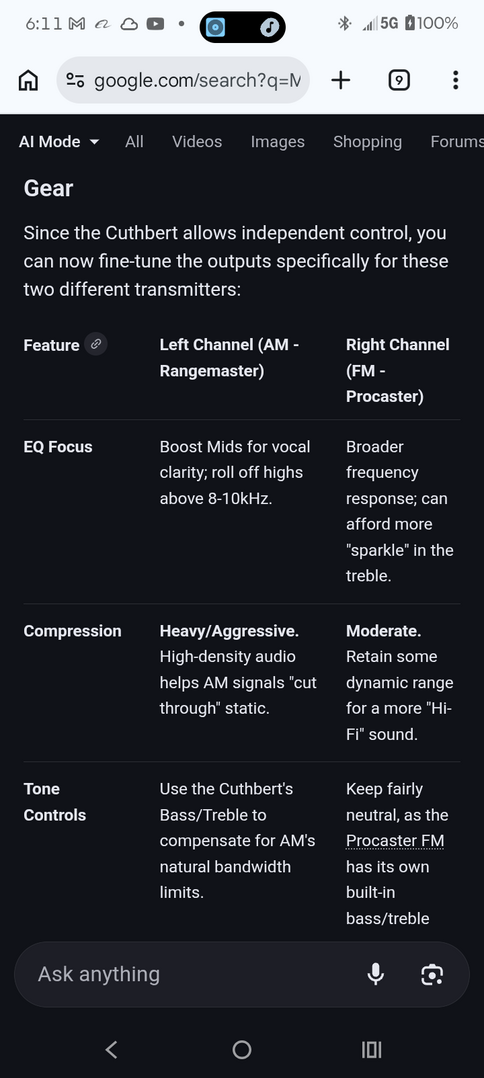
Optimized Cuthbert Settings for Your Gear
Since the Cuthbert allows independent control, you can now fine-tune the outputs specifically for these two different transmitters:
Important Implementation Note
The Procaster FM has its own built-in automatic limiter to prevent overmodulation. When setting your levels:
1. Set your Cuthbert output level first.
2. Adjust the Procaster FM's input level control until you hear the audio become slightly overmodulated in a test receiver, then back it off until it sounds clean. This ensures the transmitter is getting a strong enough signal without triggering its own internal limiting too aggressively.
Do you have the specific patch cables (XLR or 1/4" to 3.5mm) needed to connect the Cuthbert's output to the Procaster FM's front panel jack? ..... ...
Incidentally, perhaps drifting topic a bit before you've had chance to respond the topic at hand! Anyway I was looking at the citations of where it was getting its information, and this is something I've noticed before.. I saw it draw it's info this yome from the Chezradio Site, Rangemaster site, device.report, HB, RadioJayAllen, YouTube, Orban, Facebook, and... I never see it draw information from here. Seems odd, anyway, it also cited Radio World a few times and this one from 2022 caught my eye that talks about the advantages of broadcasting FM in mono..
Your Feedback on FM Stereo vs. FM Mono -Readers comment in response to commentaries by David Bialik, Gary Keener and Glynn Walden https://www.radioworld.com/columns-and-views/readers-forum/your-feedback-on-fm-stereo-vs-fm-mono
An apparent ongoing debate it is, the previous (linked there) is titled "Mono on FM? Hang on a Moment - Your streaming and radio competitors are delivering stereo to their audiences" a and that had been in response to yet another one previous article before that...

I think that the regulations regarding unlicensed broadcasting are far too vague. Particularly in Canada, where you have the added vagueness of broadcasting vs non-broadcasting.
When you think about it, it's pretty stupid. Here we have transmitters that have been tested and certified to meet regulations in FCC (and ISED) laboratories. In the case of FM, there is no easy and inexpensive way of determining compliance, i.e., field strength, out in the field (no pun intended). In the case of AM, the definition of ground lead (and therefore, antenna length) is wide open and subject to interpretation. The many years of ground lead discussion, here and elsewhere, attest to that.
So, you can use a certified transmitter, try to abide by the rules, and still feel uncertain that you are legal.
Something is very wrong here.
You're really left with the question - what kind of tolerance do you have for risk? It isn't the way things should be, but there it is.
The problem with AM in Canada is that there are only RSS-210 (non broadcasting uses only) certified transmitters, and here youneed to use a certified transmitter.
I also believe that intent is the cornerstone of the definition of broadcasting. If you intend to get listeners, advertise your station, and particularly, if you attempt to compete for revenue with licensed broadcasters, then you're broadcasting.
You can pretty much do whatever you want running a BETS-1 station, as long as you meet the content requirements of the CRTC exemption from a license, which, as Mark points out, means no political and religious programming, as well as meeting the general content requirements for any radio station (such as profanity restrictions, no 'isms, etc.). And if you are running a broadcast venture for commercial reasons, you can't use more than one transmitter carrying identical feeds. That latter restriction is there to prevent extended reach, and again, competition with licensed broadcasters.
For my purposes, I run my little transmission like a radio station. But whether that is broadcasting or not really depends on the transmitter I use, and the programming.
The only reason my current programming is public domain material is that I intend to stream, and that I will shout from the rooftops. There is currently no restriction on streaming in Canada, as long as your revenue is somewhat more than a million dollars. I don't think I have to worry about that for a while.
I will broadcast that stream over the air with a BETS-1 transmitter (the Decade MS-100). Since the two are tied together, and likely promoted together, I would say that that is a broadcast venture.
If I do decide to also use an RSS-210 transmitter, the intent would be for my purposes only. I will also program it differently. I don't have to worry about copyright and other considerations, regardless of whether SOCAN and other licensing bodies think about BETS-1. So I can play, for example, 1950s and 1960s music, as well as shows I've produced/overseen such as Teenage Dreams, 101 Below, etc.
So I guess that was just a roundabout way of giving my point of view. Also, using the same logic, if you have a broadcast venture using a BETS-1 transmitter on FM, and then also use an RSS-210 transmitter on AM for the same stream, I would think that it would be difficult to convince an ISED agent that you weren't broadcasting on AM.
"... I also believe that intent is the cornerstone of the definition of broadcasting. If you intend to get listeners, advertise your station, and particularly, if you attempt to compete for revenue with licensed broadcasters, then you're broadcasting..."
That pretty much hits the nail on the head. I realize your talking in the perspective of Canadian rules, but the same concept applies in if your signal is a public performance or not in regard to music royalties.
It's notable however that the FCC has emphasized repeatedly, and specifically over the last 70 years that they do not consider part 15 broadcasting.. however, almost contradictory they have repeatably referred to part 15 operations as radio stations... And has even treated them as such and assigned them call letters in the 1940s and 50s! (College carrier current)
@artisan-radio I think you and I agree that this non broadcasting thing is crazy. We have discussed this before. But crazy as it is it is in the rules. The dictionary and AI describe broadcasting as one to many, making an RF signal available to the public whether anyone's listening or not, or even knows it's there. ISED/CRTC say broadcasting is an intent to target the public. With RSS-210 you can't broadcast so that means it is for yourself only. With a Procaster when just turning it on operating as the rule states it will cover a good size area and unless you are out in the country or are on a farm with many acres around you with no potential audience it is broadcasting. And as soon as you make it known you are there it is an intent to broadcast. Even announcing you are tuned to 1630 is an intent to have others listening....a broadcast undertaking. So in North York Toronto or Pit Meadows Vancouver the only way to use a Procaster AM is to tune it for the null not the peak to greatly lessen the range and cut the antenna from 3 meters to 2 feet and then the signal will not leave the house or property and get to the public. And setting it up as directed outdoors with a radial system the whole bit and then try to say to an agent you are not broadcasting when just your set up is an intent to broadcast. Also if I get a visit I am now on their radar. Why if you can't broadcast with RSS-210 is a transmitter operating at 100mW even there in a broadcast band?
I want to be able to as Artisan said "shout it from the roof tops". Why can't I put a flyer to let the public know it is there? Why do I have to hide the fact that I am using a certified legal piece of equipment? We do part 15 and the Canadian equivalent for targeting the public. I don't want to have to do this and act like I am doing something wrong.
Something is wrong as pointed out with this whole thing.
As for the music license thing if you weren't streaming you could program what you want as I do as the license providers and fee collectors in Canada don't know what BETS-1 is and have no provision for those operations unlike BMI in the USA
I have still not heard back from Socan! They are still trying to find out what BETS-1 is! I mean, if no one wants your money how do you pay for music licensing?
Rich...
As for doing both AM and FM both together on the same feed putting the technical issues(and legal) to doing that aside I am not going to do that as it has no purpose.
🙂
Re the no one wants your money, when I did get licensed once again with SOCAN in 2023 & 2024, I basically had to force them to take my money for Tarif 1b (non commercial radio station). The agent had to consult with her manager because the amount was so low! I insisted.
In the licensing agreement, you get to put the SOCAN logo on your website, and you may be asked to provide 3-4 days of program logs once per year. They didn't even bother to ask.
I was asked in 2007 when I was running on Bowen Island. Back then there was a minimum C$100 fee; now, it's a straight percentage of your gross costs, no matter how little. I think it made more sense when you were paying a minimum; you didn't feel so cheap (and somewhat silly) when paying.
I'm not even sure why they ask for logs. I'm not exactly sure how licensing fees are paid out, but it was changed back in the 20 teens so that most of the money goes to the big artists in Canada, and is not entirely governed by what is played over the air. I was friends with a musician based on Bowen; he was in several modern jazz bands in the late 20th and early 21st centuries. He complained after the change that his royalties went down from several hundred dollars per month to single figures.
@mark You see no reason to do it and I see no reasoning in not doing it. I guess it's all a matter of perspective.
Anyway, at least you're station is in operation.
There is a reason not to do it, at least here in Canada. If he's broadcasting using BETS-1, and he sends the same programming feed to a ProCaster, why would the ProCaster not be broadcasting as well?
You could argue it's just for your own listening convenience, I guess, but that would be a tough sell when the ProCaster range is likely greater than the Decade's.
You would probably be better off with that argument just sticking to the ProCaster and not bothering with the Decade.
There is a reason not to do it, at least here in Canada. If he's broadcasting using BETS-1, and he sends the same programming feed to a ProCaster, why would the ProCaster not be broadcasting as well?
I don't quite understand the question
You would probably be better off with that argument just sticking to the ProCaster and not bothering with the Decade.
I keep forgetting that it's not legal in Canada to broadcast with a Canadian certified RSS-210 transmitter designed for that purpose...
Yeah, it's all very confusing to me. Every once in a while I start to think I'm beginning to get a grasp of the Canadian version of part 15 legalities.. but then I again lose grasp of exactly what the deal is. -- maybe some day I'll finally get it.