

Theres an old topic here https://www.part15.org/community/regulations-law/fcc-presentation-about-unlicensed-transmitters/paged/3/#post-53975 from back when ISS first began offering that radio with a signal meter and corresponding chart as a simple way to provide field strength readings, and the discussion was about how effective it could really be. Carl mentioned a particular radio he used for this purpose,..
"..The radios we are talking about don't have S-meters, they have LCD screens with numeric readouts and seem to be very stable...Mine is a TECSUN PL-310.."
..and the above link goes directly to Richard Fry's response (with a chart).
Anyway, it was an interesting topic worth a second look. It seems reasonable to me that something like Carl's Tescun radio would must certainly be useful in comparing field strengths after a rainy day while the ground is still saturated, or at night to rate how much its affected, or for testing a different grounding system - or whatever. It seems that as long as you use the same radio every time (that has an appropriate signal meter), then the readings would be relitivly true.
No, as pointed out in the previous thread it wouldn't be a real signal strengtg reading, but the relative changes of signal strength would be accurate, thus make it a very useful tool.
Today I see the TECSUN PL-310, the310et, and the 310 DSP not sure if what the difference in those 310s are but they're all in the $50 range. I wonder what other radios has those specific kinds of meters.
And this is the product ISS offers with a S-meter which registers in 15-99 increments to provide accurate readings in comparison to a Potomac unit by using the supplied conversion chart. https://theradiosource.com/products/smr.htm
And for the fun of it, asample ai of the picture at ISS
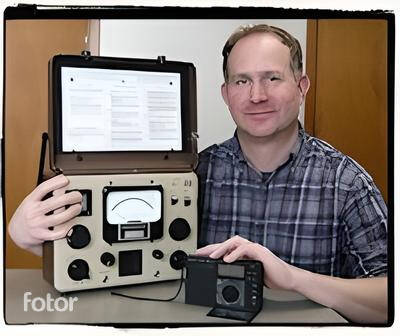
Above, Project Manager Tom Coviak compares the size of traditional AM signal-measurement equipment with the new, smaller SMR Receiver.
And an ai representation of the same:
@richpowers This has been talked about here in the past even by me. He has the right idea in the article that you need a reference to base the dbu readings on. Like the "real" field strength meter shown that we don't have. Rich Fry said no way is that an indicator of field strength.
There is one thing that would work but it is broadband and can't single out a given frequency and that is this...I tried it once for FM as it measures down small enough signals that would be useful to us. But like I said there was no way to isolate a given frequency like 89.9 mHz for example. It's broadband only.
Amazon doesn't allow pasting links so search this and read the specs. Sensitive down to 0.1 mV/M(100uV/M)
Tenmars TM 195 3 - Axis High Frequency/RF Measurement 50MHz-3.5GHz
@mark Cool. Right, I understand the radio cant be used as an accurate feild strength device (I had been part of discussion too there and before), but the point I'm making is that it can be used for accurate dbu readings in comparison to its prior readings under different circumstances. Do you get what I mean? If the its dbu readings are indeed accurate as claimed then it makes the radio to be a reliable way to take readings and compare.
@richpowers Yes I know what you mean but you need the $15.000.00 Potomac to reference the Tecson readings to get an idea of field strength.
Gerry, Procaster, has one and when I was there I had thought of getting a Tecson radio just to try to it out but I never bothered. If only that Tenmars could be frequency selective like the Potomac in a hand held item but then the cost would be way out of reach for us.
@richpowers Yes I know what you mean but you need the $15.000.00 Potomac to reference the Tecson readings to get an idea of field strength.
No you don't, or rather yes - you would need it for an accurate representation of actual feild strength. But that's not what I'm saying.
I'm saying that if the dbu reading of the S meter on the radio is indeed accurate regarding the incoming dbu, and is not being "created" as simply a reresentation of the received dbu (as the Tescun and Grudig radios purport to be), the what you do have is an accurate reading that can be used as a measurement in comparisons of alter situations, whether it be an alternate installation, or just to compare performance difference in different weather - or whatever.
No, you wont be able to determine feild strength directly, but it enables a method to accurately determine the differences in the feild strength. With or without a supplied chart.
I'm just contemplating on all this stuff. I only know what I surmise, which may be flawed. I dont know anything.
Anyway, These are $40 on Amazon.
Mcbazel Surecom SS11 Portable Field Strength RF Signal Strength Test Meter with Antenna
Test suitable antenna for walkie talkie use. High sensitivity. Frequency bandwidth: 1000KHz to 3000MHz. Measurement of radio field strength. The pointer amplitude can be adjusted (to protect the meter)
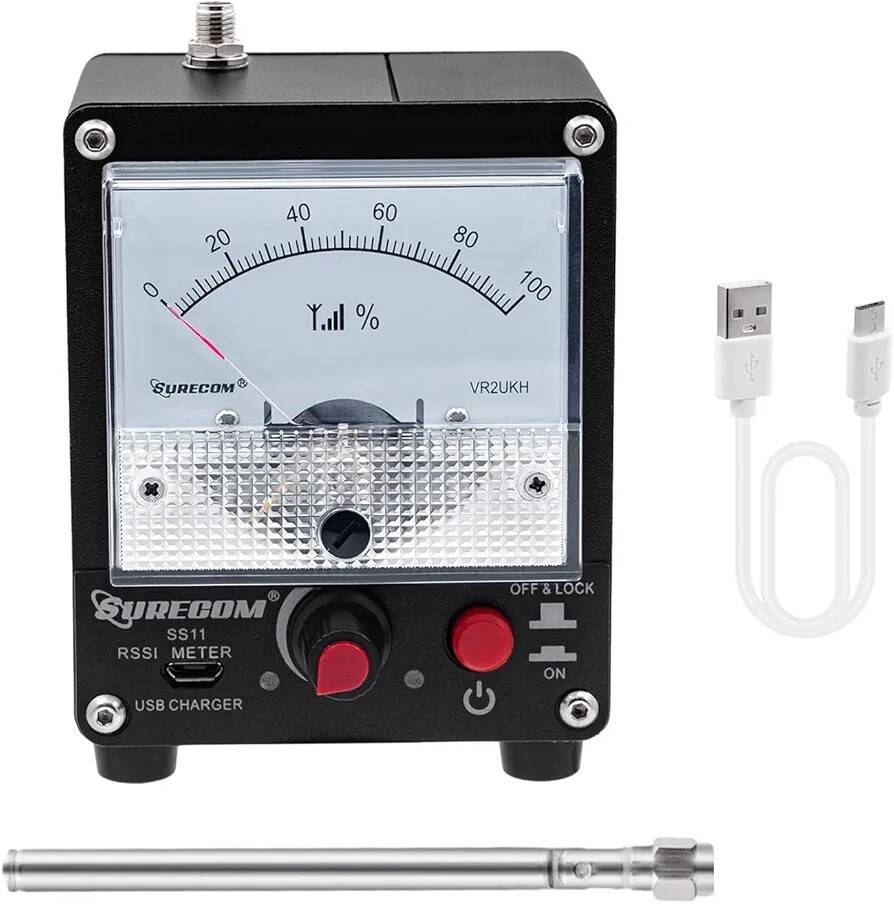
The reviews say it's very sensitive.
@richpowers I have one of those. I use it to see the signal from my antenna. Not that exact model but the same still. works with the Decade and the Procaster.
The one I have needs no power. Is just passive.
Here's the one I have....$23
RF Field Strength Meter Wide Band 100K-1GHz for Walkie Talkie Antenna Radiation, White, 452929
@mark I saw them. Walmart has them too, same price,, but I thought one over 1,000khz was required for AM use.
@richpowers The $23 one, has frequency range from 100kLz -1 GIG Hz.
AM band starts from 530 kLz. 1000kLz is the middle of the AM band.
@richpowers The $23 one, has frequency range from 100kLz -1 GIG Hz.
AM band starts from 530 kLz. 1000kLz is the middle of the AM band.
But wouldnt it need to go up to 1,700 ??
@richpowers It does. If range is 100kLz to 1 GHz it includes the whole AM band and FM band. 100kLz is .1 mHz 1700 kLz is 1.7 mHz
The range of the meter is from way below the AM band to much higher. 1000kLz is 1 mHz
The FM band is 88 to 108 mHz and the meter goes up to 1GHz. That is 1000Mhz
So you see now?
The original one you pictured doesn't measure below 1000kLz so only the upper half of the AM band.