


Very cool, I watched it a few times before, and you've posted the video here before - which is great, good topics are always worth revisiting. I'm interested in it, but just wondering why you opted to present it via a Rumble link of all things? Not a gripe or anything really, but why not just post the YouTube video directly instead of making us leave the site?
@mark Nevermind, the answer to my question to you appears to have been found nestled in a response found in the videos comments, it's because the YouTube version has been edited over copyright concerns, the version on Rumble is unedited. Also included a couple other comments and responses from Sean...
----------
R@Rob Costesi- 7y ago
Terrible demo. You have not convinced me you have anything more than a cheap compressor with three band EQ, Where are the crossovers set between the lo and mid and mid and highs for example?
@seancuthbert4587 2y ago
There are 6 compressors. 3 per channel. Each compressor is preceded by a low pass filter for bass left and right. Band pass filter for mid left and right and high pass filter for treble left and right. The EQ is actually volume controls for the output of each compressor. The point of the demo is to hear both the crossover frequencies and hear that bass frequencies don't turn the treble down etc. The fact that each compressor has its own release adjustment also shows you that it is 6 channel. This may not be the product for you as it sounds like you are expecting $5000 of optimod processing for less than $200. A more complete demo is available on Rumble, as youtube forced me to shorten the demo. over copyright.
@melvinvasquez8518, 7y ago
Hello is this unit analog or digital in terms signal processing? Also what connection types are available (inputs, outputs)?
@seancuthbert4587 7y ago
100% analog so no latency. RCA phono input and output.
@barrygeary 1890- 2y ago
Do you still sell this on ebay?
@seancuthbert4587 2y ago
These are no longer sold due to parts shortages and prices but if you are genuinely interested I have enough stock to put one together. Cost would be $189. Let me know and I'll list one.
---------
I noticed that YouTube like Google now has ai incorporated into it, and since I had always been particularly found of the Dominator processor performance, I ask the video this question, everything that follows was the ai reply..
Does it have "Loudness" capabilities similar to the "Aphex Dominator"?
The multi-band compressor demonstrated in the video is designed to make everything super loud, which the creator states is "great for long distance AM transmission" (0:30). It achieves this by compressing bass, mid, and treble separately, which eliminates the "pumping" effect found in cheaper compressors (2:42). This individual compression of frequencies brings "all the frequencies into the foreground," resulting in a "louder, more lively sound" (2:52). The compressor has an adjustable "compression adjustment" that allows for "overkill" compression to make everything "really loud" (4:21). The creator also demonstrates how the compressor keeps the output volume consistent even with varying input levels, such as when he walks away from the microphone, emphasizing its power (7:21, 8:02).
The Aphex Dominator is known for its multi-band limiting, which allows for increased loudness with less audible distortion compared to traditional single-band limiters
It processes different frequency ranges separately, leading to a more transparent sound and potentially 3 to 6 dB greater loudness than traditional limiters . Key features include an adjustable peak ceiling to prevent clipping and overload (ranging from -9 to +24 dB) and a "Density" control to balance limiting and sound openness. It also offers user-defined release times for tailoring the limiting speed.
While both units aim to increase perceived loudness and control dynamic range, they do so through different mechanisms and with different levels of advertised control. The video's compressor emphasizes achieving a "super loud" and "lively" sound by individually compressing frequency bands and offering adjustable overall compression. The Aphex Dominator, on the other hand, is specifically a multi-band limiter designed for transparent loudness maximization, with precise controls over peak levels and detailed frequency band processing .
Sources: [ https://tile.loc.gov/storage-services/master/mbrs/recordingpreservation/manuals/Aphex%20Dominator%20II%20Precision%20Multibrand%20Peak%20Limiter%20preliminary.pdf ]( https://tile.loc.gov/storage-services/master/mbrs/recordingpreservation/manuals/Aphex%20Dominator%20II%20Precision%20Multibrand%20Peak%20Limiter%20preliminary.pdf ),.
https://www.muzines.co.uk/articles/the-studio-dominator/11569
http://www.showtime-online.net/Aphex%20Dominator%20Showtime_sound.pdf
https://reverb.com/item/701119-aphex-dominator-ii-720-2-channel-multiband-limiter-excellent-condition
https://www.fullcompass.com/common/files/3709-Aphex9721Brochure.pdf
The YouTube AI providing a summary of the entire video (this is not of the unedited version as found on Rumbler, not that I think it would make much difference)
---_-----------_-----
This video demonstrates the features and advantages of a 6-channel multi-band audio compressor (0:02).
Here's a breakdown of the key points:
• Problem with no compressor (0:21): Without a compressor, audio volume can fluctuate too much, leading to distortion when too high or being too quiet, forcing listeners to constantly adjust their volume (0:31-0:40).
• Problem with basic compressors (1:24): Basic compressors stop audio from going too high but can cause a "pumping" effect, where the entire volume (bass, mid, and treble) turns down when a loud bass sound occurs (1:36-1:54).
• Deluxe Multi-band Compressor Advantages (2:42):
Compresses bass, mid, and treble individually (2:45), eliminating the "pumping" effect (2:47).
Brings all frequencies to the foreground, resulting in a louder, more lively sound (2:52-2:56).
• Allows for adjustable compression (4:21), from "overkill" (super loud) to softer settings for dynamic range (4:25-4:30).
• Includes bass, mid, and treble equalization (4:34), allowing it to function as an equalizer (4:36).
• Demonstration of Compression Levels (6:24): The video demonstrates turning up the compression to show its various effects, including how it maintains a consistent microphone volume even when the speaker moves far away (7:19-8:27).
• Limiter Function (8:30):
This function leaves the signal uncompressed but prevents it from exceeding a predetermined volume level (8:35-8:44).
It's useful for maintaining dynamic range while preventing overly loud peaks, suitable for recordings, nightclubs with legal volume limits, or radio stations (10:22-10:45).
• Release Adjustments (10:49):
These adjustments help find a balance between compression and sound quality, reducing slight distortion that can occur with heavy compression (10:52-11:17).
Separately adjustable for bass, mid, and treble, allowing for fine-tuning for different audio types, like classical or jazz music (12:15-12:35).
High compression can increase broadcast range by making the volume loud enough to mask static (12:45-12:56).
• Clumsy DJ Demonstration (13:01): A practical demonstration shows how the compressor maintains consistent audio levels even when the input source (like a DJ's microphone or a song with varying volume) fluctuates wildly (13:05-15:58).
• VU Meters (7:31): The front of the compressor has VU meters (left for input, right for output) to help with setup and ensure proper audio levels (7:34-8:01).
• Rear Switches (16:19): The back of the unit features a three-way limiter switch, allowing for off, 200 millivolts, or 500 millivolts settings to match equipment output (16:21-16:34).
@richpowers The You tube video censored some of the audio demo at the last part so the same video on Rumble has the audio for the whole thing.
A great demo of the Sean Cuthbert Compressor in operation.
Didn't remember I posted this before.
@mark Right, that's what I pointed out above, Sean had mentioned in the comments "A more complete demo is available on Rumble, as youtube forced me to shorten the demo. over copyright."
What he also mentioned of considerable importance in the comments (2 years ago): "These are no longer sold due to parts shortages and prices but if you are genuinely interested I have enough stock to put one together. Cost would be $189. Let me know and I'll list one."
I know he still had some 3 or 4 months ago, I had contacted him through eBay asking why he never list them anymore, he replied that he would list another and said they go fast when listed. He listed one that day, but I wasn't ready to buy and someone else bought it for $189.
I am again leaning towards the Culbert over the Schlockwood, but if the new Schlockwoods had been available a few weeks ago I probably would have bought one despite the fact of its peculiar power supply that tends to discourage off-grid use. At first I figured no big deal, I'll just use an inverter, but I've changed my mind, that floating power input or whatever it's called feels like a monkey wrench in my plans. So now I'm leaning between the Culbert or just getting another Aphex Compellor/Dominator pair that I liked so much, though need to look and make sure there's no similar problems with powering those.
I just can't decide, but right now I'm leaning more toward the Culbert because it's a much less of a gamble than buying 30 or 40 year old Aphex processing gear I had been real lucky last time, but damn, it's really old equipment now and I'm not talented to restore them if need be.
So yeah, I'm leaning towards Culberts processor again.
@richpowers I looked up the Aphex one you mentioned to see it and I did notice it was powered by a/c cord directly from wall as power supply is on board so with that you may need inverter also. You should contact Jim Wood and see if the new version of the Schlockwood coming out in the new year has the same power supply as the original.
Here's the rear of the Aphex where power input is.
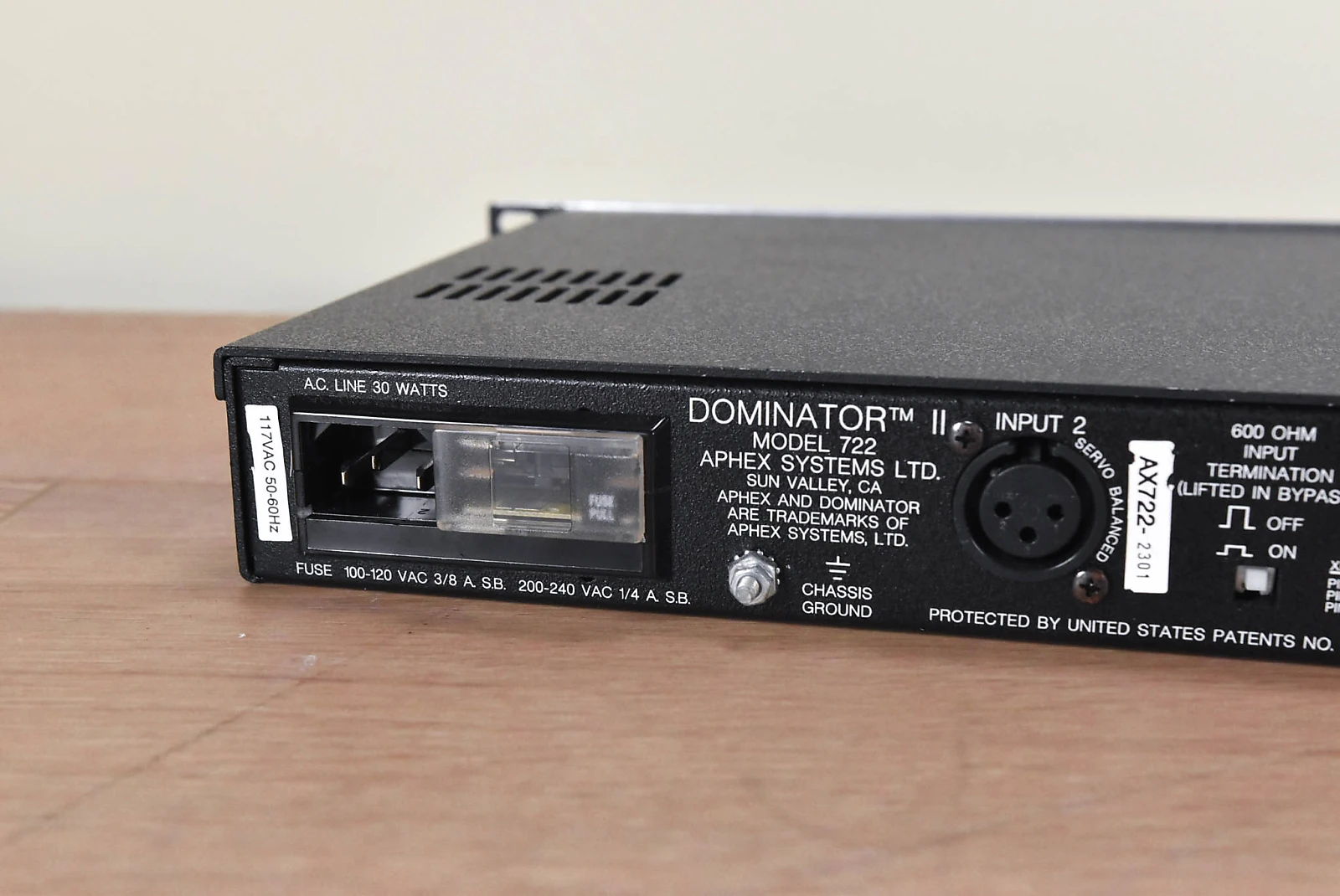
@mark Yes it is, however the majority of such electronic devices (TVs are a good example), actually are all powered DC. The inversion from AC to DC actually takes place inside the devices and can be bypassed entirely by opening up the TV (or whatever) and tapping directly into to the DC circuitry on the other side of the built-in inverter. And it doesn't take a genius to do it, it simply amounts to soldering two wires in. ..as long as there are no "floating grounds" or whatever to be concerned with as it is with the Schlockwood.
It's even easier if the device uses a power brick (wall wart), because then all it entails is to cut off the brick and splice the wires in right there.