

I've been using OpenWebRX+ to experiment with some of the transmitters I own. I'm pretty happy with the Decade MS-100, but the sizes of the BVE AXS-FMT and Whole House 3 transmitters are much more convenient, and they sound comparable. Both are certified under RSS-210 here in Canada, and Part 15 in the U.S.
I've had some interesting results with the Whole House 3. First off, I should say that I did investigate the harmonics, and found that while there, they were down significantly from the main signal. My transmitter, at least, doesn't appear to have the same problems as Mark's.
I reported previously that the mono signal in the waterfall display of OpenWebRX+ seemed to wander off frequency and display other unusual behavior, even though it sounded OK through a radio.
The stereo signal appears to be stable, and it's pretty obvious that that's what the radio was designed to transmit.
Unfortunately, OpenWebRX+ does not reliably decode the RDS signals being transmitted. Sometimes some of the information flashes up, and then it disappears. The Decade passes through everything, and the display is constant. It appears that there is a low pass filter on the Whole House 3, which is taking those RDS frequencies out.
I'm going to keep the Whole House 3 going for a while, to ensure that it is as stable as the Decade, and then turn my attention to the BVE.

I reported previously that the mono signal in the waterfall display of OpenWebRX+ seemed to wander off frequency and display other unusual behavior, even though it sounded OK through a radio.
I'm sorry, haven't really followed the OpenWebRX project, I thought it was basically an online radio receiver, but your saying it also receives and displays characteristics of a local ota station?
I'm using my SDR website as a vehicle to distribute Artisan Radio's signal. It's not strictly streaming, and is a gray area when considering copyright rules. You can look at it as just an overly sensitive radio, and there are hundreds of such sites around the world.
The OpenWebRX+ software can be used to analyze a Part 15 transmitter signal (simply, at any rate). That's what I did with the Whole House 3.
An update: the output level and range dropped dramatically when used in stereo mode. So back into the backup pile. I'm now looking at the BVE AXS-FMT. But at this point, I suspect I'll end up with the Decade MS-100.
That's what I'm saying.. it's basically an online receiver - so how does it analyze an part 15 AM signal on 1650 or whatever?
I'm further confused by your saying your signal dropped dramatically when you switched to FM (which is always a given anyway isn't it?) But according to what I see (just browsing around): The guy who created it says:
"Please note that OpenWebRX only plays mono sound, so there will not be any stereo. OpenWebRX also allows to decode textual RDS information sent within FM ..."
I also came across this, which addresses a subject you brought up here previously
https://groups.io/g/openwebrx/topic/no_stereo_or_rds_on_fm_mode/100992642
And I still dont get how an SDR can receive, much less analyze an over the air AM or FM signal.
Obviously I'm not communicating this effectively.
I meant to say that when the Whole House 3 transmitter was switched into stereo mode from mono (nothing really to do with the SDR), the output of the transmitter dropped dramatically. I knew this because the range dropped. In mono mode, the WH3 transmits a lot further.
As for the SDR. The SDR has 2 types of displays, each of which indicates in a graphical fashion the strength of the signal being received. In the waterfall display, it shows different colors to indicate strength, across the frequencies. In the graph display, it shows amplitude (your standard x-y graph). Both displays change with time, and the graph display can be turned off. Unfortunately, the waterfall display, which takes up most of the network bandwidth, cannot be turned off (or, at least, I haven't found a way to do it).
It might be a bit over the top to say that you can use these displays to analyze your transmitter signal. But you certainly can get an idea of the frequencies you're transmitting on, how stable the signal is, and whether there are harmonics, spurs, etc. As an example, I can easily see the RDS signals when I turn RDS on in the software I use.
You should take a look at Artisan Radio through the SDR - it can be accessed through the Artisan Radio homepage ( http://artisanradio.hopto.org).
Currently, I'm transmitting with a Decade MS-100 on 91.9 FM.
Yes, I'm aware that OpenWebRX+ (and its predecessor, OpenWebRX) can only output audio in mono. I was playing around with stereo settings on the transmitters to see if I could get RDS signals to output. On both the BVE and the Whole House 3, there are obviously low pass filters to take out the higher frequencies required for RDS. This filter would help with spurs and harmonics, but means that RDS is not supported, at least in mono mode. I was hoping that putting the transmitters into stereo mode might bypass these filters, but it did not.
The Decades fully support the RDS frequencies, relying on their superior internal electronics to minimize unwanted extra noise.
I can't comment on the sanity of RDS implementation, other than it's there, and it's popular (very popular in Europe, less so in North America). If you want song information without the whole hassle of digital radio, then you use what you have. My 2013 Ford Flex supports it just fine, and I like the ability to see song information pop up on the console from my little radio station, just like the big boys.
I also have to say that I'm not horribly impressed with the implementation of OpenWebRX+, particularly on Windows. To say that on Windows it's a hack would be an understatement.
But again, it's there, it works (sort of, if you can get past the lousy documentation), and it's still the only true client/server SDR implementation that utilizes a browser. Kudos to the developers who took it this far.
I've been giving consideration to rewriting the app either in C or C++ specifically for broadcasting applications, and utilizing a proper cross platform environment, such as QT. That's how I ended up with my RDS software - I started with the open source program JMPX, and modified it to operate with my specifications. I believe that both software projects utilize the same, or at least similar, radio libraries. The new project would consist of rewriting the User Interface to minimize network throughput to the browser, and to be able to better tune the bandwidth for listening to broadcasts (AM broadcast band, FM broadcast band, shortwave AM bands). And needless to say, WFM stereo.
I'd also like to see the software run on some of the lightweight browsers out there, such as those that are used in smartphone environments. OpenWebRX+ works on the major ones I tried (Chrome, Edge, Firefox, Vivaldi) but not on, say, Pluma, and likely many others that are similar.
Your OpenRX Artisian Radio plays perfect and appears to display properly on my Samsung phone
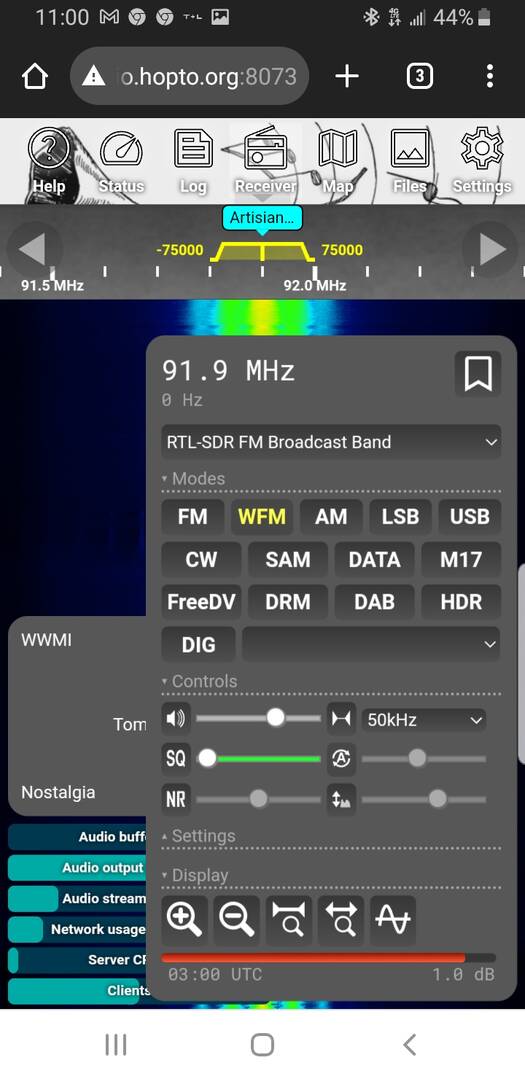
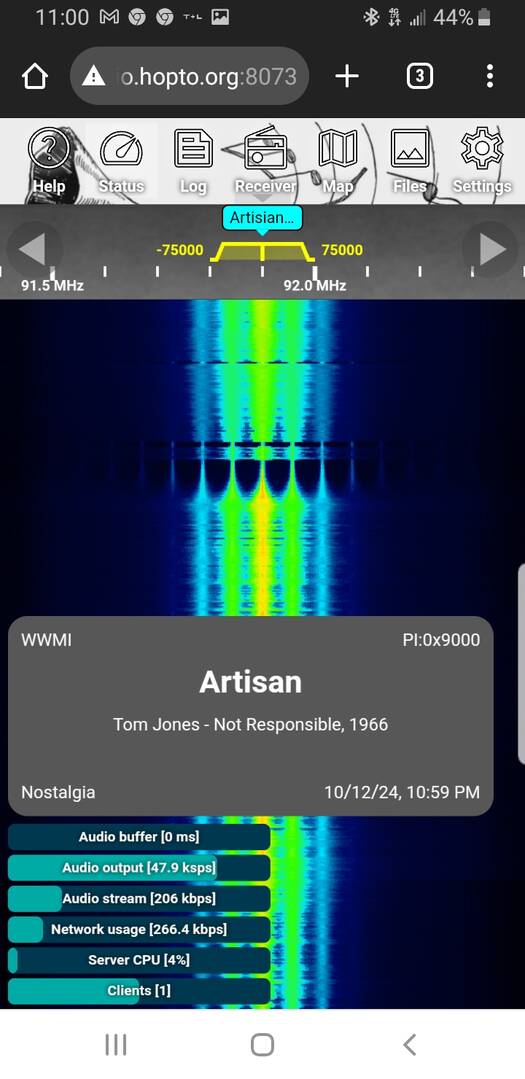
What browser do you use on that phone?
That was Chrome in that picture but it works equally well in a standard Google browser too.
The Samsung also came with a browser simply called "Internet", the page loads but the music doesn't play with that browser