

Maybe a Grundig with the Magic Eye tube.
I think you're right.. just tried to search it and this one looks very close, but it doesn't appear to have what you call the magic eye:
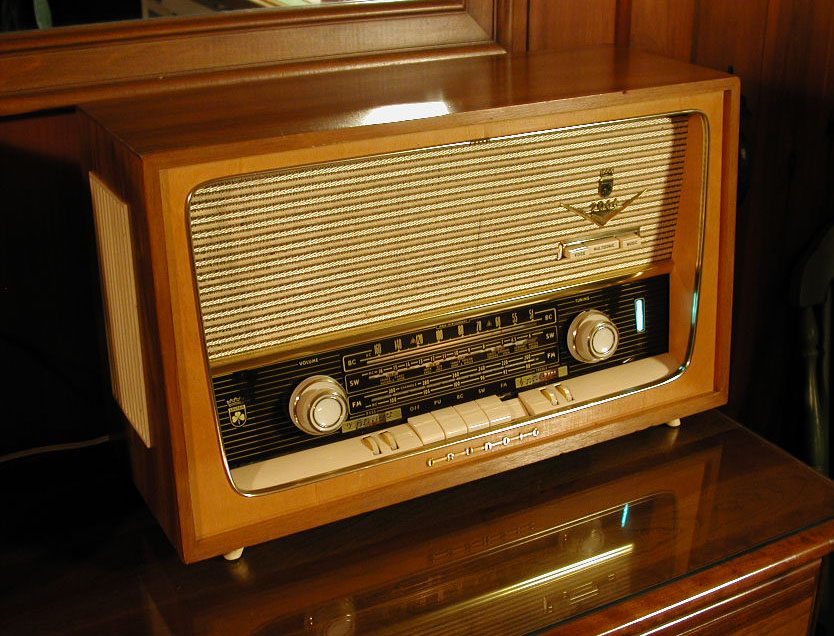
the tube should be around where the elbum is shown in the anove picture;

Go to QRZ.com and look up their project. They making AM tube transmitters.
Side note:
Somebody here - - was it you Rich/End 80? --
or someone else - - has one of these or a deck
that is very close to it. I saw it in one of
the station pictures. This is what I have and
we (a friend and myself) had it apart last week
and were laughing because of the weirdness of
the degredation of certain parts and the goofyness
of the malfunctions. Later I got it to work and it
is stable - but it needs more attention. It's a beautiful
machine which has been moved and bonked around
much too much. I have mentioned this deck many times
but having worked on it this week - I thought I would
throw this comment in. Gotta love the old stuff. The best
AM "transmitters" from the 1950s/1960s were NOT what
I owned. The Lafayette 990177 phono oscillator and
the Lafayette KT-195 (kit) / LA-320 (built version) "transmitter"
were both mysterious and dangerous. I could have blown
up the house - - but you guys have heard most of those stories.
I know MRAM took a KT-195/LA-320 and made it much better!
Crud - I have to get off of here and order a pizza!
Best Wishes
Brooce, Part 15 Hartford CT
This site shows most of the types of indicator tubes and if you click on the thumbnails it brings up an information page with an animation of the tube in operation. Pretty neat if such things are of interest to you.
Link: http://www.sm5cbw.se/tubes/eyes.htm
When in High School I designed a circuit around the EM84/6FG6 tube to operate as a modulation indicator for my KnightKit broadcaster. It made setting the audio level easy plus it was fun to watch as the music played.
Neil
I have many many things with "Eye Tubes" in them. Several radio receivers from the 40's and 50's. Several disc recorders also from the same era. I also have a couple later FM tuners that have tuning eye tubes in them, but rather than the green circle on top style, they are blue and show through a rectangular window. I also have a couple Swan ham radio transceivers that have tuning eye style tuning meters in them.
Fun to watch!
TIB
I've got a GX-4000D in my studio. Don't really use it all that much for Part 15 stuff, more for converting and archiving over 50 years of my own recordings, and for digitizing those of others as well. I use it all the time.
I bought it from a woman who said her husband brought it home from Viet Nam. She could never get the speed to work right. All his tapes sounded fine. But the ones she bought played at the wrong speed. Bought it cheap. All it needed was to take the back off and change the power setting from 50 to 60 Hz. Been just fine since.
TIB
My best ham radio buddy in 1972 had a
Swan monobander for 75 meters - the Swan 175.
He and I checked into the Connecticut Phone Net
all the time on that radio. I loved his shack. It
was that and a Drake TR-22 and about 50 QSL
cards on the wall. We were at the top of the world.
He might still have a Swan 400 (???) I might very
well be wrong about that one. I can't seem to find a
picture of that. I saw mention of a Swan 420 on the net.
Keep those Swan radios alive if you can, Neil.
That's odd - I can't find your comments on the Swan
radios now. Wrong thread? Oh well - I've got more
comments about the magic eye tubes and a few other
odds and ends. I miss things because of the eyesight
issue I have. It's all good. You should see some of
the radios I have here.
Brooce, Part 15 Hartford
Same as mine. Built like a tank. I got it from a friend
who was ill and didn't have the strength
to move the Play/Rec and Rew/FF levers.
It's in amazingly good condition considering
how it got bonked around in a couple of moves
and was then stored improperly.
There are still a lot of them out there. I would
love to have the model that is black in color.
Those look very cool.
The other thing is that - aside from the 50/60 Hz
switch - - the speed issue is a mystery to some
people. As you know - there is no 3 3/4 7 1/2 IPS
switch on the machine. Many people don't know about
the metal sleeve that goes over the capstan to go from
the lower speed to the higher one. (That sleeve is stored
under the head cover.) I do not have that sleeve - so my
Akai will only play the 3 3/4 speed. I had it - it was lost.
For me that's not a problem. I don't need 7 1/2 IPS.
Many times this Akai has been used in my Part 15 set-up.
The only reason is because I love reel to reel tape recorders.
There were everywhere when I was young.
Brooce, Part 15 Hartford
Tim - YOU have the Swan radios. OK.
I got that mistake fixed.
I looked at the magic eye tube website.
Amazing. Those indicator tubes are works
of art, I think. I had a vacuum tube FM
tuner with a magic eye tube. I remember
it well. and wish I still had it. It was mono,
but it had a rear panel output
for an external stereo decoder. It was very
sensitive and selective.
The picture of the beautiful Grundig radio is
familiar to me. I have seen a few - but I don't remember those having magic eye tubes. So I don't know about that. My
line spacing might have changed.
(Why?)
The soup can transmitter shown way
way above is really neat. I have built
transmitters in cans and
metal filing boxes.
Best wishes
By the way - spell check won't
allow me to spell my name. Um...
B r o o. c. e. Oh my
Part 15 Hartford
What Swan models Tim?
I've got an Airliner console radio that has the green tuning eye. My heathkit signal tracer has one as well.
I have a Swan Cygnet 260 that has a horizontal blue level tube -- the two illuminated "curtains" come together and meet in the middle. I suspect other Cygnet models may have had them too. Not certain anymore. I had about 6 Swan trancesivers all set up in the shack at once for several years. Now down to one and a couple modern Icoms.
Someplace I have a photo of the "Swan Shack". At that time I was big on having a 100% USA made station.
TIB
My old Philco 18 has a tuning indicator which works by projecting a shadow of a moving metal vane.
As the vane moves, the shadow becomes wider or narrower. It is projected onto a translucent window.
Same.effect as a Magic Eye indicator done mechanically.