

I have been pondering about the InfOspot (Talking House) Transmitter. Version TH-5. The positive point I see in my situation is the Transmitter is inside, and during severe thunderstorms, it can be disconnected from the Range Extender Antenna (if used) from the outside, this protecting the transmitter.
Information Station Systems, Inc. claims since they bought the rights to manufacture this version of the Talking House Transmitter, they made a few modifications. I do like if the user needs to change frequency, it can be easily done on the front panel.
I realize these Talking House Transmitters have been out there for years, and Radio Systems, Inc. was the previous manufacturer of them before Information Station Systems. Who has experience with the more up to date TH-5 model?
I not sure it "stacks up" against the Hamilton Rangemaster or the Chez Procaster when the Talking House uses the outdoor Range Extender, but just using the transmitter alone, I was wondering how well it preformed alone? I see folks selling them on ebay, but I'm unsure if it's the same version that ISS makes now. Anybody have any experience with the current version of the Talking House from ISS?

I have never used this one so I can comment personally but just on being a little knowledgeable on all these transmitters as I take an interest and do some research on them and I'm aware of all that are out there, I can say that the Talking House used indoors with the wire will not be near as good as the Procaster indoors with a wire or using it with the range extender.
One big reason is the auto tuning antenna mechanism it uses instead of a manual ATU tuned with a meter never gets it peaked right. This Youtube video demonstrates this....
My opinion...You have the Procaster as I remember? If you want to get the Talking House with the range extender keep the Procaster for times when a storm comes.
With the range extender you bypass the internal automatic antenna tuner and you manually do it outside for peaking the signal.
Mark,
I spoke with Bill Baker of Information Station Specialist, the manufacturer who bought the rights to the Talking House. They are a United States owned corporation. Radio World has done some articles on them. They also manufacturer antennas and transmitters for TIS Stations in the U.S. and Canada as well as now Emergency Antennas for Commercial Stations.
My reason for asking is I'm done with the Procaster. I found the inside wire doesn't make it two houses on either side of my house. I turned the Procaster off, packed it up and put it all in a box around the first of March. We recently had a storm come through here that struck a good size tree and about split it in half. I stop by as the man who owed the house told me he had to rented a small bucket truck to cut up the big tree with a chain saw. He told me that night, he and his family through the lightning strike hit their house.
I saw that You Tube video before you pointed out. One thing that came to my mind several days ago after I saw the video and the guy doing the mods in the video is perhaps he had an old Talking House Transmitter. Those things have been around for years and here in the U.S., two companies have own the manufacturering rights to it in the past, one being Radio Systems. The guy most likely a had a older version, and he could have bought it off ebay. I've seen them on ebay for sale going back approximately 15 years ago, before ISS bought the rights, made their modifications and selling them.
I talked to a guy on ebay selling new ones, never used that he has had for a bit over 10 years. He told me at one time he was a real estate agent and bought them at that time. He might have bought his from the manufacturer making them believe radio systems bought the manufacturer rights to the Talking House.
By the way, the website for Information Station Specialist is: theradiosource.com
I bought a emergency antenna from Bill Baker several years back for my commercial station. I still have it. What my question was, since ISS bought the rights to the Talking House, did mods to it, and it's been renamed the model "TR-5", has anybody used it?
On the phone, Bill Baker did say the typical range with "their version" of the Talking House using their Range Extender is 1/2 mile. That's just about what Chez Procaster, Hamilton Rangemaster, or any 100 millowatt signal, Part 15 Certified Boxes can guarantee on AM for a "solid signal".
Bill Baker did admit they had a couple of Procasters they tested in their company lab. He said the audio was very good to them just using the Procaster's Audio Interface. I didn't ask him, but I'm sure they got a couple of Hamilton Rangemasters to test. ISS probably did this before they made their audio modifications, checked their FCC Certifications before they started reselling their TR-5 Version of the Talking House.
The idea is to disconnect the Transmitter from the Antenna/Range Extender outside during these severe thunderstorms. Bill and me discussed this over the phone.
I told Bill I've talk to my attorney and my broker, we haven't found a small town AM to buy yet. Most of them in the U.S. have FM Translators, and the owners ignore the AM Station and promote the FM Translator as their primary programming signal. That's sad Mark. In my opinion. Do you keep up some with what's going on here in the U.S. and the radio markets? I would love to just have a 250 Watt AM playing Country Music, wouldn't bother me if it was Daytime Only.
I keep up on what happens in the US and I know of all the translators.
Strange about your Procaster. You aren't in a house with metal siding? I posted my range I'm sure you've seen with mine from indoors with a wire in a basement! I also posted the little in the cabinet ground I devised here not to long ago. In the same room with the transmitter it overloads a lot of radios, as I just posted a fix for that.
I have one question, are you getting a peak with the meter? If the meter is past the 10 when adjusting see if it's hitting the end and if it is you aren't seeing a peak. There's a trimmer to the right of the meter that works only when the Procaster is operating. This trimmer resets the pointer back from the end so you can get a peak.
If that's not it you can contact Gerry at Procaster from the web site for advice. It should be better than 2 houses. You can mention me as he knows me as he is in Toronto and I have talked with him personally. Talk to him before you give up on it.
The TH-5 now called the Infospot that ISS sells now is the TH-5 with the audio and modulation mods but it still has the auto tuning with the motor that moves the ferrite bar through the coils and I still question if it gets it right as manual tuning does.
What the range extender does is gets the antenna tuner and antenna outside and you tune it manually. I wonder what you can do to protect it from lightening? You'd think if there's lots of other things around for the lightning to hit the chances would be small it would hit the range extender.
If all the small stations don't care about the AM maybe the cost of buying a small AM station may be within reach....who knows. You can help make AM radio great again!
That's my slogan. Remembering growing up in the 50s 60s and 70s. "Making AM great again" as you remember it.
If you get the Infospot with range extender and you are automated there's a chance you won't be home to disconnect it if a storm comes. That's a possibility.
Maybe you can put a long metal rod in the ground in your yard near where the range extender is to give the lightening a more inviting target to hit?

Procaster doesn't sell a model with an inside wire antenna.
My Procaster has been running 24-7 for over 8 years, mounted 30 feet up, on the side of my 100 year old wooden house. No ground is connected and I cover a solid 1 1/2 miles (which is larger than the town I live in). Granted I'm in the wilds of northern Minnesota with a very low noise floor which helps a lot.
This also means it survives Minnesota weather, from 90+ degrees with 90% humidity in the summer, on the south side of the house in the sun, to -30 degrees in the winter, and still solid as a rock.
My Procaster has never wandered off frequency and provides consistent signal strength, tested at about 30 points around town with a Potomac FIM, every few months when I get bored.
A couple years ago I thought I'd see if I could check and see if I could "re-peak" it, since it had been outside in the wild temperature changes for 6 years. It's a pain to do since I have to remove an attic window and lean out the window to access it. It will still peaked and no adjustment would make it any better. So it held tuning just fine.
Additionally it has built in processing so no investment in external gear is necessary. It sounds just fine out of the box. You will want some processing with the TH transmitter.
If you're only getting two house range you either have a defective unit or the wire antenna idea isn't panning out.
TIB
@ Timinbovey...
To use it indoors when I got mine I didn't get the stock antenna. I just made a wire antenna with an alligator clip at one end and clipped it on to the antenna bolt. I found that different shapes with the wire affected the tuning for better and worse and got the best configuration. Also did the in the case "ground" as I showed here and that made a difference also.
Tim, I am still amazed that with the temperature changes it needs no fine tuning!
Also I have a passive field strength meter(a little hand held one) and get the signal coming off the antenna itself as it has a higher resolution than the little meter inside.

It may be that the transmitter is defective. But that's the easy answer.
I've been doing this since 2006, and have found that there's very little forgiveness in using 100mw and a short, untuned antenna. There are lots of factors that dwarf the miniscule differences between transmitters.
To give a couple of concrete examples. Ground conductivity is one of those factors. On Bowen Island, with very poor conductivity (basically a rock sticking out of the ocean), I barely could hear a Hamilton Rangemaster 1/4 mile away. In a different location on the mainland (with good conductivity), with the same transmitter mounted in the same fashion, I was able to hear it clearly over a mile, and up to 2 miles in some directions.
Grounds are another factor. In the late and not lamented AM Transmitter Challenge conducted elsewhere, most transmitters tested could easily be tuned to the marginal ground that was used. One transmitter (an SSTran 5000, Class E amplifier) was not tuned properly for that ground, and did poorly. That, in spite of the fact that many who know what they were doing have found that it does better for them than the winner of that comparison - they obviously have theirs tuned properly.
Except for something like that SSTran, you should expect most transmitters to perform roughly identically under similar conditions. They all use 100mw input to the final stage, they all have similar antennas, have about 50% efficiency in their final stages and use antenna tuners.
So, if you're getting poor range, something else is wrong. And the only way to resolve the situation is to try things.
First, I'd move the ProCaster outdoors with its original antenna, and see what that does to range. It could be something inside interfering with or absorbing your signal. Again, it doesn't take much to overpower maybe the 1/4 to 1/2mw your antenna is really putting out (50% efficiency for that final stage of the transmitter, 1% antenna efficiency at best, and indoors you probably don't have close to the best).
Try elevating the Procaster, and install in different spots if you can. You can also try moving it around indoors.
If you continue to get uniformly bad results, then sure, get another transmitter. But if you get it first, before trying other things, you might find you get the same results. As I said, minor things aside, there's really not much difference between a ProCaster and a Talking House in terms of range.
The best range I've gotten has been from a Hamilton Rangemaster installed at ground level outdoors (with good ground conductivity), but a very close second was a Talking Sign (very similar to a Talking House except manual antenna tuning) with a wire antenna. I installed the Talking Sign indoors, and strung the wire antenna outdoors up the side of my house and over the roof (the Talking Sign was mounted on the ceiling of my studio). It was in the same location as the Rangemaster.
Concluding, don't go by what others have done or are getting for range. They are in entirely different situations than you. What works for them might not work for you and obviously isn't. Experiment, experiment, experiment and you'll eventually get there.
To Mark, Tim, and All You Good Folks,
I want to thank you all so much for your input!
Yes, Signal strength is only half of the problem. As I mentioned, severe thunderstorms are very much more common in the southeastern part of the United States than the northern border of the country, just my opinion.
The problem is here in the U.S. and I'm sure in Canada is the FCC in Part 15.219 and Canada's Laws in Part 15 AM is the whole rule of the antenna and ground is written wrong and out of date. We can leave the radiating antenna at 104", but the ground wire should be at least extended to 50 feet going down the mast pole from the transmitter outdoors. The problem is our Audio Division at the FCC sees the ground wire as a part of the radiator, thinking this increases field strength.
My thoughts are, there should have been a rule making for extending the length of the ground wire to a ground rod only. My experience with the FCC as a Commercial Licensee and down to Local Government Laws and Zoning are when filing for a rule making for a request for change for the better, do not request for so much at one time, ask for very little, as little as possible. Asking for too much at one time will just get the Rule Making thrown out. If a Rule Making is request is asking for very little, chances are it will be granted. After it is granted, give it time before asking for more.
I saw the ground filter Hamilton Rangemaster came up with to put in line with the ground wire, but my understanding is the FCC turned it down. Mr. Hamilton should go back with a Rule Making, getting letters from Part 15 users for this. On a side bar, both the U.S. and Canada could get hit with heavy pandemic again for a lockdown. Churches need to be using Part 15 AM Transmitters than FM. If the ground wire length rule was modified, make the transmitters cheaper to buy, this would help the congestion on the FM Band and temptation of Churches using FM on Sunday Morning Services in parking lots, especially the large ones perhaps.
Back to ISS and Bill Baker's Company's version of the Talking House, I got a good price for the transmitter alone. If the range extender was eliminated, and the transmitter modified for using a ground wire and antenna of the right length in high part of the AM Band, 1610-1700, it can be disconnected before thunderstorms. He told me they are the only company that was allowed to have the transmitter in the building and running a cable to a range extender, like a ATU, that is put outside. Don't ask me what FCC Attorney in Washington, DC got them that permission, but it was done and it is legal.
I know one FCC Attorney in Washington that is the most powerful one that can get almost anything done with them. When I was a Commercial AM FCC Licensee, I spoke to him, he's expensive, but he has Political Clout in this area of United States Government and the NAB (National Association of Broadcaster). I was once a NAB Member.
The question was ask to me, what do you do if your not home during a thunderstorm or one is coming near your area. That answer is simple. I learned all this as a Commercial Broadcaster. Turn the transmitter off, disconnect it from the antenna or perhaps have a neighbor or family member you trust do it for you, which I know most of you run these Part 15 AM Stations from your home, have them go in, unplug the transmitter and disconnect the transmitter from the antenna and ground, easy task.
This is what I have come up with so far in thoughts about the situation. I'm thinking more on it, and not stressing out on it. I will come back with more comment and just maybe, my thoughts were if I could get some backing from you folks that love Part 15 AM, we can draw up a simple Rule Making everyone can agree on. Remember, we can't ask for much at one time, make the request modest and conservative, my opinion.
As you know Procaster is located right here in Toronto and when I got my Procaster I just arranged to go and pick it up in person and a little while ago I purchased the other MP3 studio interface that works the same with the processing but has the addition of playing messages using USB drive but I liked it because the connector for the audio and power are on the outside not inside and awkward like the original studio part. Anyways we were talking and he and I agree that some of the rules with ground leads are ridiculous. I explained as he knows my set up, that if I want to use it indoors like I am and I wanted to, for example use a cold water pipe as a ground the location for that would be, say, under the kitchen sink. I would have to put the Procaster under the kitchen sink, by the pipe! And then the antenna stretched out from the cupboard under the sink, straight up in the middle of the kitchen taped onto the ceiling, ridiculous! And if you want to mount it outside in a higher location you can't, or even up in the attic unless you have no ground. You can only put it on the ground outside so everything below it is underground.
Timinbovey is getting good results mounted on a tower with no ground and I am getting good results as I experimented with my in the case "ground" and antenna placement but I agree with you that asking for a change in the ground rule arguing the points I just made that it's impractical in some cases and that could be relaxed a bit and isn't asking for the moon.
About you worry that the range extender outside will get hit by lightning here's something to consider. You can, in advance of a storm, yes unplug the transmitter, and disconnect the coax from inside to the range extender, but, You still have the range extender set up outside and it can still be fried whether it is connected to the transmitter or not. A 3 meter metal antenna grounded is like standing on a golf course in a storm holding the golf club in the air above your head standing on the wet ground. It won't save the range extender. I think the best thing is like you said, have someone you trust if you are not home and a storm comes to unplug the transmitter and disconnect the coax but to protect the outdoor part have some other stuff around to give lightning a choice and lessen the chances of it picking your range extender.
If you use the transmitter indoors and have an indoor ground then all you have to do is have a top of the line surge protector that will also protect in case of a lightning strike by acting like a fast acting fuse if the surge protection is overwhelmed and cut power.
Not just with a light that indicates it's working. The better ones will instantly shut down.

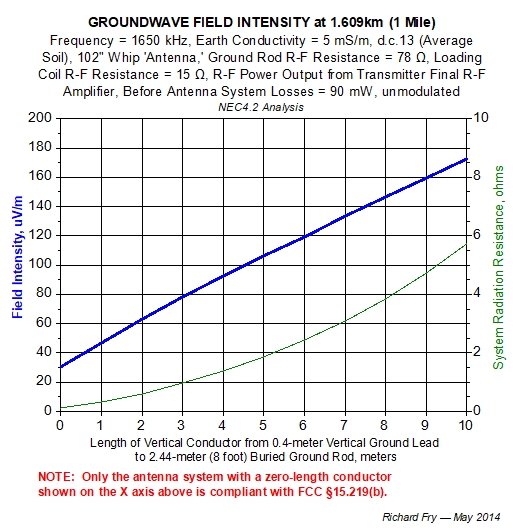
From an earlier post in this thread: "The problem is our Audio Division at the FCC sees the ground wire as a part of the radiator, thinking this increases field strength."
____________
And with good reason, too. Please refer to the graphic below.
Hi Rich,
I've seen this chart before, but I needed to study it a bit. I fully understand what you chart is tell us. There is a large increase in field strength with a longer ground wire, even if we attach that wire to a ground rod 5 to 8 feet deep. My Consultant Engineer look at it and agrees as well.
One fact I wanted to ask you, wouldn't ground conductivity come into play here as well as it did for us Licensed Commercial AM Broadcasters? Where I am at, the FCC map says the ground conductivity is a "4" in level, however one engineer of a Class A, 50 KW Full Time Station told me at a SBE Meeting I once attended he felt like in our area, the ground conductivity was more like a "1" or less, manly because of the limestone rock here. You can go from one acre to another acre of property here, the soil being deep then another acre of property the soil under 3 inches is rock.
The drawing idea for Part 15 AM you had featured in Radio World in June 2020 I felt was great! The transmitter is low to the ground, and your idea of building a ground plane of 8 copper radials will work, in addition, the 102 inch antenna is lower to the ground, hence the chances of the antenna and transmitter getting hit by lightning is decreased in my opinion. My only problem is my wife won't let me dig the backyard up and put the transmitter in the middle of the yard. She might go for it if the radials are not deep and I mount the transmitter near a our concrete patio near the house. For now I'm at a cross roads, Rich. It's not really signal in my situation the problem, as I explained "sort of" in the beginning, it's these severe thunderstorms we get here with lightning with such a charge that the transmitter antenna doesn't have to take a direct hit to be damaged. That's my real problem.
RE:
Wouldn’t ground conductivity come into play here as well as it did for us Licensed Commercial AM Broadcasters?
Yes.
It’s not really signal in my situation the problem, as I explained “sort of” in the beginning, it’s these severe thunderstorms we get here with lightning with such a charge that the transmitter antenna doesn’t have to take a direct hit to be damaged. That’s my real problem.
Some transmitters include internal devices that give some protection from e-m wave transients produced by nearby lightning activity. The transmitter manufacturer could be contacted to investigate this, and/or ask for suggestions about what could be added to a given system and installation configuration to provide it.
Hi Rich,
You are very correct on the ground conductivity! I know you worked many years for Harris (now Gates Air). In 1997, me and my Dad traveled to Quincy, Illinois and bought a Harris (Gates One) Solid State Transmitter. My Dad saw me beating my brains out, spending money on trying to keep a Collins 20V-3 Transmitter running.
We had a coil up in the output network of the Collins that was costing us $250.00 everytime it blew. I had several Consultant Engineers and Hams come to the station to help me figure out what the problem was, but nobody could. I couldn't run the Collins 20V-3 on 1 KW during the day, but I did get it to run 250. Our problem was our Sunday Preachers were complaining about the signal, so that's why we bought the new Harris Solid State Box. We drove Dad's pick up to Quincy, IL, got the new Harris (Gates One) right out of the factory after it was tested, ready to go.
The little Chez Procaster Part 15 Transmitter I have, like others on this forum, I think I was told there is some lightning protection in it, (e-m wave transients perhaps) however we in the layman's world know lightning just doesn't care where it goes.
I'm still impressed by the idea of this Ferrite Choke Coil that Hamilton Rangemaster Transmitter Guy came up (Part # AM1000FER or AM1000FIR) with that takes the ground wire and makes it not a part of the radiator of the antenna system.
I think how the Ferrite Choke Coil works is we take the copper wire at 10 inches from the Part 15 Transmitter, insert this ground wire going to the copper rod, this making the ground wire not be a part of the radiating part of the antenna for the transmitter, but "Only" for electrical grounding only incase the transmitter took a lightning hit. This is the best way I can explain this, if I'm correct. Here is the link on line page below:
https://www.am1000rangemaster.com/radiate.html
Only problem, I was told this was presented to the FCC and was turned down, but that was a rumor I picked up on and I can't get it confirmed. Correct me if I'm wrong.
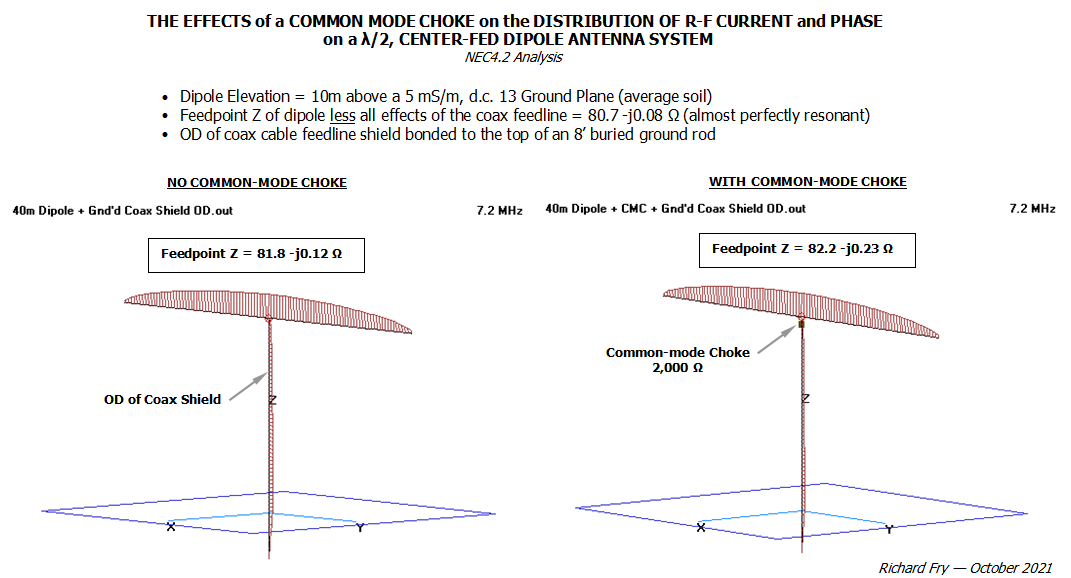
RE: I think how the Ferrite Choke Coil works is we take the copper wire at 10 inches from the Part 15 Transmitter, insert this ground wire going to the copper rod, this making the ground wire not be a part of the radiating part of the antenna for the transmitter, but “Only” for electrical grounding only in case the transmitter took a lightning hit.
_____________
Unfortunately, inserting a typical "choke" near the ungrounded end of a conductor leading to a ground rod from a radiating antenna system does not totally prevent that conductor from radiating — even when lightning transients are not present (see below).
Hi Rich,
I think maybe you have misunderstood where I was asking where to put the Ferrite Filter Choke at. I didn't get a chance to read your full reply post, but this is what I was thinking to make it simple.
Let me reverse what to you what I had in mind to you. Let's take the Chez Procaster. On the bottom on the metal box, it has a lug there to place a ground wire in and screw it down.
We know according to FCC Rule 15.219, the antenna shall not exceed 3 meters, including the ground lead. I think the aluminum antenna on the Chez Procaster is 104 inches. This leaves us 15 inches for a ground wire going from the ground lug on the bottom of the Chez Procaster to some sort of ground, at least this is the way I interpret the rule.
My idea and I would think it is legal we take a seven inch wire, attached it to the lug under the Chez Procaster's ground lug. On the other end of the seven inch wire, we attach the Ferrite Filter Choke. On the other end of the Ferrite Filter Choke, we can use any length and gage of copper wire. We attached the other end to a cold water pipe, copper rod, a galvanized pole that is driven into the ground about three feet.
My thoughts were placing the Ferrite Filter Choke "on the transmitter side" of the ground wire using 6 inches of wire from the lug on the bottom of the Chez Procaster to the Ferrite Filter Choke "THEN" you and me can run a short length of wire to a ground would be fine.
Once again, the short piece of wire going from the Ferrite Filter Choke could go to a cold water pipe, a small copper rod, or a galvanized pipe driven 3 feet into the ground. I would think this be sufficient and acceptable enough to act as a lighting "buffer only" for electrical grounding between the Ferrite Filter Choke and whatever me and you choose to attached the ground wire to. The wire between the Ferrite Filter Choke and to whatever we choose to attached to use for a ground, be it a short 3 foot galvanized galvanized pipe driven into the ground, a short copper ground rod, or a cold water pipe, that wire would be dismissed as a part of the radiator, making it in compliance with Rule 15.219 because we are within the three meter or 118 inch rule for the antenna and wire for ground.