

Weather here in the chilly north is still a bit daunting and the ground a bit frozen to tinker with outdoor antennas. So I decided to start a project towards putting together an inside antenna that might hopefully be a bit better than the 9 ft of wire. Well, and allow for a bit of tinkering.
Even if it doesn't work noticeably better, some of the parts I make and things I learn may apply to an outdoor antenna this summer. And even though I'm viewing is as a temporary sort of rig, some bits of it might be of use to folks with no yard or where there are other reasons an outdoor antenna just isn't in their possible plans right now.
I figured the first hurdle was building a loading coil. Cylinder/solenoid type coils like the ones shown on the SStran website are fairly simple to make and there's been a good bit of discussion and experimentation done with them. But things keep getting mentioned about the internal capacitance between the winds and also the material the coil is wound on being a potential loss factor. I've been reading some of the crystal radio sites and having looked at the types of coils used for those, thought it might be interesting to try a spider web coil.
At least according to what I've read, the spiderweb coil has less of a tendency to internal capacitance because the design results in some space between the windings. Doing some more reading and research on the matter, I happened across Mike Tuggle's way of making a reusable spiderweb coil form from an AOL CD.
http://www.crystalradio.net/spiderweb/index.shtml
Even more interesting, since the former is removed after the coil is wound and built, it is an air core coil. Hopefully that will give a bit lower loss.
I don't have litz wire around (and no local place carries it), but many of the antenna coils I've seen pics of here weren't wound with litz. So I decided to opt for inexpensive magnet wire from Radio Shack for the experiment. I bought two packages of their infamous 3 spool packs of "Assorted enamel coated magnet wire."
Next it was time to cut up an old AOL cd. Simple in theory, but in practice it's more of a pain in the neck than you might think. I ended up using the dremel and a cutoff wheel and scraping and sanding off the burrs from molten plastic to get the edges good and smooth. Rather than Mike Tuggle's 9 vane form, I calculated the angle (approx 51 degrees) for a 7 vane one like the non-reusable coil form on the "Professor Coyle" calculator pages since that is where I'd been playing with numbers for turns at different gauges.
http://www.crystalradio.net/professorcoyle/professorcoylespiderweb.shtml
Ok, a trip to the hardware store to get a big bold and nut and some washers so I could cobble together my coil for with an inside diameter of 2 inches (default on Professor Coyle) and plenty of space for the turns. And I was ready to wind.

My first attempt was using 50 turns of 26 gauge wire. It did not come out well. The 26 gauge was maybe a bit too flexible for this form or maybe I just needed a practice run. The turns were inconsistent, and while I might try hooking it to a tuning capacitor and a diode sometime and see what it can pick up, I felt it'd be a waste of time to try building an antenna around it. Especially after gluing it and removing it from the form, it just seemed too fragile to be good for the job and the winds were way too movable.
So I recalculated for 22 gauge wire, saw that there'd be just about enough on the radio shack spool to do the job and tried again. 45 turns for 207 uH, which with a capacitance of 150 pF (approx the middle of the range of the tuning capcitor I have handy) should tune to just under 1 Mhz. The upper range would go well beyond the top of the AM band and the lower range would be very close to the bottom of the band. Plenty of potential for tinkering.

After I'd wound it, I measured it with a ruler and checked it against the size predicted on Professor Coyle, and crap.. Outer diameter was smaller than it should be. But I recalled reading something about a difference when when thin gauge wire is wound on a spiderweb and found a mention on Dave Schmarder's crystal radio site..
http://www.schmarder.com/radios/misc-stuff/spider.htm
"When winding spider coils with thin wire strand gauge size such as the 660/46, there was a difference found between the calculated coil depth (wire diameter times number of turns) and what the coil actually turned out to be. This drove a couple of us nuts until it was discovered that when a spider coil with litz is wound, the windings are compressed at the crossing points.
It was found that the diameter worked out to 15 to 18 percent less than the manufacturers data. This is not a problem in cylinder coils, only the spider coils. So instead of using 0.055 inches as a diameter, 0.048 was used.
Reducing the value of the wire diameter by 15% will give you a closer value of the outside diameter of the coil and a closer tolerance on the coil. Plugging in the two values (.055 vs .048) only makes about a 1.5% difference in the coil inductance. The wire length and outside diameter change quite a bit using the different diameters. Make the spreadsheet and plug in the numbers and check it out for yourself. "
I applied the 15% reduction to the wire diameter and recalculated on Professor Coyle and the coil *is* just about that size (though I am using single strand, not litz). Considering how close that adjustment brought the estimate to the actual measurement on the completed coil, I suspect it's the same reason. It only changes the inductance by a few uH, so the coil should still do well enough for antenna loading experiments.
But in any case, the slightly heavier gauge wire gave a much better result, and the wire is physically solid enough to allow adjusting the turns a bit by hand (note the high tech tool whittled from a popsicle stick you see in the pic). So I'll fuss over it for a bit making sure the winds are all reasonable even and then glue it up. In the meantime I'm keeping an eye out around the house for something like a plastic box to mount it in, since it would be more prone to damage than a solenoid type coil wound on PVC, for example. But mounted inside something that can be waterproofed that's big enough to keep the walls of the container at least an inch from the winds of the coil, I think it'll probably do ok. I'm thinking maybe a modified food container like tupperware or similar.
After I'm satisfied with the turns being reasonably evenly spaced, I'll put a bead of glue where the turns cross in the slots between the vanes, let it harden, loosen the bolt and pull out the vanes of the form and I have my air-core spiderweb coil. I already have a nice little air varaible capacitor I pulled out of an old stereo and cleaned up and tested, so next steps will be figuring out the rest of the antenna system.
Theoretically it should be lower loss than the usual sort of loading coil most folks are using with the SStran, and we'll see how it works in due time.
This is the first time I'd ever tried winding this type of coil, but after the first one and going to a slightly more substantial gauge of wire, I'd say it's actually easier then winding a large solenoid type coil. The form is easy to keep tension on and doesn't "spring loose" if you let go of it for a second, and it's not that many turns anyway.
For anyone on a tight budget or who might be dreading winding the usual loading coil or just wants "something different" to experiment with during a fit of "cabin fever", it's an interesting little coil to make.
Daniel

There were a couple pics of the jig and coil that I tried to paste into the first message via HTML, but apparently I messed it up somehow. The html looks right to me, but maybe I've been sitting here too many hours. LOL
If admin has a spare (like that ever happens) minute to look at it, that'd be cool, otherwise I'll see if I can puzzle it out later.
Daniel
There were a couple pics of the jig and coil that I tried to paste into the first message via HTML, but apparently I messed it up somehow. The html looks right to me, but maybe I've been sitting here too many hours. LOL
If admin has a spare (like that ever happens) minute to look at it, that'd be cool, otherwise I'll see if I can puzzle it out later.
Daniel
At the bottom of the comment bucket you will see a little web 2.0 clickable that looks like this:

If you would like to use HTML structure tags like img src, just click the "input" variable and set for full HTML

I am constantly forgetting to do that, too. Then I say the same thing to myself "???," and remeber I need to change the input format radio button 🙂
Experimental broadcasting for a better tomorrow!
At the bottom of the comment bucket you will see a little web 2.0 clickable that looks like this:
If you would like to use HTML structure tags like img src, just click the "input" variable and set for full HTML
I am constantly forgetting to do that, too. Then I say the same thing to myself "???," and remeber I need to change the input format radio button 🙂
Experimental broadcasting for a better tomorrow!
Rattan,
If you have the test equipment to do so, I would urge you to measure the inductance and Q of your very interesting coil. The coil form and coil look very nice in the pictures. Testing your coil only with a transmitter would really not give very much information.
To measure Q, it would be very good to have a Q meter, but that is not at all necessary. Very good results can be obtained with an RF signal generator, a frequency counter, and an oscilloscope with a 1X probe. Other recent posts in this Forum describe a Q measurement method of Ben Tongue (of Blonder-Tongue fame,) which gives excellent results.
It is useful to also determine the low-frequency inductance of the coil. If the coil is cylindrical, and not too short, the well-known Wheeler formula can be used to get very accurate results. This famous formula is of the form L = [(r^2)(n^2)]/(9r + 10l). It is in a great many publications, including the ARRL Handbook. When looking for the formula, don't look for Wheeler's name. For some reason, he is usually not given the credit for his formula, which he published in 1928. He continued publishing inductance formulas for a long time. I saw a 1982 (or thereabouts) edition of the PIEEE in which he reported several additional inductance formulas.
The coil described in your thread is is not cylindrical, so the Wheeler formula does not apply. In this case, the coil can be resonated with a large known capacitor at an audio frequency, using a variable audio generator, and an oscilloscope to detect resonance. I use the frequency counter function of my DMM to accurately measure the audio frequency. Using the operating frequency inductance and the low-frequency inductance, the self-capacitance of the coil can be calculated.
I am currently measuring several kinds of coils to gain a general understanding of loading coils. For my tests, I have purchased many styrofoam cylinders of various sizes from an art supply store. I am using both Litz wire and solid wire. Because the styrofoam forms are rather fragile, I am reinforcing the surface of each cylinder with polyethylene tape. Both polystyrene and polyethylene have low dissipation factors compared to PVC, so they should be good to use as coil forms. I am not trying to design practical loading coils right now. I am just trying to gain knowledge.
I will begin posting my results only after completing all of my tests, so that I can report general trends and conclusions. It would not be very helpful to just report my raw data.
There has been some discussion in this Forum about Qs to 1500. I don't think that there is any possibility of the coil Q being nearly this high. I hope that I am wrong, however. A very-high-Q coil would make it possible to make a VLF oscillator with much lower noise than has been yet obtained. Such an oscillator would be very useful in another application that I am working on, which is not directly related to radio.
Rattan,
If you have the test equipment to do so, I would urge you to measure the inductance and Q of your very interesting coil. The coil form and coil look very nice in the pictures. Testing your coil only with a transmitter would really not give very much information.
To measure Q, it would be very good to have a Q meter, but that is not at all necessary. Very good results can be obtained with an RF signal generator, a frequency counter, and an oscilloscope with a 1X probe. Other recent posts in this Forum describe a Q measurement method of Ben Tongue (of Blonder-Tongue fame,) which gives excellent results.
It is useful to also determine the low-frequency inductance of the coil. If the coil is cylindrical, and not too short, the well-known Wheeler formula can be used to get very accurate results. This famous formula is of the form L = [(r^2)(n^2)]/(9r + 10l). It is in a great many publications, including the ARRL Handbook. When looking for the formula, don't look for Wheeler's name. For some reason, he is usually not given the credit for his formula, which he published in 1928. He continued publishing inductance formulas for a long time. I saw a 1982 (or thereabouts) edition of the PIEEE in which he reported several additional inductance formulas.
The coil described in your thread is is not cylindrical, so the Wheeler formula does not apply. In this case, the coil can be resonated with a large known capacitor at an audio frequency, using a variable audio generator, and an oscilloscope to detect resonance. I use the frequency counter function of my DMM to accurately measure the audio frequency. Using the operating frequency inductance and the low-frequency inductance, the self-capacitance of the coil can be calculated.
I am currently measuring several kinds of coils to gain a general understanding of loading coils. For my tests, I have purchased many styrofoam cylinders of various sizes from an art supply store. I am using both Litz wire and solid wire. Because the styrofoam forms are rather fragile, I am reinforcing the surface of each cylinder with polyethylene tape. Both polystyrene and polyethylene have low dissipation factors compared to PVC, so they should be good to use as coil forms. I am not trying to design practical loading coils right now. I am just trying to gain knowledge.
I will begin posting my results only after completing all of my tests, so that I can report general trends and conclusions. It would not be very helpful to just report my raw data.
There has been some discussion in this Forum about Qs to 1500. I don't think that there is any possibility of the coil Q being nearly this high. I hope that I am wrong, however. A very-high-Q coil would make it possible to make a VLF oscillator with much lower noise than has been yet obtained. Such an oscillator would be very useful in another application that I am working on, which is not directly related to radio.
I am delighted that several of you picked up on the excellent coil information over on the crystal set web sites. We even got a new member-- Mr. Macrohenrydyne himself!
Gentlemen; you will not be disappointed! These improved coil designs will make a huge difference in the performance of your station. Especially for those of you using indoor antennas. I know!
I still haven't had time to wind my toroid with litz wire from Schmarder... too many meetings out of town! But it will happen eventually.
WEAK-AM
Classical Music and More!
I am delighted that several of you picked up on the excellent coil information over on the crystal set web sites. We even got a new member-- Mr. Macrohenrydyne himself!
Gentlemen; you will not be disappointed! These improved coil designs will make a huge difference in the performance of your station. Especially for those of you using indoor antennas. I know!
I still haven't had time to wind my toroid with litz wire from Schmarder... too many meetings out of town! But it will happen eventually.
WEAK-AM
Classical Music and More!
I may see what I can do for that sort of measurement a little down the road, Ermi Roos. But at the moment I don't have the exact gear to do either measurement for the Q or the low frequency inductance. I'll give it some thought and see what I can maybe improvise.
So far as coils with a Q in the 1500 range, while they might be possible, I rather doubt they could be knocked off in an evening with wire from radio shack and an old CD one has chopped up. But this approach does lend itself well to the hobbyist of limited means who might like to tinker a bit with a different sort of coil.
I mentioned in my first post that I had serious doubts as to whether the first attempt at the spiderweb coil using 26 gauge wire would be very practical for a loading coil. The wire is just too thin and flexible to be my idea of stable enough and the turns move under your fingers when it's handled after the coil has been glued up and removed from the form. But for the sake of thoroughness, I measured the coil anyway with my capacitance/inductance/resistance meter. It actually measured very close to the predicted inductance, and light handling did not change the value.
(sorry scwis, I'm not seeing the clickable you referred to, though I think I'm looking at the place it would be. So I'll just paste in the addresses for the pics so they can be clicked.)
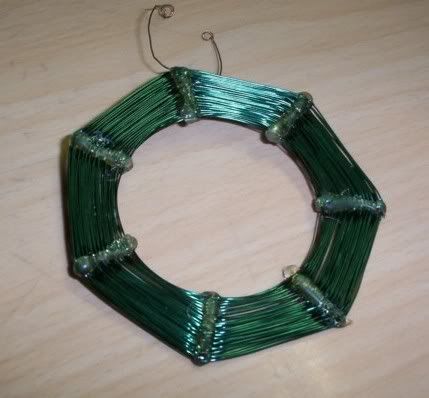
DC Ohms: 2.6
Measured Inductance: 246 uH
Predicted Inductance: 241.5 uH
It'd be at least workable, and probably better than no loading coil at all. But I personally found it difficult to get the winds anything like evenly spaced, and the sloppiness would almost certainly take down the efficiency.
The second was done with 22 gauge wire and I feel it came out better.
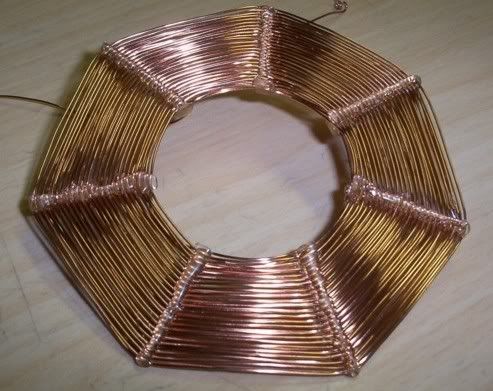
DC Ohms: .7
Measured Inductance: 209
Predicted Inductance: 207.7
I wasn't shooting for exactly the same inductance with the two coils, since there wasn't quite enough wire on the 22 gauge spool to manage it with the same form and I felt it was acceptable to give up a bit at the very low edge of the band that I likely wouldn't use anyway rather than splice/solder on more wire.
Here's a pic (not the best I've ever taken, but hopefully enough to give the idea) taken showing the edge of coil 2 so anyone who hasn't looked at one of these coils can (hopefully) see how there's space between adjacent winds. When looking straight on to the "surface" of the coil, what appear to be adjacent turns are actually "every other turn".
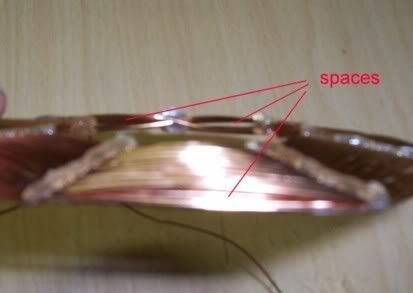
I *think* the 22 gauge version (coil 2) is physically robust enough for reasonable use in experiments. The 26 gauge (coil 1) might be usable , but the DC resistance being considerably higher is obviously not desirable. But either version can be put together out of the ubiquitous Radio Shack's infamous 5$ package of "assorted enamel coated magnet wire" an old CD and some odds and ends of hardware likely to be in most toolboxes and a bit of glue.
Now, the DC resistance is interesting, since to make the original SStran loading coil would take about 80 ft of wire by my estimate.. a spiderweb coil made in this way only takes about 40 ft. So if one was using the same gauge wire, that would be about half the DC resistance to get to the same inductance. Theoretically the Q is higher for the air core spiderweb coil, but even if it is not significantly so, the lower DC resistance could be of interest.
Spider web coils can also be tapped, of course, though I made mine without and plan on trying just tuning it with a capacitor for at least my initial experiments with using it as a loading coil.
Daniel
I may see what I can do for that sort of measurement a little down the road, Ermi Roos. But at the moment I don't have the exact gear to do either measurement for the Q or the low frequency inductance. I'll give it some thought and see what I can maybe improvise.
So far as coils with a Q in the 1500 range, while they might be possible, I rather doubt they could be knocked off in an evening with wire from radio shack and an old CD one has chopped up. But this approach does lend itself well to the hobbyist of limited means who might like to tinker a bit with a different sort of coil.
I mentioned in my first post that I had serious doubts as to whether the first attempt at the spiderweb coil using 26 gauge wire would be very practical for a loading coil. The wire is just too thin and flexible to be my idea of stable enough and the turns move under your fingers when it's handled after the coil has been glued up and removed from the form. But for the sake of thoroughness, I measured the coil anyway with my capacitance/inductance/resistance meter. It actually measured very close to the predicted inductance, and light handling did not change the value.
(sorry scwis, I'm not seeing the clickable you referred to, though I think I'm looking at the place it would be. So I'll just paste in the addresses for the pics so they can be clicked.)
DC Ohms: 2.6
Measured Inductance: 246 uH
Predicted Inductance: 241.5 uH
It'd be at least workable, and probably better than no loading coil at all. But I personally found it difficult to get the winds anything like evenly spaced, and the sloppiness would almost certainly take down the efficiency.
The second was done with 22 gauge wire and I feel it came out better.
DC Ohms: .7
Measured Inductance: 209
Predicted Inductance: 207.7
I wasn't shooting for exactly the same inductance with the two coils, since there wasn't quite enough wire on the 22 gauge spool to manage it with the same form and I felt it was acceptable to give up a bit at the very low edge of the band that I likely wouldn't use anyway rather than splice/solder on more wire.
Here's a pic (not the best I've ever taken, but hopefully enough to give the idea) taken showing the edge of coil 2 so anyone who hasn't looked at one of these coils can (hopefully) see how there's space between adjacent winds. When looking straight on to the "surface" of the coil, what appear to be adjacent turns are actually "every other turn".
I *think* the 22 gauge version (coil 2) is physically robust enough for reasonable use in experiments. The 26 gauge (coil 1) might be usable , but the DC resistance being considerably higher is obviously not desirable. But either version can be put together out of the ubiquitous Radio Shack's infamous 5$ package of "assorted enamel coated magnet wire" an old CD and some odds and ends of hardware likely to be in most toolboxes and a bit of glue.
Now, the DC resistance is interesting, since to make the original SStran loading coil would take about 80 ft of wire by my estimate.. a spiderweb coil made in this way only takes about 40 ft. So if one was using the same gauge wire, that would be about half the DC resistance to get to the same inductance. Theoretically the Q is higher for the air core spiderweb coil, but even if it is not significantly so, the lower DC resistance could be of interest.
Spider web coils can also be tapped, of course, though I made mine without and plan on trying just tuning it with a capacitor for at least my initial experiments with using it as a loading coil.
Daniel
Daniel,
Thanks much for your willingness to share your adventures and for the great writeups with pics. Some of the best technical advances happen when investigators share the step by step investigations during development rather than waiting until everything is perfect and polished. For example, anyone wanting to follow your lead knows the small wire is not optimum and can save $$$ and time. You also are getting feedback which we all hope is useful.
Regarding Litz wire, you probably know that the DC resistance doesn't tell much other than the AC resistance has to be greater than this number, thus the smaller the better. Litz wire is intended to lower the AC resistance. A source I used in the 50's and 60's (yes I know I sound younger when I type) was old radios and TVs. Console radios built in the 30's used regular enameled wire in the coils but in the 50's most table top radios used Litz wire both for IF coils and for antennae. The antennae were commonly spider web wound (as you are doing) on the Masonite back cover plate. Transistor portables from the 60's and later which used ferrite rod antennas also had Litz wire wound on the rods. These are probably easier to obtain as junkers. Maybe for a few bucks at an antique mall one could find such a treasure, but if it works or is repairable and is old enough it would be a crime against antiques to tear it apart for the Litz. The IF coils in these radios are usually dipped in beeswax and it is easy to retrieve the Litz wire with a little gentle heating. Also if you have never soldered to Litz wire, you are in for a great adventure when you attempt to do so. Just some thoughts and keep us posted.
Neil
Daniel,
Thanks much for your willingness to share your adventures and for the great writeups with pics. Some of the best technical advances happen when investigators share the step by step investigations during development rather than waiting until everything is perfect and polished. For example, anyone wanting to follow your lead knows the small wire is not optimum and can save $$$ and time. You also are getting feedback which we all hope is useful.
Regarding Litz wire, you probably know that the DC resistance doesn't tell much other than the AC resistance has to be greater than this number, thus the smaller the better. Litz wire is intended to lower the AC resistance. A source I used in the 50's and 60's (yes I know I sound younger when I type) was old radios and TVs. Console radios built in the 30's used regular enameled wire in the coils but in the 50's most table top radios used Litz wire both for IF coils and for antennae. The antennae were commonly spider web wound (as you are doing) on the Masonite back cover plate. Transistor portables from the 60's and later which used ferrite rod antennas also had Litz wire wound on the rods. These are probably easier to obtain as junkers. Maybe for a few bucks at an antique mall one could find such a treasure, but if it works or is repairable and is old enough it would be a crime against antiques to tear it apart for the Litz. The IF coils in these radios are usually dipped in beeswax and it is easy to retrieve the Litz wire with a little gentle heating. Also if you have never soldered to Litz wire, you are in for a great adventure when you attempt to do so. Just some thoughts and keep us posted.
Neil
I've been interested in high Q coils for several years. Following are some attributes of the highest Q coils (for MW) I've made note of from various studies:
1. Solenoid coils with length/dia between 1:1 and 2:1 have the highest Q of any other geometry, including spiderweb coils
2. For solid (magnet) wire, spacing the wire one wire thickness results in the highest Q. To my knowledge, this been studied only in integer wire spacing, not fractional wire spacing. Suffice it to say, spaced magnet wire results in higher Q than non-spaced. Spacing wire makes much less difference with Litz, as distributed capacitance is already minimized in Litz wire. So Litz wire can be close wound with little loss.
3. Coil forms of HDPE (high density polyethylene) , PP (polypropylene), or polystyrene have lowest loss. PVC is high loss. If it gets warm in a microwave oven, it's high loss.
4. For crystal radio use, optimum coil diameter is 3.5"-4.5". Anything above 6" in diameter starts acting like a loop antenna, receiving local radio signals. I don't know if this is detrimental to loading coil use.
5. Maximum Q using magnet wire with the above procedures can be in the 400-500 range. Changing to Litz yields Q of 800-1000. Using special combinations of ferrite bars and Litz, Q can be 1500 and above.
6. When measuring Q with Ben Tongue's method, a high quality scope probe is necessary. On my old Heathkit scope, I didn't measure Q in the 1000 range until I built Dick Kleijer's high impedance low capacitance scope amplifier. It doesn't take much to load a coil where Q drops significantly. When measuring Q in the 1000 range, no objects, metal or otherwise, should be near the measured coil. Even 8" away can drop measured Q by 100 or more. A link to Dick's page is the third below.
There is a current Spiderweb coil thread on another forum, showing recently achieved high Q. See first link below:
There is another type of air spaced coil that is intend to be high Q, similar to Mike Tuggle's coils. These are called "rook" coils, because the coil form looks like the top af a rook chess piece. The second link below is to an almost defunct website devoted to rook coils. My rook coil measurements are 100-200 points below my best solenoid coils.
Macrohenry
http://www.midnightscience.com/rapntap/topic.asp?topic_id=4872&forum_id=10&Topic_Title=Spider+Coil+Optimum+Q&forum_title=Crystal+Radio+Think+Tank+%2A%2A+Advanced+Forum&M=False&S=True
http://groups.yahoo.com/group/RookCoils/
http://www.crystal-radio.eu/enqmeting.htm
I've been interested in high Q coils for several years. Following are some attributes of the highest Q coils (for MW) I've made note of from various studies:
1. Solenoid coils with length/dia between 1:1 and 2:1 have the highest Q of any other geometry, including spiderweb coils
2. For solid (magnet) wire, spacing the wire one wire thickness results in the highest Q. To my knowledge, this been studied only in integer wire spacing, not fractional wire spacing. Suffice it to say, spaced magnet wire results in higher Q than non-spaced. Spacing wire makes much less difference with Litz, as distributed capacitance is already minimized in Litz wire. So Litz wire can be close wound with little loss.
3. Coil forms of HDPE (high density polyethylene) , PP (polypropylene), or polystyrene have lowest loss. PVC is high loss. If it gets warm in a microwave oven, it's high loss.
4. For crystal radio use, optimum coil diameter is 3.5"-4.5". Anything above 6" in diameter starts acting like a loop antenna, receiving local radio signals. I don't know if this is detrimental to loading coil use.
5. Maximum Q using magnet wire with the above procedures can be in the 400-500 range. Changing to Litz yields Q of 800-1000. Using special combinations of ferrite bars and Litz, Q can be 1500 and above.
6. When measuring Q with Ben Tongue's method, a high quality scope probe is necessary. On my old Heathkit scope, I didn't measure Q in the 1000 range until I built Dick Kleijer's high impedance low capacitance scope amplifier. It doesn't take much to load a coil where Q drops significantly. When measuring Q in the 1000 range, no objects, metal or otherwise, should be near the measured coil. Even 8" away can drop measured Q by 100 or more. A link to Dick's page is the third below.
There is a current Spiderweb coil thread on another forum, showing recently achieved high Q. See first link below:
There is another type of air spaced coil that is intend to be high Q, similar to Mike Tuggle's coils. These are called "rook" coils, because the coil form looks like the top af a rook chess piece. The second link below is to an almost defunct website devoted to rook coils. My rook coil measurements are 100-200 points below my best solenoid coils.
Macrohenry
http://www.midnightscience.com/rapntap/topic.asp?topic_id=4872&forum_id=10&Topic_Title=Spider+Coil+Optimum+Q&forum_title=Crystal+Radio+Think+Tank+%2A%2A+Advanced+Forum&M=False&S=True
http://groups.yahoo.com/group/RookCoils/
http://www.crystal-radio.eu/enqmeting.htm