

I recall a here sometime back (and more than once) where we were discussing the affects of weather conditions on our signals....Well, the other night I somehow managed to fall into a US Navy training manual about Radio Wave Propagation, and a specific topic "WEATHER VERSUS PROPAGATION", which I'll get to in just a moment.
But first I want to jump back (in the manual) to chapter 1 http://www.navymars.org/national/training/nmo_courses/NMO1/module10/14182_ch1.pdf which worded what I consider to be a rather delightful introduction to their course:
========================================
CHAPTER 1
WAVE PROPAGATION
INTRODUCTION TO WAVE PROPAGATION
Of the many technical subjects that naval personnel are expected to know, probably the one least susceptible to change is the theory of wave propagation. The basic principles that enable waves to be propagated (transmitted) through space are the same today as they were 70 years ago.
One would think, then, that a thorough understanding of these principles is a relatively simple task. For the electrical engineer or the individual with a natural curiosity for the unknown, it is indeed a simple task.
Most technicians, however, tend to view wave propagation as something complex and confusing, and would just as soon see this chapter completely disappear from training manuals. This attitude undoubtedly stems from the fact that wave propagation is an invisible force that cannot be detected by the sense of sight or touch. Understanding wave propagation requires the use of the imagination to visualize the associated concepts and how they are used in practical application. This manual was developed to help you visualize and understand those concepts. Through ample use of illustrations and a step-by-step transition from the simple to the complex, we will help you develop a better understanding of wave propagation. In this chapter, we will discuss propagation theory on an introductory level, without going into the technical details that concern the engineer. However, you must still use thought and imagination to understand the new ideas and concepts as they are presented.
=======================================
I really liked the way whoever wrote that wrote it! -- The whole manual is written in such a way that even someone like me who has little more than a hazy understanding about the mechanics of radio can comprehend.
I jumped around the manual reading for about an hour, then downloaded both chapters 1 and 2 so I could come back to it later.
Anyway the following about how weather affects radio waves, is found in the middle of chapter 2 on page Page 2-34, here's part of it..
http://www.navymars.org/national/training/nmo_courses/NMO1/module10/14182_ch2.pdf

WEATHER VERSUS PROPAGATION
Weather is an additional factor that affects the propagation of radio waves. In this section, we will explain how and to what extent the various weather phenomena affect wave propagation.
Wind, air temperature, and water content of the atmosphere can combine in many ways. Certain combinations can cause radio signals to be heard hundreds of miles beyond the ordinary range of radio communications. Conversely, a different combination of factors can cause such attenuation of the signal that it may not be heard even over a normally satisfactory path. Unfortunately, there are no hard and fast rules on the effects of weather on radio transmissions since the weather is extremely complex and subject to frequent change. We will, therefore, limit our discussion on the effects of weather on radio waves to general terms....
PRECIPITATION ATTENUATION
Calculating the effect of weather on radio wave propagation would be comparatively simple if there were no water or water vapor in the atmosphere. However, some form of water (vapor, liquid, or solid) is always present and must be considered in all calculations. Before we begin discussing the specific effects that individual forms of precipitation (rain, snow, fog) have on radio waves, you should understand that attenuation because of precipitation is generally proportionate to the frequency and wavelength of the radio wave. For example, rain has a pronounced effect on waves at microwave frequencies. However, rain hardly affects waves with long wavelengths (hf range and below). You can assume, then, that as the wavelength becomes shorter with increases in frequency, precipitation has an increasingly important attenuation effect on radio waves. Conversely, you can assume that as the wavelength becomes longer with decreases in frequency, precipitation has little attenuation effect.
Rain
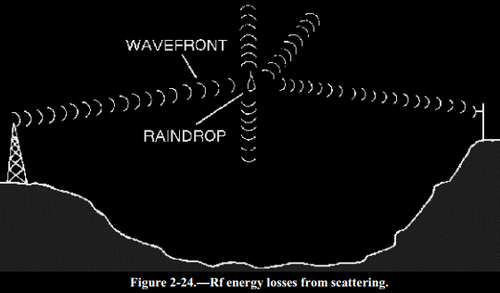
Attenuation because of raindrops is greater than attenuation because of other forms of precipitation. Attenuation may be caused by absorption, in which the raindrop, acting as a poor dielectric, absorbs power from the radio wave and dissipates the power by heat loss or by scattering (fig. 2-24). Raindrops cause greater attenuation by scattering than by absorption at frequencies above 100 megahertz. At frequencies above 6 gigahertz, attenuation by raindrop scatter is even greater.
It continues on from there discussing fog, snow, and hail.. But I got tired of reading, so I saved the pdf for another day. Thought some of you might be interested in grabbing a copy as well.
Links to the pdfs are above

Gotta make more space in the head for this fascinating new (to me) information about weather and electromagnetic radiation.
It will be printed out and filed along with Part 15 Rules and all the transmitter documentation.
Hey! Remember those Heathkit Weather Stations that allowed setting up some detection equipment up on a weather vane and a control panel in the house to see temperature, humidity, barometric pressure, wind direction and speed?
Does anybody make one of those today? Something to add to the Part 15 transmitter shed.
Instead of a weather vane maybe the detectors could be on top of the 10-foot pole?
I've had several of those great old Heathkits -- they were huge by todays standards, with big bright red LED numbers!
Replaced my last one (years ago) with a Davis weather station. Had all the same functions and easily tied into my computer to save data and share it on the internet via Weather Underground and other weather web sites. Haven't messed with one for years, but if you quick search for weather computers or weather stations you'll find a bunch.
they're not cheap, but nothing is these days. Not only that, but the new ones the whole remote station (weather vane, wind speed spinner, temp sensors, etc) all connect wirelessly to the base unit (via Part 15 compliant signal LOL) so you don't have tu run a huge multiline cable anymore!
tim in Bovey
Found the first weather station of the day, from MCM, for $200. Looks good.
http://www.mcmelectronics.com/product/72-10698
I started to reply to this, but then it
got lost somewhere (probably here.)
The weather stuff is wonderful, BUT
I really wanted to comment on the
PROPAGATION angle. (No pun intended.)
Growing up in West Hartford, Connecticut,
I became facinated by RF propagation at
a very early age.
I could not understand why WJAR, channel 10
in Providence, RI would come blasting in with
a perfect TV picture every once in a while. This was
about 1963. Usually channel 10 was "blank" with
just "snow." The VHF channels in Hartford then were just 3 and 8.
So what was going on?
This lead to a lifetime facination of radio wave propagation.
That included: TV DXing first, then AM DXing, CB, FM DXing,
ham radio (160M up through the "1296" MHz band,) Part 15 radio,
Longwave radio, radio controlled stuff, a little IR experimenting.
scanner listening, and I guess some other stuff(???)
This info above looks like wonderful reading and I'm
going to check it out.
I just wanted to leave this comment first.
Bruce, DOGRADIO