

All right... self hypnosis time... triggered by Neil's suggesting secondary voltage being too high. All right. I put in that 5k variable and twiddled it all the way up and down. That's probably when Q2 blew.
My intuition did not sense any heating from Q2, and a few times I "laid thumb" on the metal and did not get burned.
This has been another "Confessions of a Scopeless Case."
O.K. I have a factory sealed GE-20 transistor, no longer available, eqivalent with Phillips ECG 123A, and IT HAS THE SAME SPECS AS the burned out 2N2222A ! One of life's great second chances!
And this time the scope MUST be utilized. We are open on Thanksgiving because I'm not thankful, so we'll be doing transmitter work this whole week.
No signal is too small.
Neil, Radio8Z, when trying a diode from Q2 base to ground should L1 be in-circuit or removed?
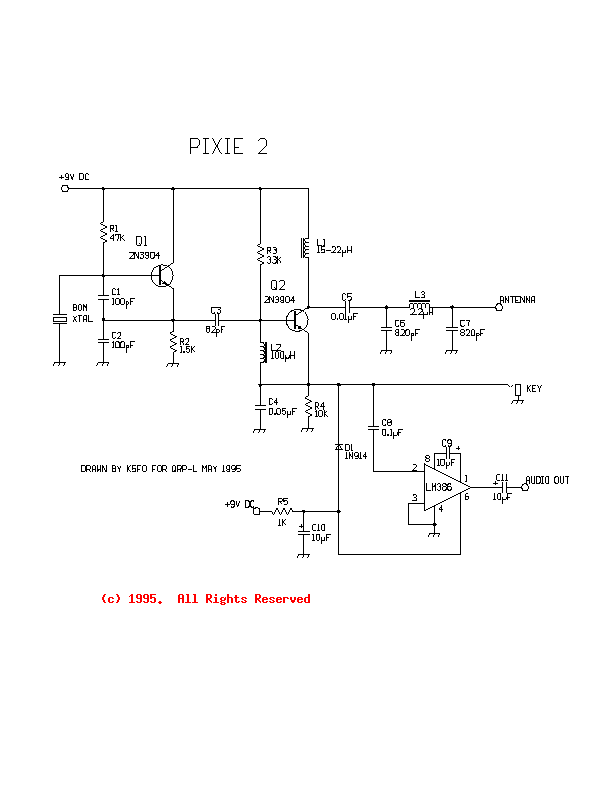
Am back to Square 2, replaced Q2 and have strong carrier, now wired exact to the Pixie2 diagram so I can continue from this point. Have put a heat sink on Q2.
Modulation Report: while transmitter is powered on there is no audio modulation. When the transmitter is turned off, during the few seconds while the electrolytics discharge the modulation (which is on a separate power supply) starts to be heard, albeit, raspy, until all carrier power is gone. This suggests to me that at the junction of mixing, likely at the collector of Q2, the carrier is much stronger than the modulation getting through L2.
Next Experiment: As suggested by Radio8Z, will parallel L2 with a cap both to resonate at that point and to bypass the audio across L2; and a cap from the junction of T1/L2 to ground so as to shunt RF from getting up to T1.
Remarks welcome.
Please don't miss my last posting on this thread, radio8z, there's an important question.
Today while monitoring the 13.56 mHz region during testing, I discovered a clearly received neighbor at 13.57 mHz, WINB, Red Lion, PA, which uses that freq. from 1100 - 1700 UTC.
I've found another QRP/AM Link, and although it's for 7 watts, it can be used for learning and of course modified for Part 15.
http://www.qsl.net/vu2msy/homebrew/VU2VWN_7MHz_AM_CW_QRP_TX.pdf
Hi Neil and Carl and everybody!
Here's a few small things.
Neil, thanks for the info on the class C
operation. It helped me understand what
is going on here more.
I have had serious vision problems all my life
and I have never been a broadcast engineer
like you guys. Thinking about this 13 MHz transmitter
project and working on my AM system on 1690
and 1700 kHz (over a few years) has been a nice
education.
Carl, that's great you're back to square two. Maybe
you're farther along now.
I went to Radio Shack today. I was looking for
something to use as a modulation transformer.
They don't carry ANY transformers in the local
store now. (They are available on the Radio
Shack online service.) Also, I was looking for
a simple perf board to build the final version of
the 13 MHz transmitter. They don't have those
anymore either. They do have boards with holes
that are surrounded have small metal areas
around them that are also circular. (I guess this
is for soldering chips and such.) I bought one
of those but I wonder if that metal will effect the
circuit's RF characteristics? (I think it probably won't.)
Any ideas on
that? These boards have a specific name, but I
can't remember what it is.
So I'm going to have to pull a transformer out of
an old radio somewhere. That's fine.
Carl, you mentioned hearing WINB right next door
to 13.560. That station has been around for a long
long time, but I'm sure you know that.
Thanks so much guys. I am really enjoying this!
Bruce MICRO1690/1700
Leave L1 in the circuit.
The purpose of the diode is a bit hard to explain but what it does is establish a DC voltage across C3 such that more of the signal is coupled to the base hence driving Q2 hard into saturation.
Few realize that the base to emitter diode of a bipolar junction transistor when reverse biased acts as a Zener with a voltage of about 5 volts. The diode reduces this to about .7 volt which lowers the voltage across C3 which the signal has to overcome. I still wonder about the function of R4 and still am not sure this is intended to be a Class C circuit as I am trying to make it. Could be the wrong tree to climb but worth a try.
Your power down observation is interesting and would indicate that there is not the proper relationship between the transformer secondary voltage and the circuit bias condition.
Neil
Neil,
You still haven't told me whether to keep L1 when trying the diode.
Also, I'm assuming R3 will stay in with the diode. I can't try it until I get your suggestion.
Also, I tried the cap (I used 470pF) across L2 with an RF cap from T1/L1 to ground, but no change at all in performance. Also, in effect, both caps act in series and probably reduce the RF all the way back to the collector of Q2 (true?)
MICRO1700
You are repeating my foot steps with Radio Shack. I looked at one of those circuit boards and didn't understand it. In earlier postings I mentioned getting almost everything from jameco.com, except for the crystal. I got the little peg-board type card with pins that plug into the holes and have used those for every project over the years. By the way, the two 270pF caps for the output filter circuit were only available as those ultra-miniature surface mount types, which are almost impossible to solder because they're so tiny. There's probably someplace that has bigger size caps of that value, or maybe 250pF would be close enough.
Previously it was said that L1 is hi-impedance at RF but perhaps it's bringing the base (Q2) too close to ground where the modulation is concerned, thus blocking it.
And I get the impression that Q2 isn't amplifying the RF in particular, it seems to be passing it along without boost.
BULLETIN INTERRUPTION - I'm glad this window is still open because I just tried something which may be telling us something. With the power to the modulator ON and the power to the transmitter OFF I attached the clip-leads from my signal tracer, which is a small amp and loudspeaker, to the B+ side of T1 and the BASE of Q2 - The result... very garbled audio!
Yes, Neil. The biasing at the base seems totally wrong! Is this a fair interpretation of what I described?
I've been lucky to find the original CW version of Pixie2 and there's a lot to learn from studying it.
One thing I'm assuming post haste is that it is rated at 9 volts and not 12 volts.
Carl,
I thought I did answer your question in my last post. If you are going to try the diode idea leave L1 in the circuit and put the diode in parallel with it.
With the power to the modulator ON and the power to the transmitter OFF I attached the clip-leads from my signal tracer, which is a small amp and loudspeaker, to the B+ side of T1 and the BASE of Q2 - The result... very garbled audio! This is not surprising since with no power applied to the transmitter the collector base junction of Q2 looks like a diode which couples the signal from collector to base and distorts because this junction is non-linear. With the power on, the collector base junction is reverse biased and blocks the audio. There shouldn't be audio on the base of this circuit since the modulation is applied to the collector.
Also, I tried the cap (I used 470pF) across L2 with an RF cap from T1/L1 to ground, but no change at all in performance. Also, in effect, both caps act in series and probably reduce the RF all the way back to the collector of Q2 (true?) It is going to take some math to get these caps in the ballpark but "by gut" 470pF is way to big to resonate with L2. Also, either L2 or the added cap will need to be variable. The cap from the junction of L2 and T1 needs to short the RF to ground yet be open to audio. Again, some calculation is needed.
I'll help when I can but I will most likely be off line until next Monday night.
Neil
Wow you guys have been busy!
Neil, we'll see you when you come back.
Carl, I'm going to proceed as best as I
can during the holiday weekend. This
means I will be trying to find a modulation
transformer and perhaps will be adding on to
what I have already built.
Since I haven't the tech experience you guys
have I've been reading your posts and
trying to understand them. This has been
really great.
I thought of one thing. Carl, if you had a variable
bench supply running the transmitter, you
could turn the voltage down until the
modulation starts to occur. Then you could
observe the circuit under those conditions.
I'll try to check the board over the weekend
as often as I can. Best Wishes!
Bruce, MICRO1690/1700
Have a good break, Neil. I bet you'll still be mulling it over while you're vacationing.
MICRO1700, I think at the beginning I tried that idea of rolling the voltage way down, but it's a good suggestion and I will try it again.
After that I'll try the diode and report on that.
Then, after studying other circuits for comparisons, I've come up with the radical idea that L1 isn't needed and can be removed entirely, and R4 can be removed and Q2 grounded at the emitter. I'll wait during a "comment period" in case anyone has a thought before actually trying it.
MICRO1700, I guess for the holiday period it's just you and me. I did two of the things talked about in the last posting.
With the Pixie2 circuit wired exactly according to the diagram, getting no modulation with the transmitter ON, I slowly rolled the voltage from 9v down to the lowest possible setting. No modulation was audible at any point.
Now I got bold. I removed L1 from the circuit and went back ON. I heard a very thin "far away" hint of modulation on the carrier. I rolled the voltage down to the lowest point AND THE MODULATION BEGAN TO INCREASE by an inverse proportion!
The lesson I think we can take from this recalls what Neil said: he estimated that the Q2 bias might not be correct for this circuit, and I believe the base of Q2 is the bias point (true?)
I still haven't found a diode, but that's next.
When in doubt page through technical books, and here in the Radio Handbook by Wm. I. Orr, W6SAI, Page 4.26, is information about the exact type of circuit used by Pixie2 Q2 as an RF amp. "When signals of different frequencies and/or amplitudes are present, the NPN transistor will demonstrate the effect of its inherent nonlinearity in a high level of cross-modulation distortion." It says this will not be true with a pure sine-wave, but happens with speech and music. That's exactly the experience I've found.
The Pixie2 lit mentions the linearity problem and Neil expressed his reservations about the circuit.
This article gives one clue about how to improve linearity, not so far mentioned in our postings: "the emitter circuit may be improved by leaving a portion of the emitter unbypassed."
Here is what that means. Presently the emitter of Q2 is shown with a 10 ohm resistor (R4) but no "by-passing," which would be a capacitor in parallel with R4. The lit suggests trying a 15 ohm in this spot. So let's say we get two 8 ohm resistors in series and bypass one of them with a capacitor. That's what the book describes. It does not give capacitor values.
Some bold experimenting got our foot in the door!
We ditched L1 and R4. Now Q2 runs straight to ground. L1 is replaced by nothing.
Modulation! Very clean full-bodied sound!
It was noticed that 1t 12 volts Q2 seemed to be near "thermal runaway," as it became quite hot. But at 9 volts it seems to remain cool to the touch.
Hey Carl! You did it!
I have to keep this brief cause something
else is going on here.
Anyway, that's really great! You have done
a great service to the Part 15 community!
Now we have a simple transmitter circuit for 13.560
that can be used for links, or for listeners in
your area that are hams or SWLs, or if your
neighbor wants to listen, you can just lend
them an old multiband SW portable you have
lying around. That's really great!!! Although
we haven't done any real Part 15.225 tests yet,
I figure it will go farther than a typical AM Part
15.219 installation if the listener has a good
receiving set-up.
By the way, I tried to hear your broadcast about
low power radio on 9955 kHz at 1600Z. I didn't
get it here. I'll have to see if I can get the
podcast later.
Now my wife says she wants to go away over the
weekend, but I'll still be here for a while.
Great job, Carl!
Bruce, MICRO1690/1700
Hey Carl!
Thanks for explaining the technical background
on what you did. I am slowly understanding it.
I will probably be reading it over and over for
a while. (I will be reading Neil's comments again, too.)
I haven't seen Bill Orr's handbook in a long time.
You're fortunate to have it.
I'll be back. Thanks again.
Bruce, MICRO1690/1700
P.S. Now, where's that modulation transformer??