


The radiated power needed over a free-space path to do that is "only" 2.7 watts -- not as high as might be expected.
//
One way to easily judge if an FM station is, indeed, a "powerhouse" is to remember that a field strength of 1 V/m at 1 km corresponds to slightly over 20 kW of radiated power from a half wave dipole. This applies to any combination of field strengths and distances where the product of the field strength and distance equals 1 (for example, 2 V/m at .5 km, and 4 V/m at .25 km). 1 V/m = 1,000,000 uV/m, and 1 km = 1000 m. Doing the math on the enforcement action that started this thread, the product is much smaller than 1, accounting for the unexpectedly low radiated power calculated by Rich.
Here is a recent enforcement action for a real powerhouse:
http://www.fcc.gov/eb/FieldNotices/2003/DOC-279738A1.html
Two field strength readings, separated by three months, are mentioned in this NOUO. One reading corresponds to 488 kW, and the other to 174 kW. These results suggest that calculating radiated power from field strength readings is not an exact science. The calculated power appears to be unrealistically high, and the two readings on the same station vary from each other greatly. Of course, the station power could have been changed in three months.
This particular NOUO was issued to the owner of the building where the station was located. The owner lives in Boca Raton, FL, which is a nice area, but the building is in Lauderdale Lakes, which is a not-so-nice area. Perhaps the owner is not involved with the pirate station, and he is merely a landlord with a bad tennant. If this is the case, the owner has been put in the difficult position of being required to stop an illegal activity on his property. It's too bad that NOUOs contain so little information. If this case ever gets to the NAL level, we will learn more, because NALs have a lot more details.
There have been several such powerhouse stations in the Ft. Lauderdale area recently. I was not able to find anything published by the news media about these cases.
Ermi wrote: These results suggest that calculating radiated power from field strength readings is not an exact science. The calculated power appears to be unrealistically high, and the two readings on the same station vary from each other greatly. Of course, the station power could have been changed in three months.
Calculating ERP accurately from a measured field strength for other than free-space conditions is difficult to impossible at VHF and above. This is the result of the direct signal almost always being accompanied by reflections of it from surfaces near the direct path between the transmit and and receive antennas. A single ground reflection in the foreground of the receive antenna can add up to 6 dB to the received signal amplitude, which 6 dB would lead to a +400% error in the ERP calculation.
The FCC accommodates this when predicting the field strengths of licensed FM stations by using a statistical approach, where a given minimum signal strength is produced X % of the time at Y % of locations (eg 50, 50). Received VHF field strength over terrestrial paths also depends on the heights of the transmit and receive antennas, the length and terrain profile of the path, urban clutter, and of course, ERP in that direction.
Calculating ERP from received groundwave fields at medium-wave frequencies is much more practical, as the longer wavelengths produce lower reflections, given the same surfaces. For example, a perfectly calibrated field strength meter located "in the clear," 1 km from a licensed AM station radiating 1 kW from a 1/4-wave monopole with a typical radial ground system will measure a field strength of about 300 mV/m -- which is very close to the calculated value for that system.
As far as the Lauderdale Lakes NOUO, even if the measured fields were inaccurate by a factor +10X as compared to a free-space path, that would reduce the free-space ERP by a factor of 1/100, which would still be millions of times more radiated power than needed to produce the maximum field permitted by Part 15 FM. But that reduction would then put the ERP down into the range of many licensed FM stations, which typically require a transmitter of 10 kW output power or so, radiated by a multibay antenna -- which seems unlikely for a pirate operator (maybe not in Florida).
These conditions taken together might suggest that the FCC equipment was not calibrated and/or used properly, as far as yielding a way to infer ERP even very roughly. But then all they had to do is show that the field strength they measured was greater than permitted by Part 15 FM.
//
Rich did a good job showing how inaccurate field strength readings at VHF can be, but the accuracy at MF, while better than at VHF, is not really great either.
In an article called "Short Medium Frequency AM Antennas" in the September 2001 issue of IEEE Transactions on Broadcasting, Valentin Trainotti says that there are not only field strength variations as a function of distance due to obstructions, but the accuracy of the field strength meters themselves can cause errors of +/- 2 dB or more. He says that, for this reason, it is difficult to measure how well a short monopole installation compares to a perfect quarter wave monopole. A well-designed antenna less than 1/10 wavelength long is likely to be at least 1.5 dB below the quarter wave monopole, but the exact difference is very difficult to measure.
Obstructions are a particular problem for short AM antennas because such antennas are often for local Class C stations installed at downtown locations, with the antennas mounted on building tops.
Short AM antennas are a specialty of Prof. Trainotti. He is called upon to consult for licensed broadcast station projects involving short AM antennas.
The linked NOUO contains field strength readings to seven places. The accuracy implied by readings with so many places is very deceptive. There was a book published in the 1950s called "How to Lie With Numbers." This book is still in print, but I don't remember the name of the author (It is Darrel Huff, or Ruff, or Duff, or something like that). Excess precision in the numbers is an example of a "lie."
Ermi wrote: Rich did a good job showing how inaccurate field strength readings at VHF can be...
To clarify, the important point from my comments is that even though the FSM may be accurately measuring the field at its receive antenna location, at VHF and above that field is not a reliable indicator for determining the ERP launched by the transmit antenna over a terrestrial path toward that receive antenna.
... Valentin Trainotti says .... the accuracy of the field strength meters themselves can cause errors of +/- 2 dB or more. He says that, for this reason, it is difficult to measure how well a short monopole installation compares to a perfect quarter wave monopole.
However a good FSM should have no difficulty in measuring the difference between two fields to within a tenth of a decibel, which accuracy probably is sufficient for the application.
A well-designed antenna less than 1/10 wavelength long is likely to be at least 1.5 dB below the quarter wave monopole, but the exact difference is very difficult to measure.
John Kraus in Chapter 6 of ANTENNAS, 3rd edition shows a gain difference of 0.4 dB between a 1/4-wave monopole and a very short monopole, with both using a perfect ground plane. This difference in gain is related to the slightly different elevation pattern shapes of these antennas, not because this short antenna system has more loss.
Of interest here are the 1937 experiments of Dr George Brown et al of RCA Labs. From their IRE paper describing this work, "It was found that the antenna shown in Figure 31 (G = 22 degrees) gave a field strength only 8.5% less than the antenna shown in Figure 20 (G = 99 degrees)."
Here G is used to denote the electrical height of the monopole in degrees, so the 22-degree radiator is less than your 1/10-wave condition (36 degrees). The ground system used in this comparison consisted of 113 radials each of 0.41 wavelengths.
The groundwave field from the 22-degree radiator with this very good, but less-than-perfect ground plane was 0.77 dB less than from the 99-degree radiator. Some of the 0.37 dB increase in Kraus' value of 0.4 dB results from the fact that a 99-degree radiator has more h-plane gain than a 90-degree (1/4-wave) radiator (related to the shape of its elevation pattern). The rest of the difference results from I^2R losses in the radial ground system.
The actual field measured by Dr Brown 3/10 of a mile from a 1/4-wave monopole using the radial ground described above was 98.5% of the maximum field possible for a perfect radiator of that height over a perfect ground plane. For the 22-degree radiator it was about 93.1%. The reduction in groundwave relative field for the shorter radiator is due to its elevation pattern shape, and its lower radiation resistance compared to other resistive losses in the antenna system.
Probably Valentin Trainotti would find that this comparison of theoretical vs measured data shows very good agreement, and that measurement of groundwave fields at MW frequencies will give quite accurate results when done with due care.
The linked NOUO contains field strength readings to seven places. The accuracy implied by readings with so many places is very deceptive.
True. An inaccurate calculation/measurement can be shown with great precision -- however that value is still inaccurate.
//
It's true that the gain of a lossless electrically short monopole is only .37 dB less than that of a lossless quarter wave monopole, but we know from our experience with Part 15 AM that the actual gain of a short monopole with losses can be enormously less than that of a quarter wave monopole. Gain is directivity times efficiency. The losses do not change the directivity of a short antenna, but they certainly reduce the efficiency.
The philosophy behind the regulations for licensed AM (Part 73) is opposite to the philosophy behind the regulations for Part 15 AM. The FCC wants a licensed AM station to use an antenna that has high efficiency. The FCC doesn't want a Part 15 AM transmitter to cause interference to licensed stations, and so they have imposed severe restrictions in Sections 15.209, 15.219, and 15.221. On the contrary, a licensed AM station is supposed to be heard well within its coverage area. Section 73.189 requires a minimum antenna height of 45 meters for a Class C stations. The height of the building the antenna may be mounted on is not counted as part of the antenna height. Note that Section 15.219 specifies a maximum antenna height, while Section 73.189 specifies a minimum height. The FCC will allow an antenna shorter than 45 meters to be used if it can be shown that the effective field strength at 1 km is at least 241 mv/m for 1KW input. This is 2.28 dB below a lossless quarter wave monopole.
Trainotti indicated that the gain of a well-designed short monopole may be as little as 1.5 dB below a perfect quarter wave monopole. The theoretical minimum gain difference of .37 dB cannot be achieved because of the lower radiation resistance to ground resistance ratio of short monopoles. Trainotti says that the radials used for full-sized antennas are not good enough when short monopoles are used. A metallic ground plane is needed at short distances from the antenna base in order to get a low enough ground resistance in relation to radiation resistance.
I should point out that a "short" antenna operating under Part 73 is quite a bit longer than what is allowed in Part 15.219. It is unlikely that a Part 73 antenna would be less than about 15 m in height.
Ermi wrote: Trainotti indicated that the gain of a well-designed short monopole may be as little as 1.5 dB below a perfect quarter wave monopole. The theoretical minimum gain difference of .37 dB cannot be achieved because of the lower radiation resistance to ground resistance ratio of short monopoles.
A perfect, 1/4-wave (90-degree) monopole with 1 kW of applied power generates a groundwave field of about 313 mV/m, 1 km away over a perfect ground.
The RCA experimental work on this subject in 1937 (George Brown) using an r-f ground consisting of 113 buried radial wires each 0.41-lambda in length shows that a groundwave field of about 283 mV/m is produced by a 22-degree monopole at 1 km for 1 kW of applied power.
Both of these fields were generated with an essentially perfect Z-match of the transmitter to the base Z of the monopole.
The reasons for the reduced groundwave field from the short monopole are:
1) Its elevation pattern has slightly less directivity in the horizontal plane,
2) The power loss associated with the ohmic value of the r-f ground used, in conjunction with the reduced radiation resistance of the short monopole, and
3) Propagation loss over real earth (an imperfect ground plane). Earth conductivity at/near the RCA test site was not higher than 4 mS/m.
But given all that, the difference in these two fields stated above is about 0.88 dB, which is noticeably, if not usefully, less than Dr Trainotti's minimum difference of 1.5 dB.
Trainotti says that the radials used for full-sized antennas are not good enough when short monopoles are used. A metallic ground plane is needed at short distances from the antenna base in order to get a low enough ground resistance in relation to radiation resistance.
The 1937 RCA experiments don't appear to support this belief very well. The same number/length of buried radial wires were used as the r-f ground terminal when collecting measured field strength data for several monopole heights from 22 to 99 degrees. Nothing is stated in the IRE paper about the use of any other conductor(s) at short distances from the antenna base.
I think I recall reading in one of your posts, Ermi, that you have been in contact with Dr Trainotti. It would be interesting to read his comments about my statements above, if you would be willing to ask him for them, and with his permission post them here.
//
Rich,
I think that there is no particular mystery or controversy about the issue you raised, and I am reluctant to contact the Master about it. I ask him about issues with which I am really stuck, such as about the subject of the post you mentioned, in order not to abuse his time. If I bug him too much, he may be reluctant to help if I really need his guidance.
A perfect electrically short monopole with 1 kW of applied power produces 300 mW/m at 1 km. A field strength of 283 mV/m implies an efficiency of (283/300)^2 = .89 =89 %. 22 degrees corresponds to an antenna height of .0611 wavelengts. The radiation resistance for a rod without top loading is 1.474 ohms. For a top-loaded rod, the maximum radiation resistance is 5.9 ohms. I don't know if Brown's 22 degree antenna was top loaded or not. I presume that it was top loaded, since, with a radiation resistance of 1.474 ohms, the ground resistance would be .182 ohms, which is too low to be practical. With a radiation resistance of 5.9 ohms, the ground resistance would be .729 ohms, which is also low.
Now, let's look at Trainotti's figure of 1.5 dB below a perfect quarter wave monopole. This implies a field strength of 263.5 mV/m at 1 km. The efficiency of the antenna is (263.5/300)^2 = .7715 = 77.15 %. If the radiation resistance is 1.474 ohms, the ground resistance for 77.15 % efficiency is .436 ohms. This is also a low ground resistance. For a radiation resistance of 5.9 ohms, the ground resistance is 1.74 ohms. This, at last, is a reasonable ground resistance, since a standard ground system with radials is said to have about 2 ohms of resistance.
The 5.9 ohm radiation resistance is the value for maximum top loading. The actual radiation resistance is likely to be lower. Some additional metallic ground plane is necessary to ensure that the needed efficiency is obtained..
As for Brown's results, the ground resistance clearly has to be too low for them to be completely correct. He probably reported exactly what he measured. As has been already pointed out, it is not easy to measure field strength with high accuracy.
Ermi wrote: I don't know if Brown's 22 degree antenna was top loaded or not. I presume that it was top loaded, since, with a radiation resistance of 1.474 ohms, the ground resistance would be .182 ohms, which is too low to be practical. With a radiation resistance of 5.9 ohms, the ground resistance would be .729 ohms, which is also low.
None of the monopoles in the BL&E experiments was top loaded. As for the r-f ground resistance, the analysis in their IRE paper states, "We see that the power lost in a ground system consisting of 113 wires, each 0.4 wave length long is insignificant."
This result also is shown by their Figure 18 plot of power lost in 113 each, 0.4-lambda radials at all monopole heights measured ranging from 22 to 88 degrees. Of interest is that Figure 18 shows 745 watts as lost in the ground system of a 22-degree monopole using only 15 radials each 0.4-lambda long, for 1 kW of applied power. All of this is shown for a ground conductivity of 2 mS/m.
Some additional metallic ground plane is necessary to ensure that the needed efficiency is obtained.
None is shown needed or used in the BL&E experiments to produce the results they measured for the 22-degree monopole with 113 each radials, each 0.4 lamda long.
At this point I'll include two links.
This one 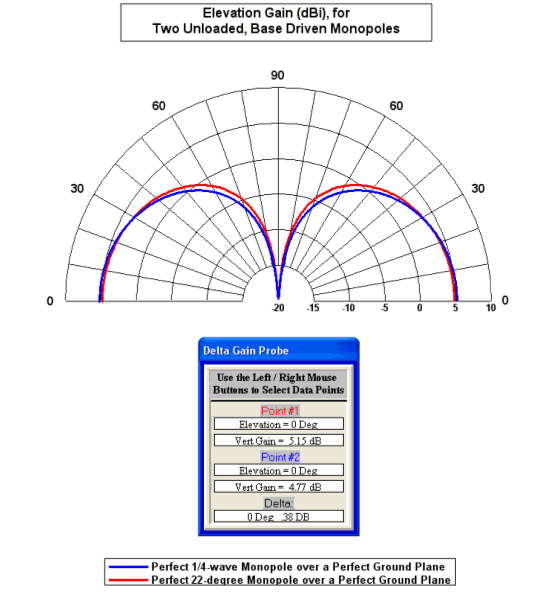 shows NEC-2 calculations and a comparison of the elevation patterns and gains for a lossless 22-degree monopole without top loading, and a 1/4-wave monopole -- both over perfect ground.
This one 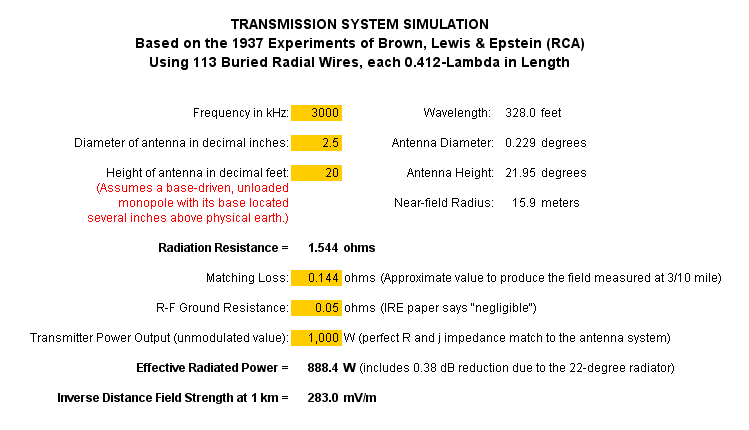 uses the 0.38 dB difference in h-plane gain for the 22-degree, perfect monopole from the NEC comparison, along with values taken or implied by the BL&E paper for this configuration. The frequency, monopole height and monopole OD are those used by BL&E.
This simulation shows that the BL&E-measured field equal to 283 mV/m at 1 km for 1 kW of applied power is achieved by this configuration as long as the matching and r-f ground loss total is not more than 0.149 ohms. BL&E state that the reactance of the monopole was determined by varying the value of a condenser (capacitor).
As for Brown's results, the ground resistance clearly has to be too low for them to be completely correct.
The r-f ground loss for the BL&E system of 113-radials each 0.412-lambda long certainly is much lower than most licensed AM stations. But then very few of them use radials longer than 1/4-lambda. Dr Trainotti suggests that about 120 buried radials each 1/2-lambda long used with a monopole virtually is a perfect r-f ground. BL&E's measurements show that they got very close to that.
He [Brown] probably reported exactly what he measured. As has been already pointed out, it is not easy to measure field strength with high accuracy.
My money is on Dr Brown and his team, who still are very highly regarded as pioneers in broadcast engineering. Their field measurements were within 1.5% of the theoretical value for that radiated power for a perfect 1/4-wave monopole over a perfect ground. Accurately measuring the change in that field from a 22-degree monopole, other things equal, is not technically difficult. The BL&E findings in these experiments became the basis for the minimum performance required by the FCC for licensed AM stations, to this very day.
For those who may be interested, paper 4 at this link http://rfry.org/Software%20&%20Misc%20Papers.htm is a PDF of the IRE publication of BL&E's experiments, and their results. It makes for very good reading and study. I hope anybody finding anything in conflict with what I have posted based on the BL&E paper will let me know.
//
In this famous quote by Alexander Pope, "doctors" are not only physicians, but highly learned men in general.
We have two recognized experts on short antennas, Brown and Trainotti, saying the opposite thing. Brown says that a ground screen near the base of a short antenna is not necessary, and Trainotti says that a ground screen is necessary. I think that Trainotti is the one who is right. I will not argue which man is the more highly regarded. I will only argue the technical facts. Here is another famous quote by Alexander Pope:
"Some judge of authors' names, not works, and then
Nor praise nor blame the writings, but the men."
A common ground structure used for AM broadcasting is 120 radials about 1/4 lambda long. It is frequently thought that the ground resistance of such a structure is about 2 ohms. There is more exact information about ground resistance in Figure 16 of Trainotti's "Short Low-and Medium-Frequency Antenna Performance," published in the October 2005 issue of IEEE Antennas and Propagation Magazine. Figure 16 shows that for a fairly high earth conductivity of 10 mS/m, and at 1 MHz, the common ground structure has an equivalent loss resistance of .7 ohms. The high earth conductivity reduces the ground loss resistance to less than half of the typical 2 ohms because the total ground impedance is the earh impedance and the radial array impedance in parallel. The ground loss resistance would be higher for lower earth conductivity.
Brown experimented with 113 radials .4 lambda long. He did not determine the loss resistance of this structure, but simply characterized the ground loss as "insignificant." Trainotti's Figure 16 has some information about the kind of ground structure studied by Brown. Interpolating from his 120 radial curve to 113 radials, and using a radial length of .4 lambda, the ground loss resistance is about .5 ohms. The ground conductivity used by Brown is five times what was used by Trainotti, so Brown's "insignificant" ground loss resistance is higher than .5 ohms (perhaps an ohm or more).
I calculated that the ground loss resistance cannot be more that .182 ohms if the Brown's claimed efficiency is to be obtained. It is not possible that Brown's ground loss resistance is nearly that low. Rich determined with his NEC program that the maximum loss resistance permissible in order to get Brown's results is .149 ohms. This is even worse for Brown's assertions than my calculations.
Trainotti did not say that 120 radials 1/2 lambda in length is virtually a perfect ground. I think that this impression is caused by his statement that all of the earth within a half wavelength radius of the antenna forms part of the return circuit of the displacement current of the antenna.
Ermi wrote: I calculated that the ground loss resistance cannot be more that .182 ohms if the Brown's claimed efficiency is to be obtained. It is not possible that Brown's ground loss resistance is nearly that low. Rich determined with his NEC program that the maximum loss resistance permissible in order to get Brown's results is .149 ohms.
I reversed the positions of the last two digits of that number when typing that post -- it should be 0.194 ohms, the sum of the 0.144 and 0.050 ohmic losses on the simulation page I linked to. So our two values actually are closer than thought.
These posts have given a lot of information, and, while our sources may not show exact agreement, hopefully the interchange had interest and value.
//
Ermi wrote: I calculated that the ground loss resistance cannot be more that .182 ohms if the Brown's claimed efficiency is to be obtained. It is not possible that Brown's ground loss resistance is nearly that low. Rich determined with his NEC program that the maximum loss resistance permissible in order to get Brown's results is .149 ohms.
I reversed the positions of the last two digits of that number when typing that post -- it should be 0.194 ohms, the sum of the 0.144 and 0.050 ohmic losses on the simulation page I linked to. So our two values actually are closer than thought.
These posts have given a lot of information, and, while our sources may not show exact agreement, hopefully the interchange had interest and value.
//
In my previous post I said, "The ground conductivity used by Brown is five times what was used by Trainotti..." I meant the opposite. Brown used 2 mS/m and Trainotti used 10 mS/m.
I apologize for the error.
In my previous post I said, "The ground conductivity used by Brown is five times what was used by Trainotti..." I meant the opposite. Brown used 2 mS/m and Trainotti used 10 mS/m.
I apologize for the error.