

All you can do is test it out in your locale, complete with obstructions, the quality of the available ground, etc.
As an illustration, this LINK shows how the loss in the r-f ground connection at the base of the antenna affects the distance to a given groundwave field intensity, other things equal.
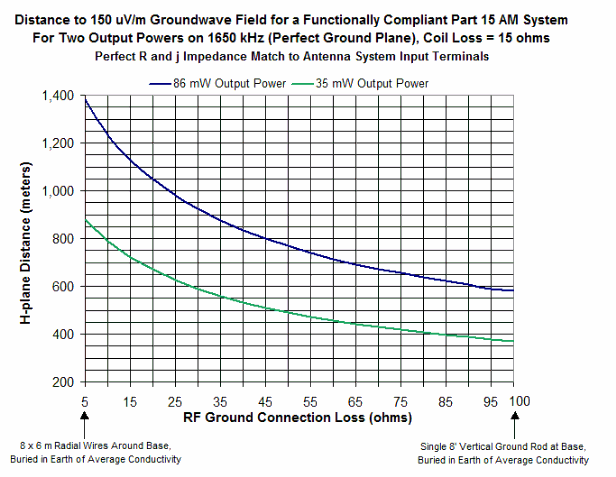
The calculations are based on a Part 15 AM transmitter mounted a few inches above the earth, with the top of its vertical antenna 3 meters above the earth.
"loss in the r-f ground connection at the base of the antenna affects the distance to a given groundwave field intensity"
Very true. Ground loss is a major player in Pt15 AM. Anything you can do to improve it, lay down more radials, longer radials, set up a small watering system to keep that ground moist, slam in ground rods, keep them irrigated too, the more conductor contact you have into the dirt the better!
AND..the shorter that ground path is from the TX to that ground system reduces that return path loss even more, as well as prevents your ground from becoming a radiator, or becoming another tag target for something that was once not an issue.
RFB
The talk about improving ground systems reminds me that I read somewhere and have heard from time to time that full power stations lay flat copper strips and not wire.
Is it for the reason just mentioned, to increase ground contact?
Good question, Carl, and I hope that my response below will not be offensive to you (or anybody else).
Flat copper conductors in widths of two or four inches commonly are used to provide a low-impedance r-f path between the common circuital potentials of the L and C components of the antenna matching and r-f phasing networks used by licensed AM broadcast stations -- and also for the r-f ground connection of those networks to the common point of the radial wires buried around the base of a tower.
Experimental measurements in the 1930s (and subsequent measurement/experience) proves that a circular conductor shape for the ~120 x 1/4-wave buried radials used with the towers of licensed AM broadcast stations provides nearly the maximum theoretical radiation efficiency for those systems.
That circular shape also avoids the problems related to the physical overlap of 120 flat, radial conductors near the base of the tower(s), and the expense of using flat conductors for buried radials, compared to circular conductors.
That's interesting, Rich, and different than I expected.....
If I read it correctly the licensed station's radials themselves are not flat copper, but connections closer in to the tower where tuning components are located....
Which, if I am on target, would mean that the radials themselves do not close in all the way to the base of the tower (?)
Is there an application within the smaller scale of part 15 AM in which flat copper would prove useful?
Buried radials should start physically as close as practical to the base of the radiator. Here is a LINK to a photo showing how these systems are installed for licensed AM broadcast stations. The short copper straps visible are used for connection to a few ground rods near the tower base, and to the "ground" side of the components of the matching network at the base of the tower.

Copper strap could be used for a few Part 15 AM buried radials, but the cost will be relatively high and the benefit compared to using circular conductors probably not very significant.
This grounding information is great! I just wish it was in a dedicated thread on the subject. I know that it's been mulled over and over in the past but maybe some new light could be shed, like the flat conductor information..
I used 2-25' pieces of chicken wire in an "X" configuration under the base of one of my set-ups and it worked well.. Just sayin'..
Good to hear that the flat copper would not be a significant improvement for part 15, rich, because, YES, copper is fantastically expensive now.
I got 70-feet of thick copper wire once and it cost so much that I ended up returning it to the store just so I could get all that money back.
The chicken wire sounds good, 12Vman, but is it bonded together, or I guess I mean, arc welded or soldered to the ground?
And I am just about to start a new thread on a ground project I have going.
I'll be waitin'.. 😉
"And I am just about to start a new thread on a ground project I have going."
"Good to hear that the flat copper would not be a significant improvement for part 15, rich, because, YES, copper is fantastically expensive now."
You're looking at contact with copper, so it doesn't need to be solid copper, i.e., copper-clad is good enough when talking about these sizes. E.g., ground rods are copper-clad, not solid copper.
In any case, though, it's a good idea to bolt on a chunk of sacrificial Zinc, which will get eaten by the electrolysis, rather than the copper connections. Our church lost a water heater ground because no one replaced the Zinc, and the connecting wire, even though 8 gauge solid wire, got completely eaten through.