

Hi there!
I hope someone might have a spare minute to set me straight:
Hi there!
I hope someone might have a spare minute to set me straight:
I'm teaching an intro electromagnetism class, and we're going to end by building an AM transmitter. I'm taking the design from sci-toys.com, which is basically a 1 MHz crystal oscillator driven above spec by a 9V battery, see diagram here 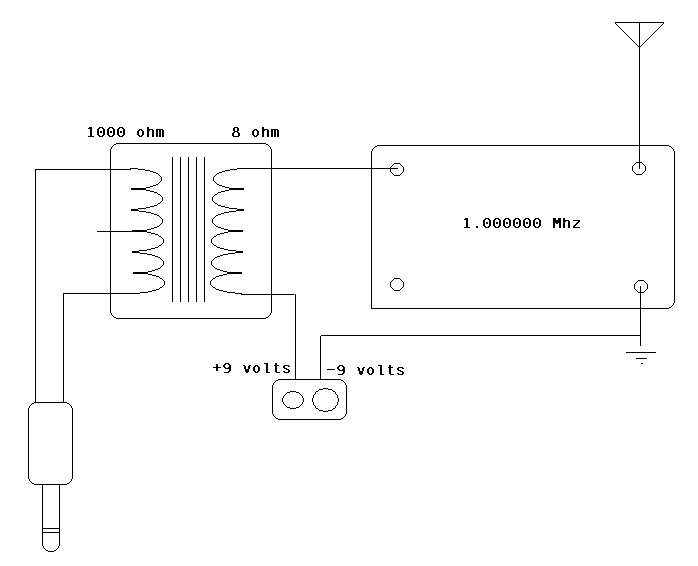 .
.
The author indicates that the range will be of the order of a few feet -- I would like a range of say, 50 feet. Does anyone think I could achieve this with a decent antenna and good ground?
Perhaps a base loaded mast/whip type as has been outlined a few times on this forum? (eg http://charliethompson.50megs.com/1610khz.htm, or http://part15files.home.comcast.net/~part15files/antweb/index.html).
Am I deluding myself? 🙂
Thanks,
H.

So I just found this thread http://www.part15.us/node/2375 on a similar vein, which at least does mention trying to couple it with a decent antenna.
But.. if you'r feeling generous, I'd still love to hear suggestions!
Cheers.
You could probably get some decent range by simply using a loading coil and short piece of wire for an antenna and maximize the resonance to increase the range a bit.
RFB
Just thinking aloud, but it looks like what you've got is an oscillator without a buffer or final stage. What power level might be expected from an oscillator alone? All I know is the question.
But the other advice given, using a loading coil and "short piece of wire", is what you'd do with a conventional part 15 transmitter. The length of "short" would be around 10-feet.
I predict you will cover more than 50-feet, maybe...... 67-feet. Yep.
Having taught electronics for a few years, I find the students liked to see on a component level what's going on.
The little metal can with the crystal oscillator in it will probably give you several feet but not much to see there.
How about a simple 1 transistor LC ocillator. They can better visualize how the RF is generated; an active device (transistor), positive feedback, frequency determining network, modulation.
Build the one I built 50 years ago on a piece of wood. I posted a link to the book here some time ago. I forget which page but here is a link to the book which has several very simple circuits.
Ramsey sells a kit AM transmitter which probably will give more predictable results. Search on "Ramsey AM1C".
It depends on the scope of your class as to what is appropriate. If it is a top down view where "this radiates and this receives" then the crystal oscillator circuit may suffice. If it is a "how do these circuits work" approach then the Ramsey unit may be better.
When I taught electronic communications lab I used an assembled Ramsey AM-25 AM transmitter which gave the range you seek. As a class demonstration, we viewed the waveforms on an oscilloscope and used a spectrum analyzer to show the spectrum. This was for a degree credit class in Electronic Engineering Technology and the content might be more than you seek.
Mram, the linked book brought back memories. I have never seen the work of this author but I grew up reading similar books on electronics. Radio parts were easy to come by back then and I tried almost every circuit I could find.
Neil
I too was going to suggest something a bit more complex in the curve of learning for the TX to be used in the class. However I think using the crystal oscillator "DIP" canister package is a good starting point. For one, that canister oscillator requires external help for modulation capability. Second it requires a good stable voltage source, another part of the project for the class is to assemble a good regulated power source for this canister oscillator. Third is to maximize its signal without some mega over-board beef up.
Once the basics are covered then I too suggest moving to a more complex design such as a one transistor LC oscillator unit, then simply add to that unit with new sections of circuitry such as a buffer amplifier, then add a modulator circuit, then final amplifier circuit, then output matching and low pass filtering circuit, then finally an antenna system, all complying with the Part 15.219 and 209 rules.
Many ways this neat project can proceed and continue to add more levels of educational experience for the students.
RFB
Welcome to the group ...
1) Find a ham radio club in your neighborhood ... priceless resource for information and education.
2) If you want to try building one from scratch and have a local parts store, you might try this:
http://www.circuitstoday.com/am-transmitter-circuit.
... doesn't get much simpler.
If you have a budget available, maybe you could consider the SSTRAN AMT3000, a modern yet widely and thoroughly field-tested kit, link on the left of this page. It will easily get you several hundred feet of range, and could later be used as a certified legal platform by students interested in broadcast programming and communications, right on the school grounds.
There is even a mod you can do to use it with an external loading coil/antenna system that could get it out past a mile (maybe more on a good day). Quite a number of folks here have built these, so there'll likely be plenty of help and encouragement available.
So much, for all the advice and suggestions.
I fear I'm in a bit over my head, as I'm really a physicist, not an engineer - ie I have little practical skill or knowledge.. 🙂
More to the point, the class I am planning is a physics class, rather than an electronics one, per se. I'm motivating some intro EM through this project.
On that note, I am wary of complicating the electronics since a) time is finite, b) it's the basic physics I'm aiming for, and c) it's not my area of knowledge.
Now perhaps this is ass-backwards, but when I learned how simply radio technology could be built, I thought, why stop at inductors and capacitors when an actual working radio is only a step or two further on?
So much for my ideas... now to yours:
I like the idea of replacing the oscillator with a 1 transistor LC circuit, but I can't say I fully understand it. There are some examples of basic LC oscillators at http://www.sentex.ca/~mec1995/tutorial/xtor/xtor7/xtor7.html, but even these are more complex than I was aiming for. I suppose the crystal oscillator unit hides a bunch of complexity. I guess the simplest circuit might be a Hartley oscillator like http://www.electronics-tutorials.ws/oscillator/hartley.html ?
I'm not really sure how to modulate the amplitude of the output signal. Would I just amplify my audio signal and make that the voltage source for the oscillator circuit?
Circuit #20 from the book mram1500 linked to is a little beyond me, but if anyone had a minute to summarise it for me, that would be awesome. Else I might ask the lab engineers at school.
Neil, in another post you said:
"A parallel LC at resonance is a high inpedance, so the 7 turn coupling acts as the primary of a transformer and transforms the high secondary impedance down so it matches the transmitter."
I believe you were talking about an antenna which was a whip attached to a tank circuit, which you then inductively coupled to your transmitter output? Do you recommend this over a series LC coil+(cap+)whip setup?
I think I might order an AM1C kit just in case the crystal doesn't cut it.
Thx!
Cheers, Ken. There seem to be 1 or 2 on eBay. Will consider it as a back-up, since if I'm going to buy a kit / product, I might as well get something decent 🙂
Neil, in another post you said:
"A parallel LC at resonance is a high inpedance, so the 7 turn coupling acts as the primary of a transformer and transforms the high secondary impedance down so it matches the transmitter."
I believe you were talking about an antenna which was a whip attached to a tank circuit, which you then inductively coupled to your transmitter output? Do you recommend this over a series LC coil+(cap+)whip setup?
This was a description of an antenna tuning system I used quite a while ago. I have since replaced it with an adjustable series L (loading coil) with the C being the capacitance of the 3 meter antenna. The resonance is very sharp and hard to tune and for this reason it may not be good for a lab bench demo. This type of tuning system also presents a rather low impedance to the transmitter which may be too much load for a simple oscillator to work properly. It may be best to start with just a length of wire as an antenna and not worry about a loading coil.
In our lab we had available two function generators and we had the students build a two transistor circuit with an L/C tank and one generator supplied the RF and the other the audio. If you want to see this I can sketch the circuit for you. I think this may be more than you want to get into however.
We used HP function generators which had an AM function and if this type of function generator is available in your lab you could simply attach a length of wire as an antenna and be on the air.
Neil
"I don't have to know what I'm doing. It just has to work when I'm done."
I built that little transistor "transmitter" when I was 10 years old. I drew the circuit on a piece of wood, drove some nails into the wood at the junction points. I strung the parts between the junction points and soldered them together.
The only part I had to buy was a slug tuned broadcast band loopstick coil. The rest of the stuff was salvaged from junk radios.
As for the circuit: For RF, the transistor is operating as a common base amplifier.
The RFC (choke coil) provides a high impedance between the emitter and B+ (common or ground) to allow positve feedback to develop at the emitter.
The base is at RF ground potential due to the .005uf cap between the base and B+ (common).
Positive feedback is provided by the 25 to 50 uuf capacitor between the collector and emitter.
The LC tuning is accomplished by the parallel variable cap and coil. Although the variable cap and coil are in series with the other .005uf capacitor, that capacitor is a very low impedance to the RF and is used as a DC block between the B- (hot) and the B+ (common). This allows the variable cap and coil to act as a parallel tuned circuit without shorting out the battery.
Modulation is accomplished by varying the base bias current. This will cause amplitude modulation but there will also be some frequency modulation as most oscillators will vary in frequency when the voltage applied varies. That is why AM transmitters generally are designed with buffer stages between the oscillator and modulated stages.
Lastly, the variable resistor sets the quiescent current to minimize distortion. The .005uf cap between the base and B+ (common) will have a high impedance to audio frequencies and allow the audio voltage to develop at the base to vary the bias, thereby modulating the oscillator/transmitter.
There will be a small DC voltage between the audio input terminals. This is why a blocking capacitor is shown connected to the phono cartridge whereas the input transformer is not affected by the small DC voltage.
I'm not sure why the author didn't show the two points labled B+ on the schematic connected but they are.
Sheesh, take a breath...
At the University where I work - a
professor used the Ramsey AM-1 in
an RF intro class.
He did this for several years, and
many were built. One student, did
not know to cut the wires off the
bottom of the circuit board. In
other words, the parts that were
mounted on the board were soldered,
and the extra wires were still poking
out the bottom of the board. It turned
out that transmitter worked better than
a lot of the others, for some reason!
My AM-1, which I purchased in 1994 worked,
but it drifted very quickly down the band.
In fact, it wasn't even on the AM BCB when
I first turned it on. It was up around 2 MHz
somewhere, and it was drifting down in
frequency very quickly - maybe 1 KC a second -
I don't know - it was a long time ago.
i had a friend who replaced a lot of the
Ramsey caps, with better ones, and the
drift stopped. Then the transmitter worked
OK around the house, but it did FM quite a bit.
I have no idea if the Ramsey AM-1C, the current
model, is a good idea or not. I wish we knew
somebody who had one. I think they want about
40 dollars for the board and parts minus the
case. It might be possible to drive the
transmitter with a 1 MHz oscillator module from one
of the electronic places. That's assuming 1000 kHz is clear in your area. With my Ramsey AM-1,
I took the LC out, built another oscillator, and
got a crystal for 1700 kHz. (The 1700 kHz crystal
wasn't cheap, that's for sure.)
After I had a good ground and tuning coil in place
with a 3 meter stick, it covered a good quarter of
a mile, and 1/2 mile in some places. It also didn't
FM anymore.
Oh boy, it's a lot later than I thought, I have to
work early tomorrow. Just thought I'd throw that in.
Best Wishes,
Bruce, DRS2
Jameco has a super-simple AM transmitter kit that costs "next to nothing."
The simple transmitter you plan to build should do about 50 feet during the day---provided the classroom lighting doesn't drown it out---and if you don't have a powerhouse (flame throwing station nearby).
If you have a shortwave receiver... I would swap out the 1.0 mhz chrystal oscillator with one using a quiet channel on shortwave.
Again.. depends on lighting/wiring AND a nearby high power station can modulate the tiny carrier that the small transmitter produces.
I believe the estimate of a few feet refers to a crystal radio set (if i remember correctly that site sells crystal radio kits). The simple little transmitter I put togeather using the same plan traveled through my house weakly...but i could hear the signal.
So assuming that you mean 50 foot radius, 25 foot from the transmitter in two directions... my experience from tinkering with the same project would say Yes (you can get the 50 ft).
Your mileage may vairy from mine. I don't think I paid much attention to the antenna length with the microscopic power level.