

Recent posts on other forums address the possible use of "MDCL" for Part 15 AM systems. MDCL is an acronym for Modulation Dependent Carrier Level.
This technology is not new, but it is still widely misunderstood. Here is a link describing it in several forms... http://www.radioworld.com/article/alaska-test-produces-lower-am-power-costs/23169
The implications made in these recent posts are that in an FCC acceptance of a field inspection based on field intensity, and/or in the data submitted to them for certification under Part 15, the FCC considers only the field intensity produced by the unmodulated carrier.
One well-known poster on another website has stated that as a result of MDCL, final r-f stage input power increases when average modulation increases.
Note that this condition also is true for AM transmitters not using MDCL techniques.
However the average AM carrier level with symmetrical modulation is ~constant without MDCL, and is NOT constant with MDCL. With MDCL that carrier level will vary as a function of the modulation waveform.
That average carrier level varying with modulation when using MDCL can be detected by the field intensity meters used by the FCC.

Based on the link to the Radio World article describing MDCL the great advantage for licensed stations is a significant reduction in electric power bills, on the order of 27%, although the cases discussed are operating by special experimental authority from the FCC while MDCL is otherwise not yet permitted.
Part 15 AM transmitters already use a very small amount of electric power therefore rendering MDCL unnecessary, since no other benefit has been claimed.
It seems to me that some old
ham AM transmitters used something
called, "Controlled Carrier Phone."
Is there any similarity?
Bruce, Mon. Stn., CT
Hey Bruce, I thought you had once a Panaxis AM-100?? This TX had carrier control! http://www.part15.us/forum/part15-forums/transmitter-talk/panaxis-am100-schematic
Rob V.
i think rich needs to give proper credit to the originaltion of his post...
http://www.hobbybroadcaster.net/community/index.php?topic=2774.msg17977;topicseen#msg17977
Good old Controller Carrier or screen modulation. Heathkit actually perfected this mode in many transmitters. The carrier idled lower when not modulated and then would ride up and down on the voice peaks. So a 50 watt transmitter might idle at say 15 watts but hit 50 watts when modulated at 100%.
I was thinking perhaps the author might wish to remain anonymous. But this possibility is now gone, seeing as how you posted that link.
one of Bill "jim jones' DeFelice" kool aide drinking disciples over there was crying and whining about someone poaching the almighty's article and didn't give him credit for originating it.
thought i would solve that issue.
Besides my earlier comment on MDCL, I would also say that in his opening post Rich was dispelling the imaginary advantage being suggested by the anonymous originator over at hobby-site. Rich pointed out the reality that AM field strengths are measured with a silent carrier, and that a modulated carrier will increase the input to the final RF stage to greater than 100mW. In his directions for setting the input of the AMT5000 PhilB makes it clear that this measurement is taken with no modulation.
Simply put, knowing the basics of Part 15 power measurement, one can easily deduce that MDCL would provide no advantage. So said Rich and I concur.
MDCL is simply a form of super modulation where the average input power can stay at say 100mW but the modulated peak power can be 1/2 to 1 watt or more for 100mW input.
the panaxis AM100 uses a form of MDCL it can swing upwards of a 1/2 watt peak.
MDCL is simply a form of super modulation where the average input power can stay at say 100mW but the modulated peak power can be 1/2 to 1 watt or more for 100mW input.
Suggest that those wanting an accurate description and understanding of MDCL in its various forms download and study the document at http://www.nrscstandards.org/download.asp?file=NRSC-G101.pdf .
Heathkit actually perfected this mode in many transmitters.
Ah, yes. That takes me back.
Below is a link to info about the Heathkit DX-35 which included a controllED-carrier AM mode.
I bought/built/operated a DX-35 for AM transmissions in the 1950s using my FCC General Class ham license -- which I let lapse after one term when I was granted an FCC First Class Commercial Radio Operator License. My original ham radio call letters lately were assigned as a vanity call to a certain Ermi Roos, at his request. But regardless...
Reception reports of the AM signal from that DX-35 transmitter complained about the variable signal-to-noise ratio in the audio waveform due to the variation of the average carrier amplitude with modulation.
However the algorithms used by MDCL systems these days largely have overcome this effect while still reducing the a-c mains power needed by licensed AM broadcast transmitters, and in compliance with FCC regulations/policy applying to them.
http://www.heathkit-museum.com/ham/hvmdx-35.shtml
This is a response for way back on the thread -
but yes, I had 2 Panaxis AM-100s. I had
no documentation, and didn't know how
to set up those transmitters to operate
properly. That modulation "expansion"
could be set, but I didn't know how at
the time. Also, the traansmitter used
different output networks for the high and
low end of the AM band, I think. I didn't
know how to set that up, either. As many of
us know, the AM-100 only operated on
600, 750, 1000, 1200, and 1500 kHz. It was
run by a 6 MHz rock.(?) This was divided
by integers. For instance, if you wanted to
be on 1500, you set some dip switches for
that frequency, i.e., divide by 4. 600 kHz
was divide by 10. I heard that the circuitry
would not work for higher than 1500. For instance,
you could not do divide by 3 - and put the transmitter
2000 kHz, for example. Of course, the transmitter would
go anywhere in the AM band between 600 and 1500,
if you got the right crystal around 6 MHz, and figured
out the division, etc.
It was a real good transmitter, and many people used it.
I also own a Heathkit DX-60A and a DX-60B. These
transmitters were AM, but did not use plate modulation.
(They are ham radio transmitters.) I believe the DX-60
line had some kind of modulation method that was similar
to the subject of above, but I don't know how it worked.
I lack documentation for those transmitters, as well.
Fun stuff.
Bruce, Mon. Stn., CT
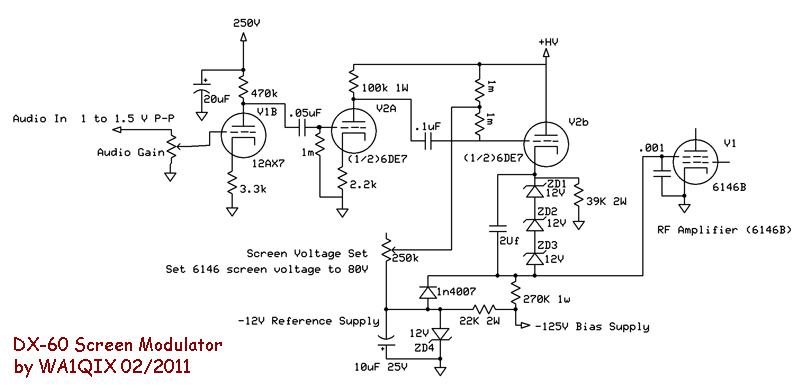
Thank you for that.
It's funny how the DX-60,
DX-60A, and DX-60B are pretty much
all the same electronically. Or exactly?
I'll have to check that.
By the way, the author of that mod,
WA1QIX, used to
live near me, and I have heard him on the
air a few times over the years. I guess he
and I became hams at roughly the same
time. My very first ham radio call was WN1POI.
Bruce, Mon., Stn., CT