

http://www.fcc.gov/eb/FieldNotices/2003/DOC-280829A1.html
Here is the notice in part....nothing mentioned about 3 meters and 100 milliwatts, curious!
http://www.fcc.gov/eb/FieldNotices/2003/DOC-280829A1.html
Here is the notice in part....nothing mentioned about 3 meters and 100 milliwatts, curious!
The Boston Office received information that an unlicensed broadcast radio
station on 1690 kHz was allegedly operating in Brockton, MA. On March 13,
2008, agents from this office confirmed by direction finding techniques
that radio signals on frequency 1690 kHz were emanating from the Brockton
Haitian Church at 28 Warren Ave., Brockton, MA. The Commission's records
show that no license was issued for operation of a broadcast station on
1690 kHz at this location in Brockton, MA
Radio stations must be licensed by the FCC pursuant to 47 U.S.C. S: 301.
The only exception to this licensing requirement is for certain
transmitters using or operating at a power level or mode of operation that
complies with the standards established in Part 15 of the Commission's
rules, 47 C.F.R. S:S: 15.1 et seq. The field strength of the signal on
frequency 1690 kHz was measured at 22,000 microvolts per meter (uV/m) at
57 meters, which exceeded the maximum permitted level of 14.2 uV/m at 30
meters for non-licensed devices. Thus, this station is operating in
violation of 47 U.S.C. S: 301.

nothing mentioned about 3 meters and 100 milliwatts, curious!
Here are some numbers if this operator claimed to be operating under Part 15.219...
With 50 ohms total coil and r-f ground loss and 75 mW of transmitter output power applied to a resonant, base-fed, 3-m radiator at ground level, the maximum inverse distance field at 57 meters would be about 2,220 µV/m -- which is only about 10% of the field measured by the FCC.
So in order to produce the field measured by the FCC for these rather typical coil/ground losses, this system used either more transmitter power, an elevated antenna, or possibly both.
So the FCC had their choice of rules to apply, but the operation wouldn't have been compliant in any case.
//
nothing mentioned about 3 meters and 100 milliwatts, curious!
Here are some numbers if this operator claimed to be operating under Part 15.219...
With 50 ohms total coil and r-f ground loss and 75 mW of transmitter output power applied to a resonant, base-fed, 3-m radiator at ground level, the maximum inverse distance field at 57 meters would be about 2,220 µV/m -- which is only about 10% of the field measured by the FCC.
So in order to produce the field measured by the FCC for these rather typical coil/ground losses, this system used either more transmitter power, an elevated antenna, or possibly both.
So the FCC had their choice of rules to apply, but the operation wouldn't have been compliant in any case.
//
If the FCC had perhaps observed something more in the order of magnitude expected for a compliant system the field engineer might have pursued it further but goodness gracious, 22,000 uV/M anywhere is waaaaay out of bounds.
Reminds me of the old Steve Martin stand-up routine:
"You can be a millionaire, and never pay taxes!"
(repeated several times for emphasis)
"First, get a million dollars"
"Then, don't pay taxes!"
"If the IRS sends you an audit letter, reply with two simple words:"
"EXCUUUUSE ME!"
Or in this case "You can run a radio station and not follow the regulations..."
Experimental broadcasting for a better tomorrow!
If the FCC had perhaps observed something more in the order of magnitude expected for a compliant system the field engineer might have pursued it further but goodness gracious, 22,000 uV/M anywhere is waaaaay out of bounds.
Reminds me of the old Steve Martin stand-up routine:
"You can be a millionaire, and never pay taxes!"
(repeated several times for emphasis)
"First, get a million dollars"
"Then, don't pay taxes!"
"If the IRS sends you an audit letter, reply with two simple words:"
"EXCUUUUSE ME!"
Or in this case "You can run a radio station and not follow the regulations..."
Experimental broadcasting for a better tomorrow!
Well, it was a thursday. Possible that nobody was there or for some other reason the FCC couldn't physically inspect the transmitter and/or antenna. It appears to be quite a new location for that church, as of December they were still fixing up the building and adding handicapped access and such and hoping to be open as of the first of the year. So there might not be anyone there 24/7 yet.
I'm sure that if they're trying to run a setup that actually is "kosher", they can respond within the 10 days and the FCC would send somebody out to take a look. I really kind of doubt it's actually a legal setup, with the field measurement that high. (Barring miracles or an antenna made out of Star Trek dilithium crystals or some other unknown sort of technology not known on Earth yet.) But if they feel they are within the rules of part 15 *or* that their station is authorized to operate under some other provision authorized by the FCC, that's what the 10 days to respond are for, I think.
At a guess, I'd say it's likely they were misinformed or got a bad piece of gear though. Considering that they're going to a considerable bit of expense for the property and refurbishing the building, bringing it up to code, adding handicapped access and etc, I'd like to think that it's improbable that they are intentionally breaking the law.
Daniel
PS.. a short article about the church can be found here:
http://www.wickedlocal.com/brockton/news/x1684495691
Well, it was a thursday. Possible that nobody was there or for some other reason the FCC couldn't physically inspect the transmitter and/or antenna. It appears to be quite a new location for that church, as of December they were still fixing up the building and adding handicapped access and such and hoping to be open as of the first of the year. So there might not be anyone there 24/7 yet.
I'm sure that if they're trying to run a setup that actually is "kosher", they can respond within the 10 days and the FCC would send somebody out to take a look. I really kind of doubt it's actually a legal setup, with the field measurement that high. (Barring miracles or an antenna made out of Star Trek dilithium crystals or some other unknown sort of technology not known on Earth yet.) But if they feel they are within the rules of part 15 *or* that their station is authorized to operate under some other provision authorized by the FCC, that's what the 10 days to respond are for, I think.
At a guess, I'd say it's likely they were misinformed or got a bad piece of gear though. Considering that they're going to a considerable bit of expense for the property and refurbishing the building, bringing it up to code, adding handicapped access and etc, I'd like to think that it's improbable that they are intentionally breaking the law.
Daniel
PS.. a short article about the church can be found here:
http://www.wickedlocal.com/brockton/news/x1684495691
...my statement earlier "So in order to produce the field measured by the FCC for these rather typical coil/ground losses, this system used either more transmitter power, an elevated antenna, or possibly both."
_______
For the same applied power and frequency, and the same coil and r-f ground resistances, an elevated and resonant 3-m antenna wouldn't produce any additional field solely as a result of its height above the earth.
Any additional field strength is the result of radiation from the conducting path or paths such as a "massive ground wire," grounded metal supports (flagpoles, masts, billboards etc) connected to the chassis of a Part 15 AM tx+3-m whip system, and un-decoupled power and program audio cables.
//
...my statement earlier "So in order to produce the field measured by the FCC for these rather typical coil/ground losses, this system used either more transmitter power, an elevated antenna, or possibly both."
_______
For the same applied power and frequency, and the same coil and r-f ground resistances, an elevated and resonant 3-m antenna wouldn't produce any additional field solely as a result of its height above the earth.
Any additional field strength is the result of radiation from the conducting path or paths such as a "massive ground wire," grounded metal supports (flagpoles, masts, billboards etc) connected to the chassis of a Part 15 AM tx+3-m whip system, and un-decoupled power and program audio cables.
//
The rule I use for evaluating Part 15 AM systems is that 1kW of radiated power from an electrically short vertical monopole above ground produces 300 mV/m at 1 km. Using this rule for the field strength generated by the church station gives us a radiated power of {[(22)(.057)/300]^2}x1000 = .01747 W = 17.47 mW. If this calculated radiated power were greater than 100 mW, there would be no question that Section 15.219(a) was being violated. The first law of thermodynamics does not have to be exceeded in order to comply with this rule. However, in practice, it is quite difficult to legally get even .1% system efficiency. 1% would be a great achievement. At the limit of what the laws of physics will allow, the audio bandwidth would have to be severely restricted for the Q to be high enough to get 17.47% system efficiency. In another post by me in this Forum, I reported an experiment that shows that intelligible audio can be obtained using an antenna with only about 2 kHz RF bandwidth, which corresponds to about 1 kHz audio bandwidth. This is because the antenna produces a single pole in the audio bandpass, and this allows attenuated frequencies beyond the 3 dB bandpass to be heard.
The rule I use for evaluating Part 15 AM systems is that 1kW of radiated power from an electrically short vertical monopole above ground produces 300 mV/m at 1 km. Using this rule for the field strength generated by the church station gives us a radiated power of {[(22)(.057)/300]^2}x1000 = .01747 W = 17.47 mW. If this calculated radiated power were greater than 100 mW, there would be no question that Section 15.219(a) was being violated. The first law of thermodynamics does not have to be exceeded in order to comply with this rule. However, in practice, it is quite difficult to legally get even .1% system efficiency. 1% would be a great achievement. At the limit of what the laws of physics will allow, the audio bandwidth would have to be severely restricted for the Q to be high enough to get 17.47% system efficiency. In another post by me in this Forum, I reported an experiment that shows that intelligible audio can be obtained using an antenna with only about 2 kHz RF bandwidth, which corresponds to about 1 kHz audio bandwidth. This is because the antenna produces a single pole in the audio bandpass, and this allows attenuated frequencies beyond the 3 dB bandpass to be heard.
Ermi wrote: The rule I use for evaluating Part 15 AM systems is that 1kW of radiated power from an electrically short vertical monopole above ground produces 300 mV/m at 1 km. Using this rule for the field strength generated by the church station gives us a radiated power of {[(22)(.057)/300]^2}x1000 = .01747 W = 17.47 mW. If this calculated radiated power were greater than 100 mW, there would be no question that Section 15.219(a) was being violated.
_______
Ermi, we agree very closely on the amount of radiated power it would take to produce a 22,000 µV/m ground wave field 57 meters from the ground-mounted Part 15 AM antenna system I described in my post above.
But the relevant point here is that Part 15.219 applies to the DC input power to the final r-f stage in the transmitter -- not to the amount of power that may be radiated.
For the 50 ohm total coil/ground loss in my post, it would take ~7.4 watts of transmitter output power for this antenna system to radiate ~17.44 mW, and produce the measured 22 mV/m field at 57 meters. If the transmitter PA was 75% efficient into a matched load, then its input power would be nearly 10 watts, which obviously is WAY beyond the power authorized by 15.219.
Given the high r-f voltages this would generate at the antenna feedpoint, probably much of the ERP in this situation was provided by radiation off a long "ground wire" or other conductor leading to an elevated installation of the Pt 15 tx + 3-m whip, while using less transmitter power.
See the link below for my calculations showing both agreement with your conclusion about radiated power, and support for my statement here about the transmitter output power it will take for this system to generate that radiated power for the assumed antenna system.
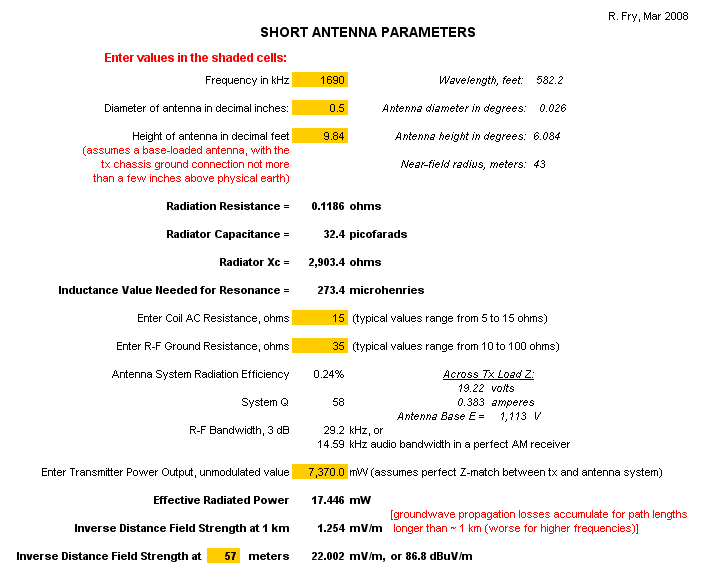
Rich
Ermi wrote: The rule I use for evaluating Part 15 AM systems is that 1kW of radiated power from an electrically short vertical monopole above ground produces 300 mV/m at 1 km. Using this rule for the field strength generated by the church station gives us a radiated power of {[(22)(.057)/300]^2}x1000 = .01747 W = 17.47 mW. If this calculated radiated power were greater than 100 mW, there would be no question that Section 15.219(a) was being violated.
_______
Ermi, we agree very closely on the amount of radiated power it would take to produce a 22,000 µV/m ground wave field 57 meters from the ground-mounted Part 15 AM antenna system I described in my post above.
But the relevant point here is that Part 15.219 applies to the DC input power to the final r-f stage in the transmitter -- not to the amount of power that may be radiated.
For the 50 ohm total coil/ground loss in my post, it would take ~7.4 watts of transmitter output power for this antenna system to radiate ~17.44 mW, and produce the measured 22 mV/m field at 57 meters. If the transmitter PA was 75% efficient into a matched load, then its input power would be nearly 10 watts, which obviously is WAY beyond the power authorized by 15.219.
Given the high r-f voltages this would generate at the antenna feedpoint, probably much of the ERP in this situation was provided by radiation off a long "ground wire" or other conductor leading to an elevated installation of the Pt 15 tx + 3-m whip, while using less transmitter power.
See the link below for my calculations showing both agreement with your conclusion about radiated power, and support for my statement here about the transmitter output power it will take for this system to generate that radiated power for the assumed antenna system.
Rich
The best we can do is speculate but it does appear that the transmitter used was likely running several watts.
I have to wonder where they obtained the equipment and who set it up for them.
Neil
The best we can do is speculate but it does appear that the transmitter used was likely running several watts.
I have to wonder where they obtained the equipment and who set it up for them.
Neil