

... if that is of any concern.
Mr Blare wrote "I want to be able to accurately measure the exact milliWattage to the hair's perfection, and then give it one extra boost.
Just to point out that an accurate measure of the input or output power of a "Part 15 AM" transmitter using an intentional radiator is not proof that such a system is compliant with Part 15.
The paper linked below shows why (note the difference in range to the same field intensity for the two systems while using equal tx power, based on their antenna configurations -- without an "extra boost" in that tx power).
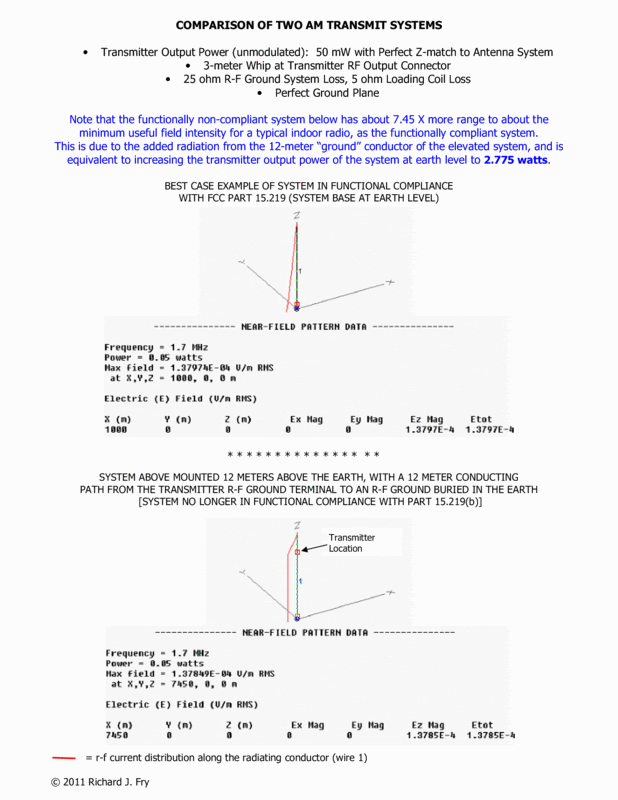
"Just to point out that an accurate measure of the input or output power of a "Part 15 AM" transmitter using an intentional radiator is not proof that such a system is compliant with Part 15."
A very valid point right there, and one that should ring a bell in everyone's memory...ie KENC.
We have seen even a certified transmitter can be found to be out of compliance by simply where it is mounted and what it is using to connect itself to ground (dirt).
For 221 it's the same, except a 221 system is not trying to establish a far field signal to reach a 1/2 mile away from the wiring. But like 219 there are specifications that must be met.
Best way to do this is to have on hand something to be able to measure with. A good general tool is a radio with several bands and an S meter. However that tool is very limited in what it can tell you.
Either way, a radio with an S meter or an investment into a piece of test gear that will serve more purposes than just checking Part 15 signals, effort is being made to have the tools on hand for checking compliance and to be in compliance.
I can't think of any other better way for a Part 15 operator to make sure they are in compliance.
Only other way is to just shut it all off. Would that then be considered "functionally compliant"?
RFB
I understand the lesson you have put forth. My exact "to the milliWatt measurements", in themselves, are no assurance that my system actually complies with FCC book.
Therefore, my extra "boost" won't matter, one way or the other.
I can't think of any other better way for a Part 15 operator to make sure they are in compliance. Only other way is to just shut it all off.
Another way would be to install the transmitter plus its attached ~3-m vertical whip so that the top of the whip is 3 meters above the earth, with the transmitter r-f ground terminal connecting to something buried in the earth via a conductor only a few inches in length.
Then, if the transmitter input power is 100 mW or less (unmodulated), the system will comply with 15.219, and field intensity measuring equipment will not be needed.
"Another way would be to install the transmitter plus its attached ~3-m vertical whip so that the top of the whip is 3 meters above the earth, with the transmitter r-f ground terminal connecting to something buried in the earth via a conductor only a few inches in length."
Based on public available data in how testing for compliance is done with Part 15 devices (not just AM or FM transmitters) is the DUT is placed upon a table that is 1 meter in height sitting on a ground plane system. Since the DUT was certified at this height and given an FCC certification number, there should not be any out of compliance issue if someone has a Rangemaster or Procaster or TH/iAM ATU mounted in the same manner.
Of course that could be said to only apply to certified units and not kits or home built systems.
However there are no rules stating that a Part 15 AM intentional radiator, certified or not, MUST be mounted at ground level (dirt).
However mounting it close to the ground improves the return pathway with less ground path resistance through a conductor longer than a few inches. The less ground resistance to the dirt the better, and the better conductivity footprint in the dirt is even all the more better, as well as eliminating the "ground lead" nonsense and eliminating any chance of a long ground path radiating.
RFB
My ever so carefully measured system would be exactly as you describe, with a 3-meter vertical and buried earth grounding.
First you said that would be no assurance of compliance,
then you assured me it would comply (100mW at the final input).
Time out.
Are we repeating ourselves, over and over and over and over and over and over?
Time for the boost.
My ever so carefully measured system would be exactly as you describe, with a 3-meter vertical and buried earth grounding. First you said that would be no assurance of compliance, then you assured me it would comply (100mW at the final input).
What I wrote was that using a transmitter with 100 mW input power to the final r-f amplifier did not assure compliance with Part 15.219, because such compliance also requires using a compliant antenna system.
Buried earth grounding doesn't necessarily mean that such an r-f ground is not connected to an elevated transmitter by one or more long, radiating "ground" conductors.
Some claim that the top of such a long conducting path connected to a buried r-f ground also is r-f ground, but it is not. That long conducting path radiates, and this issue has been the source of several NOUOs issued by the FCC.
The reasons I post this information more than some people want to see it are (1) that the point never appears to be accepted, and (2) it might help someone who wants to avoid an FCC action.
This forum is concerned with indoor antennas, and unless we live in an old church or auditorium, we will not have elevated antennas with long ground-lead attachments.
But I know that long ground leads is the inevitable outcome of many conversations in the past and many to come in the future, so I strongly suggest a dedicated forum be opened on "Long Ground Leads", where the subject could exist without need of non sequitur.
Back to the subject at hand, the Spectrum Analyzer has just arrived by postal delivery and I guess I'll spend the day reading its literature and planning where to install.
Then, maybe tonight, I'll round-up available plans and instructions for building a MW loop, and will do a triangular design, since they can be anywhere from round to square.
Mr. rich, do you have any input re: loops?
Although this is about indoor antennas, grounding topics are important here as well.
Reason? An indoor antenna's ground can also radiate if it is long enough to overtake the short wire's length. The TX will cause the longer conductor to radiate rather than the intended radiator, which is the wire, or custom built antenna. They all need something for a return path for the RF.
Usually this ends up being either the ground via the audio cables, power cables or the enclosure of the TX connected to some form of ground system via copper strap or wire. But the same result will occur, long grounds will end up radiating.
Perhaps what might help in this situation would be the approach taken by neutral coupling in CC, installing an isolated Earth ground and use that for your return path for your indoor antenna, or attach to a cold water pipe.
Anything but attaching to the home's electrical wiring ground or utility ground. Turn the whole house's wiring into a radiator.
This indoor antenna research plan is fantastic and I think Carl deserves a huge salute and well wishes for creating a new area of study in Part 15.
RFB
"Some claim that the top of such a long conducting path connected to a buried r-f ground also is r-f ground, but it is not. That long conducting path radiates, and this issue has been the source of several NOUOs issued by the FCC."
This was never an issue prior to 2005. Then suddenly it was. I wonder why?
"Buried earth grounding doesn't necessarily mean that such an r-f ground is not connected to an elevated transmitter by one or more long, radiating "ground" conductors."
True it does not mean anything really. However you cannot just assume that every installation has a transmitter mounted up on a pole using that pole as it's ground path.
Not everyone is a bad apple! 🙂
RFB
Mr. RFB made a good plea to keep grounding part of the indoor antenna discussion, although the conversation becomes very murky when considering such common practices as grounding to a water pipe.
If a water pipe happens to be vertical, say from a kitchen downward, where do we stand on compliance?
I tend to agree with Mr. RFB that a dedicated ground rod is much preferred over attaching to the home's electrical ground. But with a dedicated ground rod, there's the question of the lead in wire.
Usually the surface of the earth is above the basement floor level, therefore is the basement "under ground?"
I have the Spectrum Analyzer set on the floor, wondering where to put it. Right now there is no place anywhere of the size and location suitable for this large appliance.
In my head I asked, "What can be put off until tomorrow?"
The answer I replied is, "All of it."
The next question became, "Since everything is put off until tomorrow, what will I do today?"
The reply, "I don't know."
RE: .Perhaps what might help in this situation would be the approach taken by neutral coupling in CC, installing an isolated Earth ground and use that for your return path for your indoor antenna, or attach to a cold water pipe.
Just have to remember that the only part of a cold water pipe that won't radiate significant r-f energy is the part of it that is actually in contact with (buried in) the earth.
Once the copper/galvanized pipe from the water main enters the basement wall to connect with whatever cold water outlets exist in that structure, those indoor conductors will radiate -- if the "ground lead" of a Part 15 AM transmitter is connected to them anywhere.
And as stated by RFB, the same will result from connecting the transmitter ground lead to the a-c neutral, because that path does not meet the earth until it reaches the grounding rod used by the utility company, near the service entrance outside the building.
Thank you for the input on grounding.
Setting standards for my anticipated series of indoor antenna tests I state the following:
- I do not intend connecting transmitter RF ground to AC neutral;
- I do not intend connecting transmitter RF ground to water pipes.
Therefore those two subjects are removed from further discussion in this Indoor Antenna Forum.
CAVEAT: If a contributor believes there is a reason I should reverse either of those stances, bring it in.
I do not intend connecting transmitter ground to AC neutral; I do not intend connecting transmitter ground to water pipes.
You might want to consider whether or not to put in your own, dedicated ground rod too, because the conducting path from the transmitter r-f ground terminal to reach that ground rod also will radiate.
Of course one doesn't really need an r-f ground for an indoor antenna for lightning protection, but the signal coverage of that system will be less than otherwise.
And I guess that what people intend to do isn't always what they actually do 🙂
And I guess that what people intend to do isn't always what they actually do 🙂
--rich -- quote/unquote
That seems a little snide. Especially with the smile tag.