

The system radiation efficiency of a Part 15 AM monopole greatly depends on the r-f resistance of the ground system in use. In a typical Part 15 AM setup the r-f ground resistance produces losses greater than in any other circuit element. Reducing ground loss will give more "payback" than reducing losses in the loading coil in typical Part 15 AM systems
Ground resistance sometimes is considered to be the resistance of a "massive ground wire" leading from the chassis of a Part 15 AM transmitter to a ground rod, a water pipe, a few buried radials, the AC mains neutral, etc. But the resistance of that conductor is a very small part of the r-f ground resistance of a Part 15 AM transmitter/antenna system.
The reason for this is that the radiated displacement currents induced in the earth from the antenna base to at least 1/4 wavelength away from it need to be available to whatever the "ground wire" connects to. This is the r-f current that will flow in, and produce radiation by the antenna system, and for best system performance it must be maximized.
If these currents must pass through the lossy earth for a few hundred feet to reach the ground rod, water pipe etc that the antenna ground wire connects to, then those earth currents will be greatly reduced by I^2R loss, and antenna system radiation efficiency will suffer..
This reality is the origin of the radial ground system used by licensed AM broadcast stations, which typically consists of 120 evenly-spaced, buried wires each at least 1/4-wave long. The wires intercept the induced earth currents a short distance from where they enter the earth, and provide a low-loss path back to the ground terminal of the transmitter/antenna system.
The r-f resistance of the radial system described above is around 2 ohms, regardless of earth conductivity at the antenna site. Resistance rises rapidly with fewer and shorter radials, and can exceed 10 ohms for some configurations. But still that may be better than using just a ground rod or two, or a copper water pipe as "ground" -- such r-f resistance can be 50 ohms or more.
It would be a rare Part 15 AM setup that had an r-f ground resistance of 10 ohms or less, so even with a 5-ohm loading coil probably the system Q and received audio bandwidth concerns expressed in a recent Part15us thread are not of much practical concern.
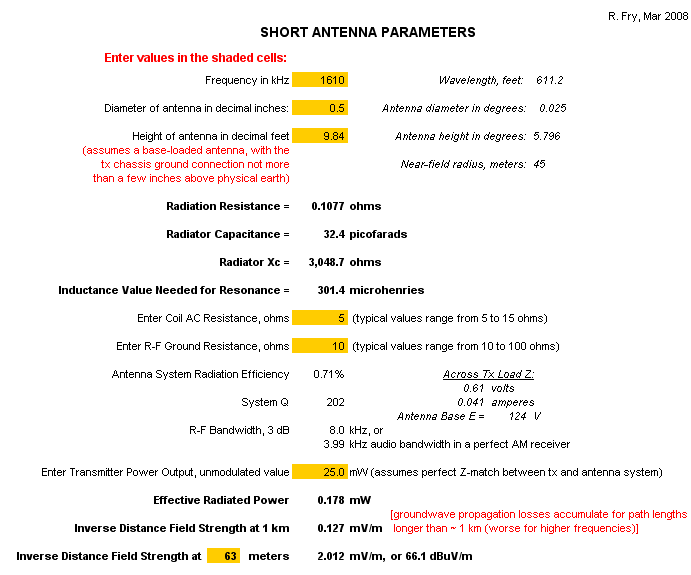
The link below leads to an analysis of such a system on 1610 kHz, where the received audio bandwidth is about 4 kHz -- similar to that of many licensed AM broadcast stations these days.
Also note in the analysis that the radiation efficiency is 0.71%, and with 25 mW of matched transmitter output power the distance to the 2 mV/m inverse distance field is about 207 feet. Without interference this field usually is enough for quiet reception on a cheap indoor radio, and it is interesting to see that the ~200 foot distance is about what the FCC expects for Part 15 systems according to their OET Bulletin 63.
//

Ok, so if I'm understanding correctly, at least part of the reason why a long ground wire would result in more range is because it would represent more of a fraction of a wavelength that is an easy/good conductor for the rf current radiated from the short antenna to return through.
I was just reading an interesting page by G4NSJ where he has the circuit for a simple RF ammeter and mentions that he finds it of more use in tuning his "top band" (160 meter bend, the amateur band closest to AM BCB frequencies) system than most swr meters. What particularly came to mind when reading your post, Rich, was where G4NSJ had said:
"I tune the aerial matching until for maximum earth current. This, as I have checked, corresponds exactly to the minimum reflected power and maximum power into the aerial. I borrowed a decent SWR meter from a friend of mine to check this."
I may be missing something, but at least to my layman's sensibilities, that statement sounds supportive of what Rich is saying in this topic.
It's a short page, and can be found at:
http://www.g4nsj.co.uk/rfamps.shtml
However, what had caught my attention is that the circuit is extremely simple and if one already owns a simple multimeter, then calibrating the circuit to give a reasonably accurate readout wouldn't be very difficult.
Now, if the measure of the current on the wire leading to the ground system can be taken as a fairly reliable indicator of the efficiency of an antenna system (including the antenna, ground wire, and lossy earth), then a simple rf ammeter might be a better tool for comparing part15 AM antenna systems than an FSM. The topic of field strength meters has come up a number of times and it seems to always boil down to the difficulties in calibration to get any sort of a consistent standard of measurement if they were being built by different individuals or possibly with slightly different parts. But measuring current with a multimeter is part of any beginner's usual activities when learning Ohm's law, and adjusting a pot on a homebrew rf ammeter (or making tick marks on a piece of masking tape on the meter face) so it can be used to give at least reasonably consistent readings of the current shouldn't be too hard for most here with an interest in their antenna systems.
Then if one tries a different sort of coil or a different diameter of wire or pipe for the vertical element or whatever sorts of change one might make to attempt to improve an antenna system, the difference from the reading in milliamps before the modification would give a reasonable indicator that would be consistent enough to perhaps be of more use in discussions of designs here.
Tracking things like the differences between the rf current into the ground system (whether it's a buried radial system or the infamous "cold water pipe") during different weather conditions could be interesting, like comparing readings with the same system made after several days with rainfall compared to drought conditions, or when trees and other plants in the area are in full foliage compared to winter and etc.
Just kind of brainstorming the idea here at the moment, since comparison of antenna systems tends to be a recurrent topic of conversation/interest.
Here's another rf ammeter design that was apparently developed for LOWfer and MEDfer use.
http://www.mlecmn.net/~lyle/currprob/currprob.htm
(For those unfamiliar with those hobby distinctions, part15 AM would fall under "MEDfer"). Now, I don't know as either of these designs would be ideal for part15 AM hobby use, but perhaps with some thought and discussion it would be possible to come up with a simple design that would be?
My thought is that if we can come up with even one antenna system parameter that can be tracked as simply as "100 milliwatts input power to the final rf stage", then discussing diameters of antennas or ground wires or number and length of radials and if they're buried or not could be less subjective than "seems to work better". If the design is inexpensive enough and easy enough to build that a number of people could make one and get involved, then we could perhaps get some interesting experiments going from the data collected.
Daniel
Ok, so if I'm understanding correctly, at least part of the reason why a long ground wire would result in more range is because it would represent more of a fraction of a wavelength that is an easy/good conductor for the rf current radiated from the short antenna to return through.
I was just reading an interesting page by G4NSJ where he has the circuit for a simple RF ammeter and mentions that he finds it of more use in tuning his "top band" (160 meter bend, the amateur band closest to AM BCB frequencies) system than most swr meters. What particularly came to mind when reading your post, Rich, was where G4NSJ had said:
"I tune the aerial matching until for maximum earth current. This, as I have checked, corresponds exactly to the minimum reflected power and maximum power into the aerial. I borrowed a decent SWR meter from a friend of mine to check this."
I may be missing something, but at least to my layman's sensibilities, that statement sounds supportive of what Rich is saying in this topic.
It's a short page, and can be found at:
http://www.g4nsj.co.uk/rfamps.shtml
However, what had caught my attention is that the circuit is extremely simple and if one already owns a simple multimeter, then calibrating the circuit to give a reasonably accurate readout wouldn't be very difficult.
Now, if the measure of the current on the wire leading to the ground system can be taken as a fairly reliable indicator of the efficiency of an antenna system (including the antenna, ground wire, and lossy earth), then a simple rf ammeter might be a better tool for comparing part15 AM antenna systems than an FSM. The topic of field strength meters has come up a number of times and it seems to always boil down to the difficulties in calibration to get any sort of a consistent standard of measurement if they were being built by different individuals or possibly with slightly different parts. But measuring current with a multimeter is part of any beginner's usual activities when learning Ohm's law, and adjusting a pot on a homebrew rf ammeter (or making tick marks on a piece of masking tape on the meter face) so it can be used to give at least reasonably consistent readings of the current shouldn't be too hard for most here with an interest in their antenna systems.
Then if one tries a different sort of coil or a different diameter of wire or pipe for the vertical element or whatever sorts of change one might make to attempt to improve an antenna system, the difference from the reading in milliamps before the modification would give a reasonable indicator that would be consistent enough to perhaps be of more use in discussions of designs here.
Tracking things like the differences between the rf current into the ground system (whether it's a buried radial system or the infamous "cold water pipe") during different weather conditions could be interesting, like comparing readings with the same system made after several days with rainfall compared to drought conditions, or when trees and other plants in the area are in full foliage compared to winter and etc.
Just kind of brainstorming the idea here at the moment, since comparison of antenna systems tends to be a recurrent topic of conversation/interest.
Here's another rf ammeter design that was apparently developed for LOWfer and MEDfer use.
http://www.mlecmn.net/~lyle/currprob/currprob.htm
(For those unfamiliar with those hobby distinctions, part15 AM would fall under "MEDfer"). Now, I don't know as either of these designs would be ideal for part15 AM hobby use, but perhaps with some thought and discussion it would be possible to come up with a simple design that would be?
My thought is that if we can come up with even one antenna system parameter that can be tracked as simply as "100 milliwatts input power to the final rf stage", then discussing diameters of antennas or ground wires or number and length of radials and if they're buried or not could be less subjective than "seems to work better". If the design is inexpensive enough and easy enough to build that a number of people could make one and get involved, then we could perhaps get some interesting experiments going from the data collected.
Daniel
Thanks much, Rich, for the fine tutorial on part 15 AM antenna theory.
Daniel,
Thanks for the links. I have constructed and used a RF ammeter similar to the one in the first link in your post. Since my scope works well into the RF spectrum (20 MHz) I use it as a detector rather than the diode and microammeter. Nothing wrong with the design, it is just simpler for me to use the scope.
I found the functional relationship between the secondary voltage and the primary current to be very linear over a wide range of currents. So, with this toroidal transformer I was able to measure the current into my antenna, but due to the phase shift of the transformer which does not agree with theory I was not able to get and actual power measurement. (Power = VIcos(theta) and theta was unknown). The antenna current did correlate with the field strength so this appears to be a decent way to peak tune an antenna/transmitter.
So, here's a question for Rich: If the current measurement is made in the ground lead, would the voltage and current necessarily be in phase? It would seem to me that this is not a good assumption since the phasing would also depend on the antenna Z but I sometimes miss things.
Edit...I realized after I typed the above paragraph that I don't know what voltage I am referencing. The new site is so fast I don't have time to think as I type.
Another Edit...What I am getting at and did not state clearly is developing a way to measure the actual real power delivered to the antenna. It now seems to me the way to do this is to measure the antenna current and feedpoint voltage to ground. I can easily get the apparent power with my scheme, but as I mentioned the phase angle between the V and I with a resistive load does not match theory so I have no confidence in the method as I now use it. I am overlooking something obvious regarding the transformer, probably self inductance or using it as a voltage transformer rather than a current transformer. Just thinking out loud.
Neil
Thanks much, Rich, for the fine tutorial on part 15 AM antenna theory.
Daniel,
Thanks for the links. I have constructed and used a RF ammeter similar to the one in the first link in your post. Since my scope works well into the RF spectrum (20 MHz) I use it as a detector rather than the diode and microammeter. Nothing wrong with the design, it is just simpler for me to use the scope.
I found the functional relationship between the secondary voltage and the primary current to be very linear over a wide range of currents. So, with this toroidal transformer I was able to measure the current into my antenna, but due to the phase shift of the transformer which does not agree with theory I was not able to get and actual power measurement. (Power = VIcos(theta) and theta was unknown). The antenna current did correlate with the field strength so this appears to be a decent way to peak tune an antenna/transmitter.
So, here's a question for Rich: If the current measurement is made in the ground lead, would the voltage and current necessarily be in phase? It would seem to me that this is not a good assumption since the phasing would also depend on the antenna Z but I sometimes miss things.
Edit...I realized after I typed the above paragraph that I don't know what voltage I am referencing. The new site is so fast I don't have time to think as I type.
Another Edit...What I am getting at and did not state clearly is developing a way to measure the actual real power delivered to the antenna. It now seems to me the way to do this is to measure the antenna current and feedpoint voltage to ground. I can easily get the apparent power with my scheme, but as I mentioned the phase angle between the V and I with a resistive load does not match theory so I have no confidence in the method as I now use it. I am overlooking something obvious regarding the transformer, probably self inductance or using it as a voltage transformer rather than a current transformer. Just thinking out loud.
Neil
Neil wrote: What I am getting at and did not state clearly is developing a way to measure the actual real power delivered to the antenna.
At resonance, the real power radiated by a base-driven monopole antenna can be calculated by multiplying its radiation resistance by the square of the r-f current at the feedpoint.
The current distribution on a short, base-driven monopole has a triangular shape -- maximum at the base and near zero at the top.
A close approximation for the radiation resistance at the base of a short monopole is h^2/312, where h is the height of the monopole in electrical degrees. This assumes that the monopole is "in the clear," and not coupling to other conductors nearby. NOTE: This equation is not usable to calculate the radiation resistance of "elevated" or whip/mast Part 15 AM installations with radiating conductors leading from the transmitter chassis (ground leads, ground wires, "lightning" grounds, flagpoles, masts, un-decoupled power and program wires etc).
A non-resonant antenna system will reflect some of the available power back toward the source, and the power it radiates will be less than when it is resonant. If its return loss to the source is zero (infinite SWR) it will radiate nothing at all.
//
Neil wrote: What I am getting at and did not state clearly is developing a way to measure the actual real power delivered to the antenna.
At resonance, the real power radiated by a base-driven monopole antenna can be calculated by multiplying its radiation resistance by the square of the r-f current at the feedpoint.
The current distribution on a short, base-driven monopole has a triangular shape -- maximum at the base and near zero at the top.
A close approximation for the radiation resistance at the base of a short monopole is h^2/312, where h is the height of the monopole in electrical degrees. This assumes that the monopole is "in the clear," and not coupling to other conductors nearby. NOTE: This equation is not usable to calculate the radiation resistance of "elevated" or whip/mast Part 15 AM installations with radiating conductors leading from the transmitter chassis (ground leads, ground wires, "lightning" grounds, flagpoles, masts, un-decoupled power and program wires etc).
A non-resonant antenna system will reflect some of the available power back toward the source, and the power it radiates will be less than when it is resonant. If its return loss to the source is zero (infinite SWR) it will radiate nothing at all.
//
Rich,
I appreciate your reply and I understand your suggestion to use I^2*Rrad and the measured current to obtain the radiated power, but this depends on a good estimation (or measurement) of the radiation resistance. For antennas subject to external influences such as you mentioned this estimated R may be in error which affects the calculated power. I wonder how much this error could be. Perhaps it is small enough that the calculated Prad could be meaningful.
Unless we can measure the actual radiation resistance this may be the best we can do. This measurement of Rrad could be done if the voltage, current, and phase were measured at the feedpoint of the radiating element but given the huge difference between the radiation resistance and the capacitive reactance here it appears this is beyond what can be done with home built instrumentation. I am confident that I can measure the current in the antenna system with a transformer and, along with the measured voltage, the real power delivered could be found. But this would include the power dissipated by the other resistive losses in the system and, since they are unknown, would not yield the radiated power.
So, thanks for helping me as I brainstorm this and if time and energy permit I'll continue pondering this.
Neil
Rich,
I appreciate your reply and I understand your suggestion to use I^2*Rrad and the measured current to obtain the radiated power, but this depends on a good estimation (or measurement) of the radiation resistance. For antennas subject to external influences such as you mentioned this estimated R may be in error which affects the calculated power. I wonder how much this error could be. Perhaps it is small enough that the calculated Prad could be meaningful.
Unless we can measure the actual radiation resistance this may be the best we can do. This measurement of Rrad could be done if the voltage, current, and phase were measured at the feedpoint of the radiating element but given the huge difference between the radiation resistance and the capacitive reactance here it appears this is beyond what can be done with home built instrumentation. I am confident that I can measure the current in the antenna system with a transformer and, along with the measured voltage, the real power delivered could be found. But this would include the power dissipated by the other resistive losses in the system and, since they are unknown, would not yield the radiated power.
So, thanks for helping me as I brainstorm this and if time and energy permit I'll continue pondering this.
Neil
There is one simple way to "measure" the ground resistance of a part 15 AM antenna. This doesn't help with the Rrad measurement, but since the ground resistance is much higher than the radiation resistance, it is the most important factor for a good performing part 15 AM antenna. Ground resistance measurement can be done by substituting a dummy load.
A dummy load which models a part 15 AM antenna is just a capacitor in series with a resistor to ground substituted for the antenna. The capacitor needs to be close to the antenna capacitance. This can be found by trial and error with a selection of capacitors in the range of 22 - 32 pf. Try various values until you find one that produces a tuning peak as near as possible to the antenna resonant frequency. Silver Mica 500 V capacitors are best for lowest loss and appropriate voltage rating.
Then select a resistor for the dummy load by trial and error that that results in the same RF current as the antenna. The RF current can be measured before a series-loading coil (low impedance point). You only need a relative measurement so you can select a dummy load resistor that results in the same current as the real antenna.
This method should be independent of the losses in the series loading inductor.
RMS POWER ALERT!
I think there should be a distinction made between peak power and RMS power. Nobody seems to talk about this. Transmitter input power as determined by the DC supply voltage and current feeding the RF stage of a transmitter is equivalent to the RMS RF AC output power of a 100% efficient RF output stage. Peak RF power is Ipeak * Epeak. RMS power is Ipeak *.707 * Epeak * .707 = Ipeak * Epeak * .5. A scope or simple diode detector will measure the peak voltage or current. RMS power is only one half the peak power. This should be taken into account when measuring power. For example the referenced equation, I^2*Rrad, should use the RMS value of I to get the real power from peak I measurements. When measuring peak current, the equation should be: RMS Power = Ipeak^2 * .5 * Rrad
Phil
There is one simple way to "measure" the ground resistance of a part 15 AM antenna. This doesn't help with the Rrad measurement, but since the ground resistance is much higher than the radiation resistance, it is the most important factor for a good performing part 15 AM antenna. Ground resistance measurement can be done by substituting a dummy load.
A dummy load which models a part 15 AM antenna is just a capacitor in series with a resistor to ground substituted for the antenna. The capacitor needs to be close to the antenna capacitance. This can be found by trial and error with a selection of capacitors in the range of 22 - 32 pf. Try various values until you find one that produces a tuning peak as near as possible to the antenna resonant frequency. Silver Mica 500 V capacitors are best for lowest loss and appropriate voltage rating.
Then select a resistor for the dummy load by trial and error that that results in the same RF current as the antenna. The RF current can be measured before a series-loading coil (low impedance point). You only need a relative measurement so you can select a dummy load resistor that results in the same current as the real antenna.
This method should be independent of the losses in the series loading inductor.
RMS POWER ALERT!
I think there should be a distinction made between peak power and RMS power. Nobody seems to talk about this. Transmitter input power as determined by the DC supply voltage and current feeding the RF stage of a transmitter is equivalent to the RMS RF AC output power of a 100% efficient RF output stage. Peak RF power is Ipeak * Epeak. RMS power is Ipeak *.707 * Epeak * .707 = Ipeak * Epeak * .5. A scope or simple diode detector will measure the peak voltage or current. RMS power is only one half the peak power. This should be taken into account when measuring power. For example the referenced equation, I^2*Rrad, should use the RMS value of I to get the real power from peak I measurements. When measuring peak current, the equation should be: RMS Power = Ipeak^2 * .5 * Rrad
Phil