

This is probally a stupid question, so I'm going to ask it..
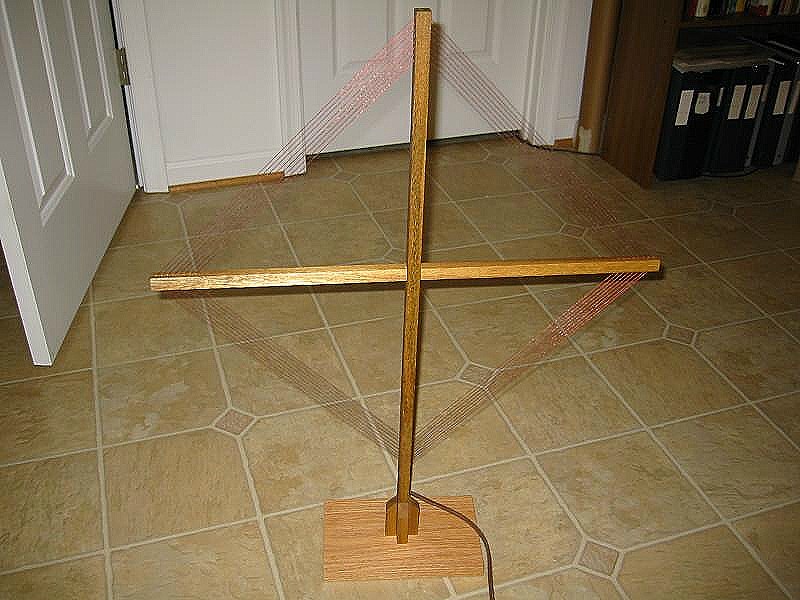
I'm going to construct a loop antenna as described here: http://www.mile204.us/PotsdamDan/RubeGoldberg/Ultimate_AM.html because it's so simple and looks better (to me) than the more common designs which kind of look like a failed attempt of building a kite..! whatever..
Anyway, as you see this version mounted positioned is as a square, whereas almost every other one I've ever seen is mounted in the posistion of a diamond, or it's round.. I can't help but suspect there must be some reason for that.. is there? Or does the shape make no difference at all?

Most others are like this:
or

In case you missed it, my question is; does the shape of a loop antenna have any bearing in the performance of it's receivng capability?

I have 2 nice homemade square
loop antennas that are very much
like your second picture down from
the top.
One of them is about 40
years old. I used to use it for daytime
AM broadcast DXing. With a Hammarlund
HQ-140X, I was able to receive lots of little
daytime only AM stations in states outside
of Connecticut, where I lived then (and now.)
They both were wonderful for nulling out
RF noise.
I don't know about other shapes, but
square is real good, even if it is just a
diamond rotated a little bit. I don't
think it makes much difference in a practical
sense.
Bruce, DOGRADIO
Most of the MW (Medium Wave) loops we see are usually fairly large, but I have a component AM tuner that has a small MW rectangular loop contained within 1/4" plastic piping, dimensions 6" X 2.5". It is mounted to a swivel on the rear of the tuner so that the loop can stand out at right-angles to the back of the tuner, or swung flat against the back of the tuner. It also can be lifted off and has a 2' wire so that it can be placed away from the tuner a little bit. It works amazingly well for reception.
I am thinking the same question about whether the shape of a loop makes any difference is possibly comparable to a question I had as to whether the shape of a loading coil made any difference, and somebody told me it did not matter. So I made the loading coil for my AMT3000 triangular, and it loads up wonderfully.
The shapes shown in your pics all would work well for receive applications, but small loop antennas have relatively high losses when used for transmitting in the MW band.
Below is a table showing the performance of a loop designed for Part 15 AM. Its radiation efficiency is about 5 dB worse than the typical Part 15 AM setup on 1650 kHz using a 3-meter whip, loading coil, and legal-length connection to an r-f ground in the earth.
Also the loop r-f bandwidth is only about 3 kHz, which would reduce the high frequency audio at the receiver output by 3 dB or more starting at 1.5 kHz (worse than a telephone). The 3 dB r-f bandwidth of a 3-m whip with coil R of 15 ohms and ground R of 50 ohms is 10 X greater than this loop.
The Potomac Instruments FIM-41 calibrated field intensity meter uses a receive loop with an almost square shape, embedded in the cover of the meter case.

Ahhhhh. the 140X. I wish I still had mine.
http://members.cox.net/rwagoner/columns/antenna.gi f" alt="" align="right" />
 The above pvc loop antenna calls for 6 foot of round telephone wire with four solid 22awg wires.. the design of which he said is based on this wood constructed loop found at https://web.archive.org/web/20070127072856/http://members.cox.net/rwagoner/columns/am_antenna.html which also calls for 4 winds of wire..
Would it be better to use more? Like maybe 8 or 12 winds?
He states "The idea is that the size of the antenna acts as a long wire antenna, but the loop acts as a local noise eliminator."... So it seems to me that more wires would result in improved performance (receiving). Is this correct?
Also, what is it about the manufactured round loop antenna that makes them to be so expensive at hundreds of dollars each?
What is meant by the "size" of the antenna?
That could refer to the vertical height or the horizontal width or both.
On the other hand maybe it refers to the legth of the wire used to make the loop.
The rest of the description seems clear, unless I am misunderstanding something else.
Would it be better to use more? Like maybe 8 or 12 winds?
You might want check out sites like this one (Google) ...
http://www.smeter.net/antennas/multiturn-receiving-loop.php
I checked out that site and tried the software..
Neat program, but I began to get lost in entering the data..
Leght of one side of square I entered 305 mm
Number of turns of wire on the frame, I entered 4
Diameter of the wire, I ented 1.0 mm (? no option for awg)
Ratio, I entered the default 1.05 (because I had no clue)
For Frequency, kilo-hertz.. I put in 1700 (uh.. ??)
Anyway, the results I received was a such;
=========================================================
Inductance........................ 18.5 micro-henrys
Inductive reactance............ 198 ohms
HF loss resistance............... 0.00 milii-ohms
Self-resonant frequency...... 3.7 mega-hertz
Total capacitance req.......... 473 pico-farade for resonance
deduct stray capacitance..... 98
Aprox. coil Q...................... 151
Width of winding................. 4.2 milli-meters
Total length of wire............. 4.88 meteres
Impedance seen across loop.... 29.9 K-ohms, when tuned to resonance
Impedanch seen by receiver....1.9 K-ohms, via 1-turn coupling loop
=========================================================
Sigh...
Umm.. would it be better to use more than 4 winds? Like maybe 8 or 12 winds?
To John at WDCX: There are still plenty of HQ-140s
and other Hammarlund receivers out there. I
saw an HQ-145X on E-bay a while back that had
a good price. I always wanted an HQ-180, but I
guess that won't happen anytime soon. I have
an HQ-140X. It's my second one. I either lent
or sold the first one out to a good friend. Anyway,
we had some kind of questionable understanding
between the two of us, and then neither of us understood
what it was, I guess. So the radio never came back to me,
but the dude on the other end was a great friend, so it
sort of didn't matter. He had left the U.S., anyway -
to do an international job. So the first one is gone,
but the second one is actually a little better, so it
worked out OK. The first one went away in about
1982. I got the second one in 2007.
On another subject, I sure like the idea of an
indoor Part 15 AM transmitting loop. I know
it is not an efficient transmitting antenna - but
it is self contained and I also think loops look
really neat. If you want to transmit just nearby,
I does it's job and just sits on the table nice and neat.
I actually love loop antennas. I say just try different
turns and sizes and shapes, and whatever.
It's fun!
Bruce, DOGRADIO
P.S. I love all of the info you guys put up
on this thread, by the way.
Sigh...Umm.. would it be better to use more than 4 winds? Like maybe 8 or 12 winds?
The radiation resistance of a loop antenna increases by the square of the number of turns, while losses increase in direct proportion to the number of turns. Higher radiation resistance with respect to the losses in a loop antenna improve its performance, so 12 turns would be better than any number of turns less than 12 (other things equal).
Here is a link to some homemade multiturn loop receive antennas http://www.mtmscientific.com/loop.html
If you are not looking at this as a construction project you might consider a "Select A Tenna." I'm not sure they are still manufactured, but I saw some on EBay http://www.ebay.com/sch/i.html?_kw=select-a-tenna+antenna
Square or round is a choice usually determined by the construction method and materials available. If building a frame from wood or plastic pipe square is easier.
It is the enclosed area and the number of turns which affect performance. If resonance is wanted then the number of turns needs to be considered. Much of this was covered in other posts here.
This link http://www.part15.us/forum/part15-forums/general-discussion/basic-loop-antenna-and-field-strength-meter details one I built for receive and "signal sniffing" and might be worth considering since it was easy to build. The size of the wire used doesn't matter much and I used some which is about #28 from an old TV focus coil.
First try, with this connected to my BC-1004-C receiver I heard a Radio Chechnya short wave station with a very strong and clear signal. The loop was not tuned. One great advantage is that usually by rotating the loop you can null out noise or other stations.
I have not tried this for transmitting.
Neil
Do any high power stations anywhere in the world use loop antennas for transmission?
Carl, some hams us rhombic loop antennas for transmit and receive with success. I can't be certain but I think the VOA Bethany Relay Station near Cincinnati used these. They had several "curtain" antennas also.
A web search for rhombic antennas and short wave broadcast may give some information.
Neil
I have an active VHF/UHF receiving antenna, the UHF portion of which is a cicle (loop) of silver, broken at the bottom so each leg can be fed in a balanced fashion.
Also, there is good description of rhombic antennas in Radio Handbook, and now that you've pointed it out, Neil, I spot the similarity to the loop antennas we've been talking about.
The rhombics described in the book are specified as high frequency antennas, but the frequency chart shows a low end of 3.6 MHz, which isn't terribly above the medium wave band.
For receiving purposes, now thinking in terms of Part 15 medium wave, loops and rhombics look like a good way to go.
If loops/rhombics of 3-meter height or length have any use for Part 15 transmission it would be worth an article in CQ Magazine.