

Seen a lot of basic crystal radio receivers on the net that require no electricity.. I find this very intersting gadgets. I suspect there are several people on this board who have built them at some point.
Curious to know the recieving and auido quailty capailities of such a receiver?

If a nearby station is close enough and strong enough can a crystal receiver intercept enough energy to light a low voltage bulb?
Well.. I would suspect it could certainly light an led bulb
when I was a little kid. It used a galena crystal and a cat's whisker with tuning via a slider along a coil. I still recall using sand paper to make a bare track along the top of the coil for contact with the slider.
It came with an ear bud type phone and it didn't sound good but my cousin gave me an army surplus headset and this helped quite a bit.
The sensitivity wasn't very good and we lived out in a rural area with the nearest AM stations (mostly 5 kW) about 30 miles away so only a few stations could be heard until...
I discovered that the phone line made a great antenna! No recollection of the fidelity since this wasn't in the vocabulary back then but a crystal or diode will introduce some distortion with how much depending on the non-linearity of the detector. The audio volume was whatever the signal strength would provide and was usually low.
When transistors became available there was a design which derived power from a strong station but could be tuned to another station with the audio amplified by the transistor but I didn't have one of these.
It was fun to build and use but I had my own tube type radio procured for a quarter at an auction so I didn't use the crystal set much.
Neil
I started building these when I was a kid. I was lucky enough to have 2000 ohm headphones and a wire antenna that was 145 feet long and strung over the neighbor's yard to a barn from my 2nd story bedroom window. The ground wire was about 20 feet long to a ground rod. I made the coil that was about 1 foot long and 2 inches in diameter with tightly wound enamel wire. The crystal was a 1N34 looted from the demod coil of a black and white tv. I used a variable cap from an old radio. I also made a slider to vary the inductance. With this arrangement I could bring in stations in Ohio from south western Michigan. I could also hear old LORAN stations as well as the 160 meter band when hams were using AM. If they were ising SSB I heard Donald Duck. 🙂
My first crystal radio was the Remco Tiny Tim. A nice little portable about the size of a pack of cigarettes. Had a folding 3 section antenna and a grounding wire. The earphone was a crystal type. I still have a Tiny Tim.
Then another Remco crystal radio more of a desk radio. Also used a germanium diode and slider on the coil. That one didn't work as well. I still have one of these.
Then came a Cub Scout crystal radio. This one similar to Neil's description with a Galena crystal and cat whisker. It had a single earphone, metal diaphram dual coil. I still have one of these.
Then I made a "fox hole" receiver using a Gillette blue blade with a piece of pencil lead. Together that formed the diode. Add a coil and earphone and you could hear stations.
I hook them up once in a while just for old time sake. They still pick up the same 3 local stations.
Just like a rotary telephone, most kids don't know what you're talking about when you mention crystal radios.
I'm in Connecticut. With a 150 foot wire
I heard the Cuban time station on 570 kHz:
Radio Reloj. I could receive WFAN, 660 kHz,
New York, 24 hours a day from 100 miles away.
I also heard ham radio stations on the 160 M band.
But Indoor antennas work, too. Obvously not
as well, but I was working on a crystal radio
indoor loop a few weeks ago. With that loop
I could receive several local stations.
The crystal receiver was/still is a Heathkit CR-1.
The CR-1 is widely sought after, although I think
there are other crystal radios that are much better.
The CR-1 was marketed as a "bomb shelter" receiver
during the cold war. Heathkit stopped making them
in 1962, I think. The CR-1 has the old Conelrad markings
on the dial - 640 and 1240 kHz.
I could talk about this all day. I love crystal radios.
Bruce, DOGRADIO
A REMCO Transistor Radio, circa late 50's http://www.ohio.edu/people/postr/bapix../Remco.htm. It was really just a crystal radio despite the name. It had exactly 3 more components than the REMCO Crystal Radio: a resistor, an early point-contact transistor as an audio amplifier and a 1.5 V battery. The crystal was a 1N34A.
I just dangled the antenna out the second story window and connected the ground wire under the screw in the center of the valve on the hot water radiator.
Being in a very rural area, I got mostly nothing during the day, but at night it came alive with a jumble of signals. I don't remember actually hearing an AM broadcast band station. The jumble was obviously short wave signals like morse code and foreign languages.
I somehow thought I might get better performance by increasing the battery voltage with another 1.5 V in series, so I tried it. That made a dramatic improvement. Daytime reception increased to the former nighttime level and nighttime was a cacophony of loud signals. That lasted for a day or two before the transistor blew out. Then I junked it in frustration. Hey, I was just a kid!
Check the web for crystal radios. The hottest ones no longer use the increasingly harder to get 1N34A crystal. They are now using a "zero threshold" mosfet IC connected without external power. The 1N34A has a threshold voltage of .3V. The mosfet has a zero threshold, so it responds to lower RF voltage allowing tapping down on the coil, which results in higher tuning Q. http://www.arrl.org/files/file/Technology/tis/info/pdf/culter.pdf
Ha!.. the telephone handset as the earphone nade me grin,,
The telephone handset is probably
very sensitive.. Old sound powered
handsets from many years ago are
supposed to work really well. Many
crystal set builders try to get the
most sensitive transducers possible.
I don't think it is very easy to find
these kinds of transducers.
That zero bias chip looks like a lot
of fun. It's funny - I've done a little
bit of crystal set dxing. Sometimes
something is so soft in volume that
you are not even sure it isn't your
imagination. But I guess there is
SOME voltage there, because the
diode (I think there is a 1N34 in my
radio) is conducting.
I thnk building a hi sensitivity crystal
set is sort of like building a streamlined
car or plane.
The best transducer you can find - the best
wiring (litz wire) the highest Q coils - best
detector - all are needed. And the best
mounting hardware - etc. etc.
Neil - I really like your "3 part radio." that
sounds llike a lot of fun. You could call
it a "propagation monitor," or something
like that.
Very interesting.
Bruce, DOGRADIO
How long was the antenna on your
Remco 3 part radio? I think it
would be fun to build one. Oh -
I see - a little more than 3 parts.
I missed that. Well, anyway...
It sure wouldn't cost much
money.
Bruce, DOGRADIO
Sorry, Neil. I just read the link and
it answered all of my questions.
Because of retina problems, I miss things
sometimes. I didn't see the link you had there.
Wonderful stuff.
If I remember correctly, my uncle built a one
transistor radio not too long after transistors
came out. He made it from scratch, and the
transistor cost him a tremendous amount of
money. The figure I remember is $40 in 1950s
money, but that cost probably isn't right. It
seems too high. It seems to me, the first
transistor radio (the Regency in 1954 (?))
cost about $40. I beleive the Regency came
in lots of different bright colors. That's not
too different from the IPOD, which is already
obsolete and going out of style. We have several
IPODs here, in several different colors.
It's so much fun to talk about this.
Bruce, DOGRADIO
Bruce, DOGRADIO
Sometime in the 1980s, in my collection
of communications gear, sat a very very
minimal Radio Shack crystal set for the AM BCB.
One night while tuning around, I received a radio
station that I could not find on the AM dial of
another radio I had there.
Finally, after listening to it for a while, I realized
it was Radio Canada International from Sackville,
Canada, on 5960 kHz. So this SW transmission
was literally just "leaking" into the crystal set,
that's how strong it was.
I went over to my Icom R-70A and tuned into
5960. The Canadian signal was 50 to 60 dB
over S9. I guess that explains why it was
getting into the crystal set, even though the
frequency heard was out of the set's range.
Bruce, DOGRADIO
I once had one of these, and wish I had one again. While it is basically just a crystal set, it was designed to be a component tuner, connected to an input (probably microphone or ceramic phono) of a HiFi amplifier. It was marketed as a serious HiFi tuner, with no tubes or power supply to introduce unwanted hum or distortion. It really did sound good, too!
Here's the photo/schematic/instructions as several JPG files:
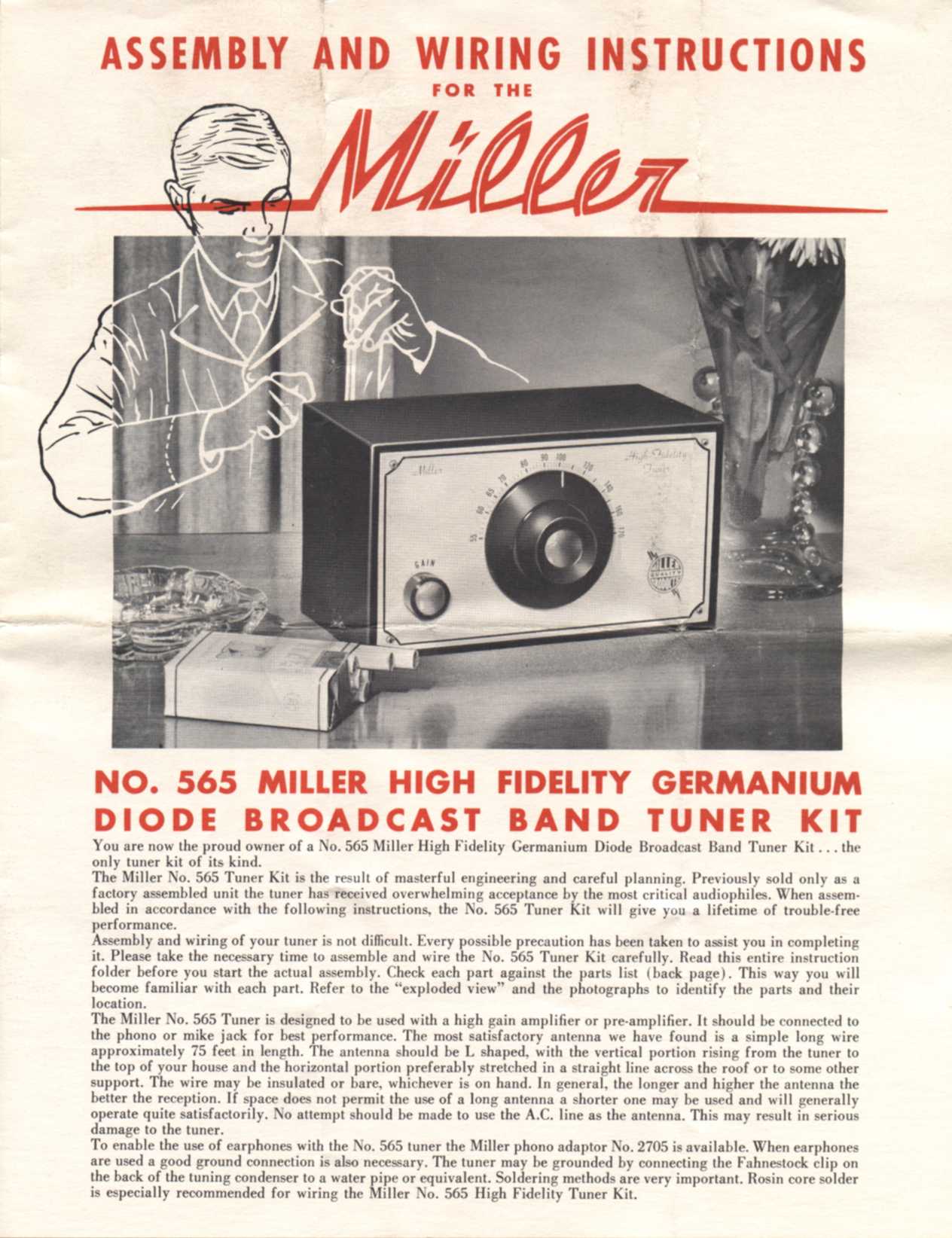
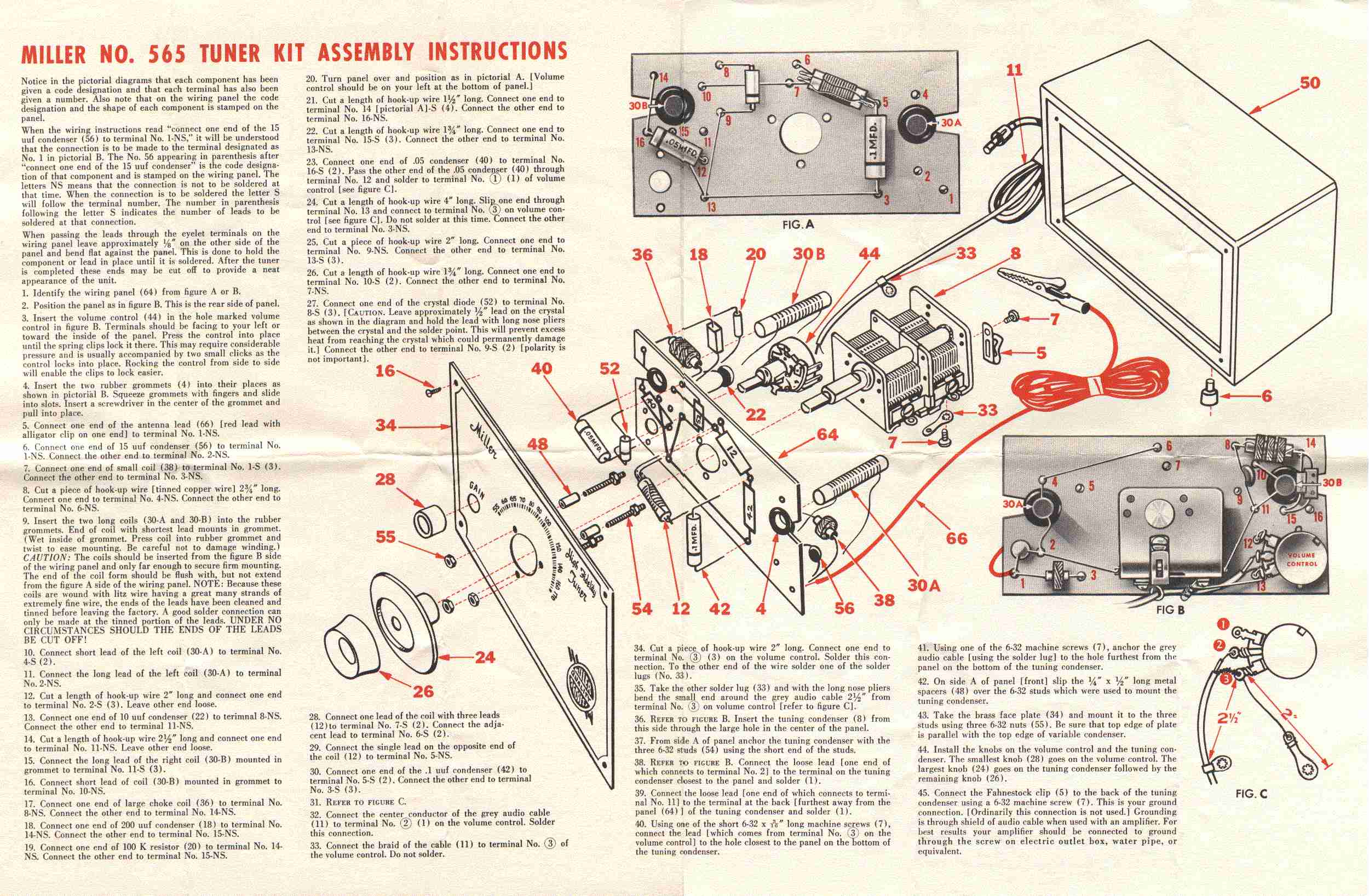
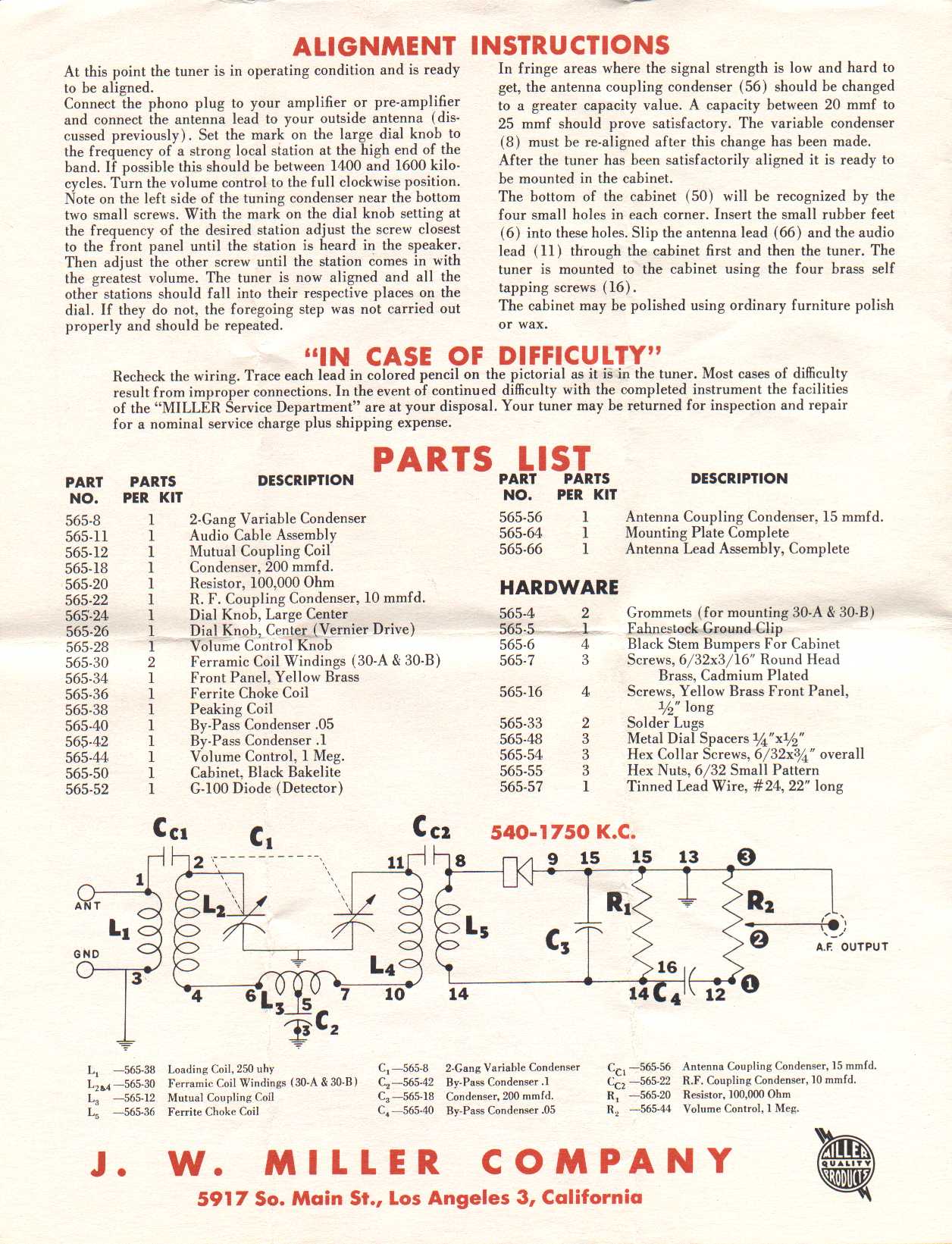
is a beautiful piece of gear.
I think they are pretty rare, but I
really don't know.
I put my Heathkit CR-1 through the
stereo system when I was about 14.
It sounded really good, too.
I guess you can't be too far away
from the broadcast station.
Bruce, BOGRADIO