

I've been thinking a LOT about the state of broadcasting in the United States.
One thing that keep reappearing in my mind is the consolidation of stations (Clear Channel, Cumulus, etc.) and their propensity to buy these 50,000 watt blow torches.
I think if we want Part15 rules to expand and give us more power, longer ground leads, etc. then we need to start calling for an end to these licenses of gross watt broadcast abuse.
Was listening to a big station out of Boston earlier this evening. Not because the programming was good, no, that sucked royally. Rather, I was curious where this station was since it was so darn strong on my little kick about Eton FR-250 receiver I love.
I was might miffed when I heard the traffic, knew it was Boston, then confirmed when they said their call sign.
Uggh! Boston is 585+ miles driving distance.
You know how many stations have the same syndicated crap within that 585 miles? Tons.
I wonder how many FCC enforcement actions are initiated against unlicensed broadcasters at the bequest of this blowtorchers?
To think, that crazy Boston station proudly brags with a cart they play about being able to hear them in 38 US States. That shouldn't be. No valid license use doing that. That's just an assault on the spectrum and reduction of usable frequencies on the broadcast band.
To get more, we have to start taking watts off these big licensees. You don't need 50k watts to cover a metropolitan or extended metro area.

I think these should be charged an interstate fee for their signal invading other states, where their signal takes up what is normally vacant spectrum where localized stations can be on the air with a staff meaning jobs and economy.
Say..50K a year to each state it invades. Yeah that sounds fair!
My vote is in.
RFB
Censoredship has identified the iceberg and the tip.
The 50kW stations are fossils from an earlier time, when America was mostly outlying farmland and the powerful stations brought radio to the sticks and boondocks where very few small local stations existed.
Since then smaller radio stations have been licensed over every square mile and the 50kW stations have become dinosaurs.
The waste of electric power is part of the global warming problem, and should be halted at once.
The benefits of ending high power AM radio are great: spectrum would open up for many new medium-power stations serving localized regions; many new jobs would result; the public would be more fully served with choice and vital information.
Along with it part 15 AM rules need to be relaxed to allow earnest programmers to bring their work to the public, as a matter of artistic freedom.
Christmas tree lights and other mindless devices spit racket under part 15 and never receive a NOUO. Let's allow some intelligent audio to join the mix.
Bravo! Good post. This needs to be addressed.
Carl Blare said:
"The 50kW stations are fossils from an earlier time, when America was mostly outlying farmland and the powerful stations brought radio to the sticks and boondocks where very few small local stations existed."
My history in radio isn't very long or detailed other than being an end "consumer".
Where in the past 50 years could a 50KW, 25KW, or even a 10KW watt AM station truly be justified? A 10KW station is an insane amount of power, even where topography is endless mountains and small valleys.
On the flat open land, 10KW is enough broadcast juice on the AM band to go 1000 miles and still be heard.
I can't envision where and when, in history that such large broadcast licenses were justified and rubber stamped by "authorities". Only way I guess the licenses make sense is reaching listeners who didn't have radios by beaming so much power that they teeth and other objects started resonating and playing the signal absent a radio.
"I can't envision where and when, in history that such large broadcast licenses were justified and rubber stamped by "authorities". Only way I guess the licenses make sense is reaching listeners who didn't have radios by beaming so much power that they teeth and other objects started resonating and playing the signal absent a radio."
Although funny, it has happened even with 1Kw and less stations..ie resonating something besides the detector circuit in a radio receiver. There have been documented reports of people hearing stations in their heads due to high level RF making their fillings in their teeth resonate, or braces, or things like metal plates or pins keeping bones together.
Another example of this is someone with a pace maker are advised to stay away from any high level RF device like a microwave oven or even CB radios and cell phone sites. The high level RF can interfere with the pace maker pulses which keeps their heart beating normally or correcting the erratic heart beat in check, sometimes even stopping the heart and the poor person dies just because they wanted to warm up a plate of munchies.
And there are reports of this resonance being heard from high level RF signals without those metal objects in the body.
Back in the day when radio was new, populations were scattered and spread out unlike today where it is all crammed like sardines in a can. In those glory days, high power levels were common place, some of which went way beyond 50Kw. Some were operating well above 100Kw and even more. As population increased in density in areas, the power levels above 50Kw were not needed, and it was necessary to reduce those ultra flame thrower power levels down in order to prevent drastic interference to areas that found themselves in-between the two high power RF emitting points. Plus in order to allow more stations to be put on the air, it was necessary as well to reduce those ridiculous power levels and thus local coverage classes of stations began to spring up everywhere.
But if you think 50Kw is flamethrower, look up the Megawatt flamethrower Long Wave stations currently on the air in Europe! There are a few out there throwing up to 5 MW of long wave power! And in the day of the cold war, the Soviet Union maintained "buzz saw" stations known as "Electronic Iron Curtains" that operated with MW of output power, spreading that buzz saw love all over the planet!
RFB
Good historical piece @RFB! Thanks for sharing.
Even years ago when things were per se more rural, why were just large Kw (50Kw+) even necessary? Where receivers then that darn lousy?
Are you aware of any actions over the year to trim watts off these big stations?
Megawatt stations, yikes! What in the world are they doing with all that power? Not so bad since it's not on the public radio band the masses use though.
"Megawatt stations, yikes! What in the world are they doing with all that power? Not so bad since it's not on the public radio band the masses use though."
During the cold war era, the Soviet block transmitted megawatts of buzz saw noise all over the place on the shortwave bands and long wave bands. In Europe they also had buzz saw transmitters sending out buzz luv on the MW bands in that region of the world. Sometimes during real good skywave one could be picked up on the MW band here in the US.
In the 60's thru the 80's, Cuba set up a series of buzz transmitters along their northern coasts to block out US broadcast signals from entering their little island paradise, often causing serious problems with US broadcasters along the southern coast. Eventually Cuba ceased those nasty operations in treaties and by the time of the fall of the Soviet Union, all those buzz luv stations went into history.
They were quite irritating when trying to DX the SW band.
But on the lighter side of things, and in about that same time frame, there were 250 and 500 kilowatt AM stations out of Mexico..one famous one was called XERF on 1570, which pumped out a whopping 500KW! Another was located in Ciudad Warez Mexico, XERO on 800Khz. Both of those stations had quite a history and both covered the entire US continent with a loud clear signal. I remember them both, tuning in to them daily and listening to great classic rock and hearing DJ's like Wolfman Jack and a few other famous names. Man were those REAL radio broadcasts!
RFB
On the flat open land, 10KW is enough broadcast juice on the AM band to go 1000 miles and still be heard.
Below is a link to a graphic about this from an article appearing in Radio World Engineering Extra (June 8, 2011), and reprinted in the Summer 2011 Edition of the IEEE Broadcast Technology Society Newsletter.
This chart was referenced to the groundwave propagation curves of the FCC for AM broadcast stations of several power levels and very good earth conductivity, over most of the AM broadcast band.
A field of 0.5 mV/m (shown in the chart) is getting close to the limit for useful reception in quiet areas, assuming no interference from other broadcast stations.
I agree with many here who point out that there isn't much value to them in a high power AM station that broadcasts the same programs in the same time slots that are available on local, lower-power AM stations.
But OTOH, the high-power station may be providing one of few signals that are useful in some parts of its daytime coverage area.
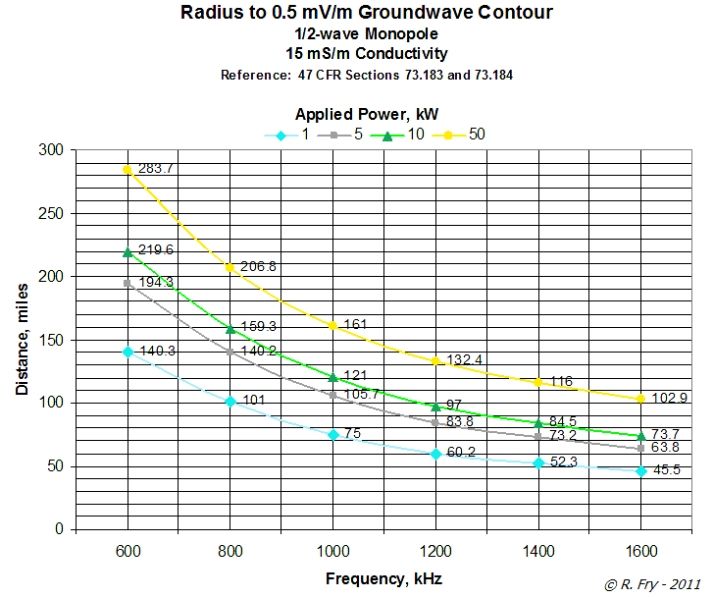
Excellent chart Rich. However what that chart is leaving out is population density factors within those ranges.
On average across the US, where are any cities or towns separated by more than 175 miles, especially East of the Mississippi?
Even West of the Mississippi it is very difficult to find a gap between two cities or towns of 175 miles, and according to the chart, even a tiny tot town sporting a 1Kw station on a local channel..say 1230 for example, covers enough range that chances of a population between those two towns getting no radio service is pretty much next to nill.
If we move to the next power class..5Kw, and take the same distance of two towns at 175 miles apart, that 5Kw covers right up to the edge of half of 175 miles distance, again pointing out the chances of a population right in between the two towns will be served by a station in either or of the two towns. One of them will have at least a 5Kw station. Or the tiny population town all alone in between the other two will most likely have it's own local station of the 1Kw class.
And as noted, the higher power stations may be serving some area somewhere, but it is highly probable that the area being served by the high power station, a local station will be nearby carrying the same programing in the same time slots.
There isn't any need for a station in Washington DC (WTOP 1500) and one in Minneapolis MN (KSTP 1500) to be needing to serve Casper Wyoming with sports programing when Casper has AM 1400 KKTL, a sports programing station.
Now somewhere between Casper Wyoming and those two cities just mentioned, there is bound to be more stations at lower power classes carrying the same programing (ESPN Sports), thus the two power house stations are again not needed.
Getting more local towards those two major cities, chances of even more of the lower power class stations carrying that same sports programing will exist on other frequencies, again nullifying the necessity for those two 50Kw stations to be needing to throw a signal as far as they do.
As I pointed out earlier, back in the hey day when there were cities and towns separated by more than 175 miles due to thin population density, the 50Kw clear channel stations were needed. But not in today's heavy population density which is continuing to increase more than what was even anticipated back in the hey day of radio.
There really should be a hard examination by the FCC to the necessity of keeping these 50Kw stations going when their signals are simply occupying too much space (distance) especially at night when local stations can do the job, and do it with a clear solid signal rather than one that will tend to come and go with skywave variable.
RFB
I really wish this forum had the edit function returned as the need to repost a new post to simply add is quite annoying, and needlessly adds to the thread pages btw. Consider putting the edit function back please.
"But OTOH, the high-power station may be providing one of few signals that are useful in some parts of its daytime coverage area."
Very true, however those stations should bump the power level back at night because even if said 50Kw station is providing a service to some parts of its daytime coverage, again due to population density factors, there most likely is already a local station with the same programing a lot closer to that area.
RFB
Paul Thurst and his Engineering Blog makes the chilling suggestion that we document the tower sites and other aspects of aging AM stations before they disappear, and he gives an example.
1310 kHz, WDTW in Detroit, Michigan, has been removed from service.
As Paul reports, Clear Channel donated the license to Minority Media and Telecommunications Council, but NOT including the towers and land.
Paul links to a video showing the towers being demolished.
He estimates that the new licensee may never have the means to develop a new tower site.
Part 15ers in Detroit now have 1310 to play with.
@Rich, while the graph/chart shared is nice, it seems FAR from accurate.
I've been getting two pretty strong signals on the upper side of AM (1600-1700) that are 1Kw and 600 watt stations. Those two stations are some 283 driving miles away. Direct air miles are less, but still way above the limits in the graph.
According to the graph at 1Kw should be 45.5 miles on upper freqs and 140.3 miles on the low band.
Yes, I am speaking of night time signal reception. But, I know I can pick those stations up most daytimes too on my little hand held with just the internal antenna.
Since most signal propagation is a circular out pouring, even with a 45 mile range you are talking about an insane amount of acres covered and that is at 1Kw.
I wonder how common enforcement actions against low power unlicensed folks are at the bequest of these huge stations?
The assigned carrier frequencies in the "extended band" for licensed AM broadcast stations in the US are spaced at 10 kHz intervals from 1610 kHz to 1700 kHz.
Some of them are authorized for 10 kW daytime, but none for more than 1 kW nighttime (even less in some cases).
There are many fewer AM broadcast stations on a given frequency in that part of the r-f spectrum than on many lower frequencies, so it is not uncommon for them to be received at relatively long distances -- especially at night via their skywave signals.
Some US "ham" radio operators using the 160-meter band (around 1800 kHz) have been received many thousands of miles away, when using much less radiated power, and more inefficient antenna systems than required of licensed broadcast stations in the US expanded band.
The values in the chart to which I linked show the daytime fields relative to the FCC propagation charts, the accuracy of which charts has been shown by 1000s of accurate measurements taken over many decades.
.5 mv/m is 500uv/m. That translates to a signal at the antenna of a portable radio of about 200uv, and it would have to be a pretty bad radio not to receive that signal.
Most portable radios can easily receive signals of around 100uv, and many good radios, i.e., home stereos, go down to 25uv or so.
So I would imagine that at best, that chart is a worst case scenario, and most radio stations should be able to get listeners far beyond that .5mv/m limit.