

Almost a year ago, I bought a Chez Procaster. I know what the FCC Rule says in 15.219 on the Ground Lead. I'm more interested in lighting protection for the transmitter than range.
I'm going to have it installed on the size of my house going up 10 to 13 feet for the transmitter to clear the roof.
Chez says run a wire to a ground rod that is 8 feet. Viloation of the rule 15.219. My question is can you just ground it to the galvanize pipe I'm using against the house, or just take a risk and use no ground lead at all?

You can try the elevated ground by using the metal gutter around the roof. I'm not sure but I'd think with no path to the earth lightening may avoid it.
Yeah if you have a long ground wire to a stake in the earth from the roof it would violate the ground rule.
The procaster also has a gas discharged arrestor to protect the output amp but I don't know how good it would work with a lightning bolt.
I think if you just had no ground and the antenna a full 118" 3 meters and it's on a wooden post above the roof with no path to earth the chances of a direct hit are no to likely.
I use the Procaster and I've posted on this forum my range with it indoors no ground and a 3 meter wire clipped on to the top post.
Look here......post number #115337 in general discussion.
So with the transmitter outside and higher than the roof you should do better. Even with no ground.

Best bet is to install at ground level away from the house, with a short ground lead to a pipe pounded into the earth.
I would not run it ungrounded if you live in an area with the possibility of lightning, regardless of what you decide.
To add to my post I forgot even with no ground you still have the power and audio cable into the house and a path for lightning to come into the house through that to electrical ground but I was told that the connections from the studio to the transmitter has the shield connected on the transmitter side but not at the studio and asked what it's for if not connected at both points and was told lightning protection.
But a wire to a stake in the ground is a lightning magnet so best to use no ground or the metal gutter around the roof. Some of this is covered in the manual.
Post 3 on this.
Ask Timinbovey on this forum about this as he uses a Procaster on a tower with no ground as I understand and he can give you good info on this subject. I think he has been running this for 7 years? Forget what he said, but he hasn't had a lightning strike that he has ever mentioned.
I got to thinking this evening and I think the metal gutter on the roof is the best place to attach the ground lead. The gutter is just floating and not attach to a earth ground, like trees are. Here where I live, trees get hit by lightning. I saw one that got hit earlier this year before the Pandemic at a home of a friend of my wifes. It nearly hit the house during the storm!
With that said, I am a former FCC Licensee for 27 years. In a nutshell, the station was failing financially, I'm not doing great heath wise, the bank wanted to reposition on the tower site property and studio building, so I sold the building and property and turn in the FCC License. It was just a AM Daytimer. At least I got $14,000 for the sale of the building and property.
I still have a FCC Attorney I can call, but I'm not worried about doing something wrong because I can go back on the manufacturer, according to Procaster. I just don't want to have a static build up around that little antenna, burning up the Procaster, my Behringer Mixer, and my PC.
- BTW: The $14,000 was my profit after the sale of my studio building, property, and tower site.
Well, welcome to the world of hobby broadcasting. Too bad about your station.
Yeah, you are better off having a lot of things near you that lightning would prefer to hit.
Grounding to a floating gutter will not give you any lightning protection. You have to provide a path to Earth for that. It will, however, effectively increase the length of your ground wire, which could be construed by the FCC as illegal. Regardless of knowing FCC lawyers, I'm not sure I'd take a chance with the PIRATE laws in effect (the FCC does not have to issue an NOUO but can go right to a fine without warning).
The only legal way to run an elevated transmitter is to not use any ground wire at all. That's been done by many members here. There is some question as to whether there might be a 'hidden' lengthy path to ground with the audio or power cables fed to the transmitter. However, that has been discussed ad nauseum and I don't think any further discussion is useful.
The safest and most legal way to run a transmitter, as I stated previously, is to install it at Earth level, using a short ground lead to one or more buried ground rods. You get lightning protection, and keep within the 3 meter rule. If you locate the transmitter well away from any obstructions, such as buildings, you'll get as much range as an elevated install. Maybe even more, depending on ground conductivity in your area and the use of radials.
I achieved the best results on AM with such an install (and I've had many installations, including rooftops). I had a Rangemaster mounted several feet up on a metal pipe pounded into the Earth, grounded to the pipe, and about 20 feet away from the house. You can adjust the Rangemaster to deliver exactly 100mw to the final stage (unlike most other transmitters which use a little less for a fudge factor), and I had great ground conductivity (the house was basically on a flood plain). With that install, I easily was able to receive a signal over a mile away using a good car radio, and even more in some directions.
One thing that I've never seen discussed here or elsewhere is insurance requirements for lightning protection. If you're going to mount a piece of metal high up over your rooftop, and it does get struck by lightning, your insurance might not cover damage to the house if you are not properly grounded. Just something else to look into.
Over the years I've seen plenty of justifications for not following the Part 15 rules. I've seen lots of speculation as to what the FCC really looks for when inspecting a station, and what they will and will not allow. The bottom line is that if you are inspected, it's that inspector who will decide your fate. You need to thoroughly understand the rules, and be prepared to (reasonably) defend what you eventually decide to do.

ArtisanRadio wrote: The safest and most legal way to run a transmitter...is to install it at Earth level, using a short ground lead to one or more buried ground rods. ...If you locate the transmitter well away from any obstructions, such as buildings, you’ll get as much range as an elevated install.
The first sentence in the clip above is accurate, but the second sentence really is not (sorry to report).
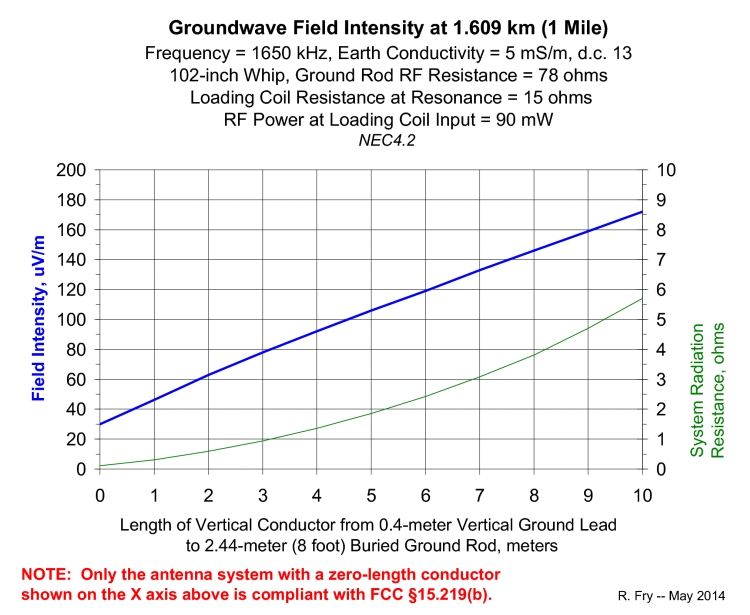
With other things the same, the graphic below shows that the transmit system defined there when using a 10.4 meter length of ground lead produces a signal strength that is over 5 times greater at a distance of 1 mile than if it uses only a 0.4 meter length ground lead. Of course, a ~5X improvement in radiation greatly increases the useful coverage area of such an installation.
Note: The 90 mW of power shown in the graphic is the total, unmodulated, r-f output power of the transmitter, INcluding the power lost in the loading coil and the path through the ground rod to the Earth it is buried in.
People are free to install and operate whatever they wish, but those hoping to comply with FCC §15.219 may find this information interesting.
Here's a good article
https://www.jpole-antenna.com/2013/03/29/lightning-protection-for-antennas/
A bit about lightning here. It says that lightning will strike from cloud to earth and look for the easiest path to earth. So don't understand how the transmitter mounted on the ground with a metal stake deep in the ground will be protected? You have just provided a magnet via a metal conductor with the antenna through the transmitter to ground. I can't understand how this in the event of a strike wouldn't fry the transmitter?
I would like to hear how Tim has his with no ground on a tower and has he had lightning problems.
Rich, can you weigh in on this?
Here's another article... http://www.nojolt.com/lightning_protection_for_tv_antennas.shtml
Seems logical that if you want to protect something don't have it connected to earth to make it easy for lightning to hit it, in this case the transmitter.
Mark wrote: Seems logical that if you want to protect something don’t have it connected to earth to make it easy for lightning to hit it, in this case the transmitter.
Connecting the chassis/r-f ground bus of the transmitter via a low-impedance path to the electrical potential of the Earth helps to protect the transmit system, because it appears to be no different than the Earth does to the static electrical charge buildup that produces lightning.
There is a lot more area of Earth around the transmitter than at the top of their antenna, so chances are quite high that lightning will strike elsewhere. This effect was discovered by Benjamin Franklin, and is the reason why so many rural buildings (farmhouses, barns, broadcast radio/TV towers, etc) have lightning rod systems installed on top of them.
Very occasionally, lightning might directly strike a "grounded" structure. In that case, nothing that man can do beforehand will prevent the destruction that can result.
Thanks Rich!
Seems if more attractive things around like trees you lessen the risk also.
To get up and running, from the middle to late Sept. to middle of May in the northern half of the USA and Canada thunderstorm season is past so just set up and go and worry about it next spring after April.

FWIW, yes, I have run my Procaster, elevated, with no ground lead, connected for over 7 years. It is mounted on the on a pole of plastic conduit pipe (much like PVC plumbing pipe, except it is thicker walled and gray so it doesn't show so much) which is mounted to the side of a wooden attic window frame on the third floor probably about 30 feet to the ground.
Here in Northern Minnesota thunderstorms are pretty common all summer, including plenty of severe ones with lots of lightning. I have yet to suffer a lightning strike or any other sort of static event that would damage anything. I also have mounted to the house various receiving and transmitting antennas including ham radio, scanners, and aircraft radios. All are just straight coax from their positions to the radios. In somewhere around 50 years of doing this I have yet to suffer a lightning strike or any other similar damage to my equipment. Call me lucky. Call me tempting fate, whatever. In an area where severe thunderstorms and even tornados are regular occurrences, I've had no issues.
The only lightning strike I can tell tales about is working in broadcast radio (which I still do full time as a morning announcer and chief engineer for a group of 4 stations). About 30 years ago our studios were located on the third floor )top floor) of a bank building and we had satellite receiving dishes mounted on the roof, along with all the typical electrical boxes, roof air conditioners, power poles etc. During a severe thunderstorm a direct lightning strike got something on the roof and sent a ton of juice right into our production studio. It wiped out the 1950's era tube RCA mixing console, along with every piece of solid state gear in the studio, reel to reel tape machines, cart machines, everything was toasted. All still looked fine but none of it was operational. This was in a commercial station, in a commercial building, with all proper up to code wiring, grounding, and safety precautions in place. Oddly, the air studio and news studio which were adjacent to the production studio in the same hallway were completely undamaged and still fully functional! As was the computer in the front office (back in those days that was the only computer in the place, and was used for logging and billing only).
This experience over time has taught me that puny antennas like we have are pretty unlikely to draw a strike. And that even properly installed gear, up to code with all the latest lightning protection can be struck and destroyed and in strange unique patterns (leaving two studios alone while taking out one, even though they were all interconnected and taking power from the same place).
Methinks Part 15 types worry far too much about lightning. And many hope it's an excuse or some sort of loophole to let them have a long ground lead for an elevated installation. I personally don't buy it.
Your mileage may vary. Your gear is far more likely to be damaged by a strike or surge that comes through the power lines.
TIB
Tim, Rich and others: Sorry I've not posted back. It's been a rough two weeks Two! Two weeks ago, I had my Chez Procaster on in the house. It's not been put up outside since I got it last October.
It was a nice Sunday Afternoon outside, then the lights started to flicker. Being I've worked as a Administration Clerk at a Electrical Utility, and my service here is overhead from pole to the meterbase, my Behringer XENYX Mixer 302 took a hit and died. I figured the surge was a the pole, and I have a good APC Surge Protector on the Computer, Mixer, and Procaster.
The line in of the Behringer was plugged into the output of the sound card of the computer. I was taking the headphone jack and running it to the studio interface of the Procaster. My wife bought a new Behringer XENYX 302 for me. This time instead of using the line input rca's on the Behringer, I am using the USB port on the Desktop PC. I'm noticing distortion in the audio. I did all I could with the Procaster Studio interface to the transmitter, even bypass the processing, still distortion.
I've called Jeremy at the Chez Procaster Factory last week and he told us to get ready to send the transmitter back to the factory with the studio interface. He will email us the paperwork this coming week.
This is the main reason I wanted to ask about lighting protection for these transmitters being I've worked and owned a stand alone AM Station I've been through this and the insurance company replacing my transmitter. I will say tube transmitters will take the lighting strikes better than the solid state ones in my situation.
I'm sending the Chez Procaster back this week and Jeremy will report back to us.