

Three days to go and it will be the 85th birthday of.Part 15..
I meant to post this last month as part of the countdown, but it slipped my mind..
RADIO DIAL, OCTOBER 7, 1938 page 5:
At another Commission hearing earlier in the week the subject of remote control radio devices was taken up by representatives of the FCC and The Radio Manufacturers Association. The proposed rules and regulations governing the operation of these low power radio frequency devices were discussed.
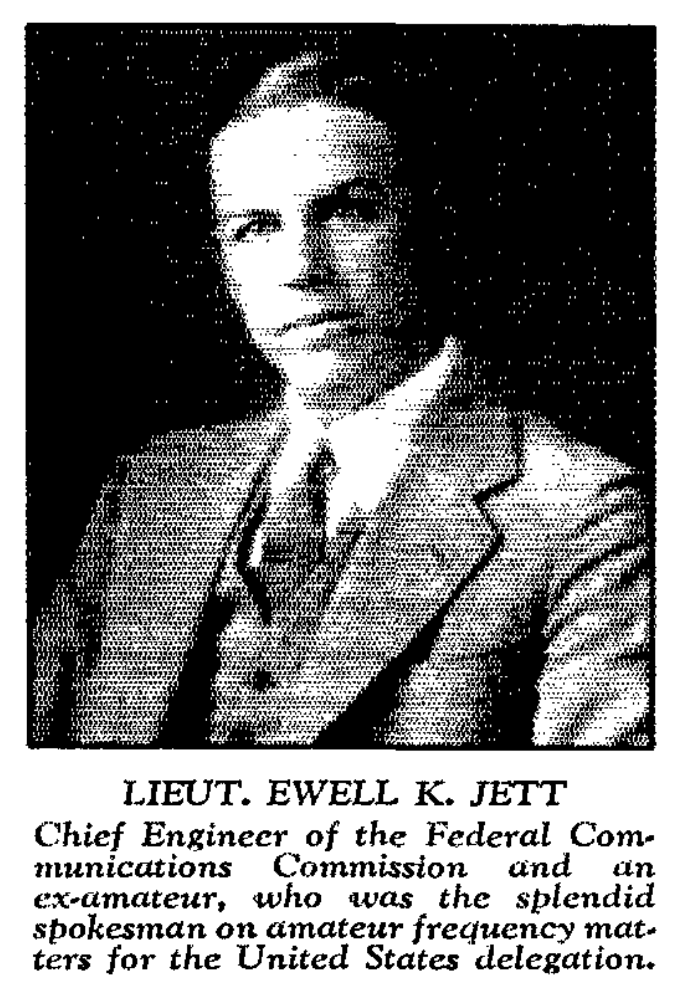
The primary discussion was how the small devices could operate without interference of the radio broadcasting band. Mr. E. K. Jett, Chief Engineer of the FCC, acted as Chairman of the meetings and stated that for a number of years the Commission has been confronted with requests for rulings as to the legality of operating certain radio frequency devices without radio station licenses.
"If certain low power devices can be used without interfering in any way whatsoever with radio communications," Jett said, "there would appear to be no engineering reason for suppressing their use. It is on this basis that the Commission decided to consider the proposed rules and regulations, and I trust you will keep this in mind in all considerations of the problem."
Mr. R. M. Wilmotte of the National Association of Broadcasters advocated using the devices outside the regular broadcast band but Jett pointed out that such use might interfere with safety service.
Engineers from the manufacturing companies also appeared to give technical information on the devices.
There appears to be no legitimacy to the legend of a Philco wireless remote control being what prompted creation of Part 15. That "legend" was based entirely on a single 1942 QST article, but it's hardly accurate that Philco had much to do with it.
Evidence strongly indicates it was the growing popularity of extremely low-power hobby "radio stations". Originally it was independent radio shops custom building them, but Wireless models began being manufactured around 1935, by a few companies and it was devices like those which prompted the creation of part 15.
So to clarify, the primary catalyst for the creation of Part 15 were the little low-powered AM transmitters. Those were original Part 15 devices.
But where the initial spark appears to have been first ignited goes back to 1932 with the Little Wonder Microphone..
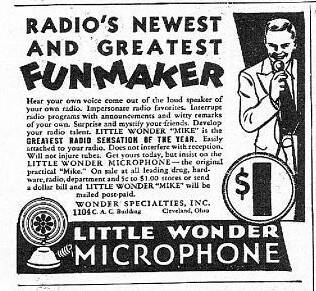
Playthings - Volume 30 - 1932 page 53
Home Broadcasting is Big Business
The Little Wonder introduced by the Wonder Specialties, Inc., 455 C.A.C. Bldg., Cleveland, Ohio, is reported to be an item on which dealers develop rapid turnover. So realistic in appearance that it readily attracts attention, and because it's a real microphone, carefully engineered and produces realistic transmission, its low price of $1 makes it'a value that even disinterested passersby find hard to resist.
It is quickly attached permanently to any radio set, and because of its cutoff switch that enables the user to tune in on any program, it does not interfere with reception when not in use . It comes completely equipped with 15 ft . of wire , and is very professional looking with its beautiful bronze finish.
The quick and enthusiastic reception shown the "Little Wonder" is due to a natural curiosity of every one to know how his voice would sound over the radio. For this, as well as putting on impromptu surprise parties, imitating crooners, announcers, pet artists, joshing friends, "Little Wonder's" possibilities are unlimited- and Wonder Specialties , Inc. , reports that all indications point to record sales , and steady demand in all seasons.
Anyone check out the Little Wonder Microphone above?
Now back to the point...
To elaborate on my above post, although the legend that Philco was responsible for the creation of Part 15 is partially true, it's just not accurate to say it was because of the remote control device they invented.. First here's an excerpt from the article that created that legend;
-------------------------
QST April 1942
"..1938, that is. In that year Philco engineers, seeking a remote-control tuning system without the inconvenient multi-wire cables and accompanying complexities, evolved the idea of using an inductively coupled r.f. transformer with its primary and secondary spaced as much as 75 feet. The primary of this transformer was supplied from a small battery-powered oscillator, and the voltage induced in the secondary fed a supplementary amplifier in the b.c. set.
Naturally, because of its resemblance to a conventional transmitter and receiver, questions arose concerning the legality of the device. After considerable debate pro and con and a hearing or two, the FCC finally handed down rules covering the subject. For the record, those rules are reproduced here in their entirety:
PROVISIONS GOVERNING THE OPERATION OF LOW POWER RADIO FREQUENCY DEVICES ... [a compleate copy of rules are provided]... And so we have the regulatory justification for all such miscellaneous gadgets as the "Mystery Control," wireless phonograph record players, phantom volume controls in p.a, systems and the like. We have also an interesting field for interim experimentation in connection with limited-range communication and remote control devices.
--------------------------
So although that article implies Philco was the reason behind part 15 being created, it really wasn't the case. Philco was planning on coming out (it wasn't on the market yet) with a new remote control device that did not require a wired connection, so they did attend the FCC meeting proposing the new rule but they were not the reason for it. It was because of the already popular micto-power AM transmitters which were already on the market.
The actual reason for the proposal was not the Philco device which didnt even hit the market until 1939. The reason for the proposal, as Jett explained in late October 1938:
"Mr. E. K. Jett, Chief Engineer of the FCC, acted as Chairman of the meetings and stated that for a number of years the Commission has been confronted with requests for rulings as to the legality of operating certain radio frequency devices without radio station licenses."
All evidence points to the wireless AM phono-occilators as the culprit.
The First Part 15 College Station
Now this next point is a debatable one, but I suggest that the Brown University college station was not, as commonly thought, the first part 15 college station..
The Brown University station actually began in 1936, initially it was just a two-way student built private intercom system (this was nothing new) used by participating college students which evolved over the next two years, and changed to lower frequencies to simply access to receivers for the intercom - that was AM radios which students already had. So this is what made It a semblance of an actual AM broadcast system which reached almost all parts of the campus.
But its operation wasn't even on the FCCs radar. By the time part 15 was created in 1938 it did not originally apply to carrier-current operations, which didn't happen officially until a decade later in 1948.
So the Brown station could not have been the first part 15 station because it was not a part 15 operation!
Again, Part 15 was written to apply specifically to wireless remote devices, primarily the Wireless AM phono-occilators which had already been being manufactured for several years had already become very popular with the general public - in spite of the fact that technically they were illegal to operate under the Communications Act of 1934, So in November 1938 the FCC created an exception to those rules to allow the legal operation of wireless devices:
Carrier-current communications had already been in common use for decades and unlike the wireless phono-occilators, cc was completely legal and in no way violated the Communications Act,
There was no issue with carrier current at the time, it wasn't even on the FCCs radar. The part 15 rules were prompted by, and written specifically to provide wireless devices an exception to the Communications Act rules:
"2.102. Apparatus excepted from requirements of other rules. With respect to any apparatus which generates a radio frequency electromagnetic field functionally utilizing a small part of such field in the operation of associated apparatus not physically connected thereto and a distance not greater than , the existing rules and regulations of the Commission shall not be applicable provided:"
So what was the first Part 15 College Station? - It was actually at Dartmouth college in November of 1939, a wireless 1 tube part 15 AM that served only about 40 students of the dormitory...
And that is a very fascinating story that has been lost in the history of college stations. I tell that story another time.
I should have read my comments above before hitting posy because I see I repeated myself a lot.
But did anyone like the little wonder microphone song?

@richardpowers Yes, I liked the Little Wonder Song very much. You are getting to be a virtual band leader.
Also, you are to be commended for your detailed work on part 15 history.
I'm going to go ahead and tell the Dartmouth story although I really wanted to research it further, but I simply came to a dead end.
Actually, rather then rewriting it, here's a copy of an email I wrote Jennifer (of Radio Survivor) who I tend to communicate with frequently now days.
On Thu, Nov 16, 2023 at 12:42 PM Richard Powers <[email protected]> wrote:
Hello Jennifer,
It seems I've uncovered a missing chapter of college radio history, and who better than you to reveal it?
Apparently, it's not been mentioned in any book, article, or webpage in the 80 years since it occurred. It's a lost story. Rather surprisingly, because it was well known at the time.. and it's a pretty cool story too. So here's my attempt to reconstruct it in its entirety, just what had took place during that 6 month period of time beginning in Nov.1939. I'd also like any input you can provide on the Brown University side of this story, because what I know of Brown Network history is only rudimentary.
The following concerns a Dartmouth station in relation to the founding of IBS. This is everything I've dug up, maybe you can excavate further, or at least clear any misconceptions I may have about it.. New eyes can shine new light, so for that reason I still consider this an investigation.
The key points are: Dartmouth was home of the second legal unlicensed student owned and operated college station to exist, and (perhaps) the first, to have local advertisers; first just one, then a second, then a third sponsor, and also the first to negotiate with a national advertiser.
I insert the "perhaps" above because (for example) the January 1938 issue of Radio World, titled "Campus Network Blossoms", says: "Sponsors of the broadcasting system call it the “Brown Network” and "..Fifty outlets are used now. The sponsors have had requests for close to 100, including fraternity houses and Pembroke College dormitories..". But it's not clear exactly what it meant by "sponsors", or who they might have been.
I've not seen any any newspapers from the time period to indicate Brown actually had advertisers before 1940. I see other articles that mention "Browns sponsors" want this, or want that, but its always so vague, and seems like it refers to some group backing them-- it just never seems to me like the "sponsor" reference refers to business advertising. So maybe you can clear that up.
Lets move on... This Dartmouth station received far more national attention in the first few months of 1940 than the Brown Network did.
This Dartmouth station was an active charter member of IBS from the start, and significantly involved with it's founding.
That's what this story shows. So I'm flabbergasted there's been no mention of this Dartmouth station anywhere since! How and why has this story become absent from the history of college radio?
This Dartmouth station was WHD, of the Russell Sage Broadcasting Company (in Russell Sage Hall), and headed by Hugh Dryfoos '40, who, during his senior year, began broadcasting in November of 1939.
Also, in 1940, during Christmas recess, Brown, Dartmouth, Williams, and R.I. State, together, put IBS in gear, and into motion. The historic record however, lacks any mention of WHD.
Anyway, Let me pull out my notes and try to tie this thing together in a more naritive form, in sequence.. This will probably be sloppy, I've rolled it around in my head a dozens of time, but until now have not attempted to put it down to paper, so bear with me... I'll send you copies of all the original articles as citations in a separate email .
1939
OCTOBER:
The earliest mention I'm aware of concerning plans for an Intercollegiate Broadcasting System was published in the Democrat and Chronicle, Sunday, October 22, 1939:
(excerpts)
COLLEGES GET RADIO NETWORK Providence, R. I.—(AP)—Out of a late night radio “bull session” between two pals in a dormitory, a Brown University organization has launched plans for what reputedly would be the nation's first intercollegiate radio broadcasting system, linking all New England colleges. George Abraham... said yesterday the “Brown Network” now plans ‘to branch out over a leased wire, system, including Dartmouth, Wesleyan, Harvard, Massachusetts Institute of Technology....."
Originally I thought nothing odd about that article, but later, after considering the entire shebang, I saw the articles opening line as cryptic: "Out of a late night radio bull session between two pals in a dormitory, a Brown University organization has launched plans.."
What two pals? What dormitory? What college? Why did they write it that way? I've not come across anything specifically stating who's idea it was. Not from the time anyway.. Why was the opening line so unnecessarily vague? - But I shouldn't be spouting speculation, and definitely not to start with, I can come back to that later - So let's just drop that thought and focus on what the article was clear about: A decision had been made to form a college radio network, connecting: Dartmouth, Wesleyan, Harvard, and M.I.T.
Numerous articles follow, many are AP and UP stories, so they turn up in papers across the nation (makes them easier to find). On thru to the official launch of IBS in Febuary, most every article, every month, all specify: Harvard, Brown, Dartmouth, M.I.T., and Wesleyan as the charter members. I'll cite a few of them to structure the timeline.
NOVEMBER:
The Times Gazette Fri Nov 3 1939 (excerpts) INTER-COLLEGE RADIO PLANNED Providence, R.I.—New England college students are working to establish the first intercollegiate radio broadcasting system in the country. Brown university already has a radio station and if present plans materialize, there soon will be a leased wire network linking Harvard, Brown, Dartmouth, Massaehusetts Institute of Technology, and Wesleyan...."
Anyway, best I can confirm, Hugh Dryfoos launched his station, WHD, in his room in Russell Sage and began broadcasting in late November, 1939. But during his free time he would sometimes head downtown to the 1400 block of Poindexter* which was a thriving business district not far Dartmouth.
[[*Note: this info about Mac's was incorrect because it was actually a different 'Macs Sandwich Shop' that had sponsored WHD. So I'm omitting this portion going on about Macs from this copy here. But it doesnt affect the story at ] ]
Mac's became his favorite place to grab a burger and a shake (which totaled about 10 cents back then), but this time Dryfoos (described elsewhere as "a friendly, untimid man"), had a particular goal and made a proposition to the owner/operator. And that's when Mac’s Sandwich Shop became WHDs' first advertising sponsor.
At Dartmouth, Dryfoos (undoubtedly) talked with his fellow students about how his station was part of the IBS.. Evidently there was at least one student (unnamed) that had not been enthused about it, and he expressed a sentiment of "Screw Brown, we'll start our own IBS!". And he did.
But this IBS was an acronym for "Illegal Broadcast System". WHD barely had its feet wet by the time the illegitimate IBS went on the air using a described " two-tube transmitter". Student Unnamed setup the station in one of Dartmouth's off-campus dorms, and broadcast the kind of stuff somebody might hear on a barroom juke-box, but was objectionable over the air. He played records like Bruz Fletcher's Nympho-Dipso-Ego-Maniac, and She Had to Go and Lose It at the Astor. Between songs he tell "smoking-car jokes" (off-color humor), and then follow by playing some equally questionable Dwight Fiske records.
Before long, someone, somewhere, called the FCC, who listened in one night, and during their investigation discovered the signal traveled ten miles, across the state line and three miles into Vermont. The next afternoon the FCC shut it down. The Illegal Broadcasting System was no more.
It's not clear exactly when Dartmouth's President Ernest H. Hopkins became aware of what had occurred, but he was surely irritated by the whole matter. Hopkins had been presiding at Dartmouth for a long time and experienced a similar situation before. Back in 1925 Dartmouth had a student-ran licensed station, WDCH. Hopkins hesitantly permitted it, but only with some firm stipulations. All went well until a live microphone accidentally broadcast someone shout "Shut the goddamn door!!" The FCC didn't even exist at that time, but Hopkins himself had ordered the station permanently shut down.
Returning to 1939... The FCC, after shutting down the Illegal IBS, paid a visit to the Dryfoos's WHD station too. They inspected the operation and informed both Hopkins and Dryfoos that the station could stay on the air as long as the signal stayed within Russell Sage. President Hopkins didn't object either, but simply told Dryfoos to "Keep it clean".
Dryfoos, relieved, enthusiastically continued his broadcast.
He operated on an a regular schedule. He'd step into the stairwell and blow a police whistle to alert the dorm 5 minutes to air. There were morning and nightly shows of music, news, sports, skits, various press releases and all-request shows. There were giveaways, like choclate malteds (redeemable at Mac’s) and a "Pot o' Gold program" (50 cents cash). He would pre-record some of his shows, which enabled him to roam the 40 rooms of Russell Sage during the broadcast to insure everyone was receiving good reception. He operated the station in a professional and structured manner..
And he kept it clean.
DECEMBER:
The Daily Olympian Dec. 17, 1939 (excerpt) PARADE of YOUTH Youth Sets Up College Radio Network ....George [Abraham] has set up the network on a basis so it will continue after he is graduated next June. Staff members number 70. But before he leaves school, he has even greater plans for his organization. He's helping to organize similar systems in other New England colleges, all to be linked together....
During that Christmas vacation, Brown, Williams, R.I. State and Dartmouth formulated, and fine-tuned the structure of the Intercollegiate Broadcasting System as a nonprofit, cooperative sales agency.
1940:
JANUARY:
Radio Craft January 1940 -(excerpts) AN INTERCOLLEGIATE radio broadcasting system to link Brown, Dartmouth, Wesleyan, Harvard and the Massachusetts Institute of Technology over a wire network is being planned by engineers at Brown University, and other colleges are also to be asked to join...There are now 75 members taking care of programs, advertising and technical arrangements at Brown and Pembroke Colleges...
FEBRUARY:
On February 9th 1940, the Intercollegiate Broadcast System (IBS) was officially formed. (This was four years to the day, since Abraham, as a freshman, had setup the initial home-made intercom in his dorm on February 9th of 1936.) One week later, IBS held a two day weekend conference (Fri. Feb 17 and 18) at Brown University.
Providence Journal Feb 17 1940: [Convention announced]: 10 a.m. Intercollegiate broadcasting system discussion and convention, Brown University Network, Art Gallery.
It was a very big deal. The event featured some predominant speakers: Dr, Franklin Dunham, educational director of NBC, H. Linus ‘Travers '27, vice-president of the Yankee Network; Dr. Loring Andrews, chairman of the program committee af the World Wide Broadcasting Foundation; John A. Hulman, general manager of WBZ, Boston, Springfield; Malcolm S. Parker, supervisor of WEAN, Providence, and James A. Williams, district manager of the New England Telephone and Telegraph Company.
Hugh Dryfoos, was there too, representing Dartmouth, along with representatives from a dozen other colleges.
Providence Journal Feb 18 1940 (excerpt) College Net Parley Opens Leaders in the fleld of radio are among those taking part in a conference which opened at Brown University yesterday and continued today, to launch the nation’s first inlercollegiate broadcasting system aventure that is expected to link together a score of Eastern universities..."
Naturally, the event attracted several reporter's. One was from the massively popular Billboard magazine. On the first day of the conference, that reporter interviewed Hugh Dryfoos.
Providence Journal February 19 1940 (excerpts) BROWN SELECTED AS RADIO CENTRE Brown University was selected yesterday as headquarters for the coming year of the Intercollegiate Broadcasting System, organized at a week-end conference of delegates from 12 New England colleges. George Abraham... was elected chairman of the IBS, ...At the week-end conference were delegates from Columbia, Cornell, Dartmouth. Harvard, M.I.T., Pembroke. R.J. State, Connecticul. New Hampshire. Wesleyan and Williams...."
Five days after the event Billboard publishes a story from that day.. But the only thing it reports is about the Dartmouth station, WHD! No mention of IBS, or its big convention, no mention of the Brown station or its Network. WTF?...
BILLBOARD February 24, 1940 (excerpts): “Room-to-Room” Network Boasts Sponsor, Censor—and Audience; Malted Milks Test Fan Loyalty HANOVER, N.H. Feb. 17---A “room-to- room network” with an audience of about 40 Dartmouth College students has proven highly successful since it's recent inauguration here,.. ..Dryfoos operates his “station” under the call letters WHD, ...operates on a regular schedule, ..in Russell Sage Dormitory (which is his primary, secondary and tertiary market area) and,.. ..he has a sponsor, Mac’s Sandwich Shop, which pays the bills for several of Dryfoos’ programs. Schedule includes morning and evening recorded shows and news programs,.. ..he maintains a rigid censorship,. ..Neither race nor obscene records are played over his transmitter. Dryfoos' radio system is the kind which allows the signal to be picked up at a given kilocycle number on the listeners’ radios...
The story obviously should have mentioned the Intercollegiate plans, why was it silent? Who knows? - Maybe the conference was boring, and the reporter thought Dryfoos's venture a more interesting and entertaining subject.
Abraham and Borst must have been resentful. Brown had been at it for 4 years and this tiny Dartmouth station was two months old, why was it getting this national exposure?
But it gets worse, the sole reference to "IBS" in the article was like a slap in their face:
BILLBOARD: "...before long IBS was forced of the air by the Federal Communications Commission..."
A similar story in American Druggist with no mention of Brown in that one either:
American Druggist February 1940. (excerpts) Sponsor - Mac's Sandwich Shop at Hanover , N. H., sponsors programs on the world's smallest radio broadcasting system (listening audience, 40 Dartmouth College students) ... student Hugh Dryfoos broadcasts from one-tube station WHD ... super-power, competitive students set up two-tube transmitter and started broadcasting over a self-styled "Illegal Broadcasting System." The Federal Communications System ruled that it really was illegal;..."
MARCH:
Two weeks later, however, Time magazine prints a feature which does acknowledge both the Brown Network and the IBS convention:
TIME March 4 1940: (excerpts)
Radio: Ivy Networks Throughout New England's college towns last week, a live-wire topic was Brown University's proposal for an intercollegiate radio network. For the last three years Brown has had a wire hookup of receivers in the rooms of 1,600 students, thinks that an ivy network could pay its way with radio ads,..."
(Notice they specified the endeavor only as an "Intercollegiate radio network". Maybe the Time editors worded it that way to avoid confusion with the IBS in their story:)
TIME: "...One night FCC listened in, found IBS illegal indeed, since its unlicensed broadcasts could be heard beyond the dormitory walls, way over in Vermont..."
Good grief! Well, at least Brown did get a paragraph, but it is was probably quite discouraging to Brown that most of the article, the very bulk of it, was actually about, none other than,... you guessed it; the Dartmouth station, who, by the way,, had now picked up another two advertising sponsors:
TIME: "...The Dartmouth station, unofficially called WHD, is run by Senior Hugh Dryfoos... Its audience: 40 other students in Russell Sage... conducts morning and evening news programs.... invites faculty guest speakers, fills in with programs of popular records... Dryfoos started broadcasting three months ago, soon had two Hanover, N.H. restaurants for sponsors. Last week Broadcaster Dryfoos got another sponsor, a stationer...."
One can imagine what Abraham and Borst thought of the article. One thing's certain; the Brown Network was becoming second fiddle to Dartmouth in media coverage. Both Billboard and Time were very major publications, no question that Dartmouth was getting,--at the expense of IBS-- the bulk of the limelight and public attention.
But the limelight was also inciting troubling questions about Dartmouth.The editors of the magazine RADIO NEWS had read the Time article and were imeadiatly taken aback by it. They saw it as operating in blantent disregard to the Communications Act of 1934. They immediately sent a letter of inquiry to the FCC:
"....[WE are] requesting information regarding the so-called station WHD reported in the current issues of TIME magazine. This station is operating at Dartmouth College, with the knowledge of the College authorities. The means used to broadcast is by what is generally known as a “phono oscillator.” We are struck by the fact that the station has a regular listening audience, and that it has a “sponsor” who pays for “time on the air.” We thought that such operation was in violation of the FCC Rules & Regulations which do not permit unlicensed stations (and WHD is admittedly unlicensed) to operate and specially to have paying “sponsors"....”
RADIO NEWS would later publish the FCCs response, but before we take a look at that, realize that the Dryfoos station was also getting attention from the FBI too.. This is really outside the context of our story, it's a whole other story in itself (an interesting one at that), but not part of our story, but the only reason I bring it up here is because Dryfoos station does get mentioned:
RADIO NEWS September 1940 (excerpt)--ONE of the ripest fields yet uncovered for 5th Column activity is in the use of the lowly phono oscillator... ..The FCC presently has no control over these oscillators as long as they comply with the FCC rules regarding power. That Rule, however, has not prevented the oscillators from being used as a regular (and in this case legitimate) broadcast station at Dartmouth College...."
Anyway, as for the Radio News editors letter of inquiry about Dryfoos WHD station, the editors weren't exactly satisfied with the FCCs response...which they would later publish in RADIO NEWS June 1940:
"....The answer of the Commission is repeated below. Whether or not it is the answer to our inquiry, we leave to the reader's interpretation.
Gentlemen :
This is with reference to your letter of March 4, 1940, concerning an article in Time magazine referring to a low power radio frequency device used for broadcasting programs throughout the Russell Sage Dormitory at Dartmouth.
The Commission has established regulations concerning the operation of low power radio frequency devices which rely largely on the induction held for the operation of remote control radio receivers, to eliminate wire connections between record players and receivers, for wired radio communication systems, and for other similar purposes. A copy of the regulations is encloscd herewith.
The regulations permit operation without a license so long as the field of the device does not exceed 15 microvolts per meter at a predetermined distance fixed by the operating frequency. and no interference is caused to the reception of signals of radio stations.
Very truly yours,
(Sged.) T. J. Slowie. Secretary.
Ok, so, getting back to our sequence of events... Over the course of just the past 10 days, Abraham and Borst endured watching three nationally distributed magazines, two of them top in the nation, all feature Hugh Dryfoos' station, and those articles either didn't mention Brown at all, or referred to IBS as a pirate station shut down by the FCC! - It'd be funny if it wasn't.
Do you think this might have bothered Abraham and Borst? Maybe pissed them off? No citation is needed to back the fact that it had irritated the living crap out them. They probably couldn't stand to look at Dryfoos's face.
Before the month was out, College Life published an update on IBS progress:
(excerpts)
College Life Friday March 29, 1940
Radio Broadcasts For Universities Providence, R. I.—(ACP)—Radio-minded students in a dozen eastern colleges and universities are working overtime these days.. ..over the Intercollegiate Broadcasting System, first undergraduate network of its kind... ..Charter members of the “IBS,” as its organizers call it, include Brown, Cornell, Columbia, Holy Cross, Pembroke, Rhode Island State, St. Lawrence, University of Connecticut, Wesleyan and Williams.. ..Non-member local systems are ready at Antioch, Dartmouth and Kent State College in Kent, Ohio. Harvard, Columbia, Holy Cross, Rhode Island State and Colorado College are building their stations..."
In case you missed that; Dartmouth status has been changed from charter member to being a "Non-member local system". Did Dryfoos just get kicked out of IBS?
APRIL
As we near the end of our story, we see that the April issue of Radio Craft still indicates Dartmouth as a charter member, but that's probably because it had gone to press by the time Dartmouth had been omitted:
RADIO CRAFT April 1940 (excerpts) INTER-COLLEGE WIRED-RADIO NETWORK ...A 2-WAY interphone started Brown U. student Abraham on a chain of thought which concluded last month in... ..distinction of being the first in the United States to institute an intercollege wired-radio system—calls for linking Brown, Dartmouth, M.I.T. and Wesleyan together over a leased wire system so that each college can broadcast to the other.. ..Much of the expense involved will be written off through advertising contracts—an innovation begun successfuliy a year ago..."
Ok, I just caught that. So Brown did have advertisers in 1939, thus, probably before Dartmouth did. My bad, but this doesn't detract from the story. Let's move on.
As April comes to a close, LIFE magazine features a pictorial with a short story about Dryfoos station. Although there's no mention of Brown or the real IBS, - it does change the pirate stations name -after the fact- to the "Illegal Broadcasting Co.". Perhaps to avoid confusion between IBS and IBC.:
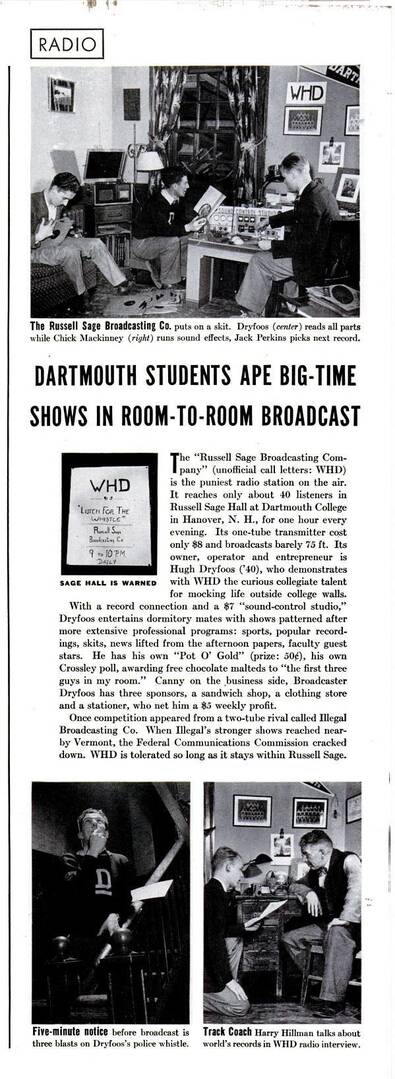
LIFE April 29 1940: (excerpts): DARTMOUTH STUDENTS APE BIG-TIME SHOWS IN ROOM-T0-ROOM BROADCAST The "Russell Sage Broadcasting Company” (unofficial call letters: WHD) is the puniest radio station on the air.. ..Its owner, operator and entrepreneur is Hugh Dryfoos (’40), who demonstrates with WHD the curious collegiate talent for mocking life outside college walls.. ..Dryfoos entertains dormitory mates with shows patterned after more extensive professional programs... Canny on the business side, Broadcaster Dryfoos has three sponsors, a sandwich shop, a clothing store and a stationer, who net him a $5 weekly profit. Once competition appeared from a two-tube rival called Illegal Broadcasting Co. When Illegal’s stronger shows reached nearby Vermont, the Federal Communications Commission cracked down...."
The pirates rename would appear again, 2 years later in Dartmouths 1942 Alumni magazine. May 1942 Page 11:
"..The story continues with the somewhat widely publicized “Illegal Broadcasting Co.,” which suddenly discontinued broadcasting one autumn afternoon in 1939 when FCC agents visited the off-campus studios of IBC ..."
But let's not get ahead of ourselves, we're still here in 1940..
AUGUST 1940:
Ok, so June has passed and Abraham, Borst, and Dryfoos had all graduated. Now we come to the last, and most revealing article, which clearly states Dartmouth's direct involvement with founding IBS.
TIDE was a prominate national advertising industry magazine, the article's title "Short Cheer Esso" refers to ESSOs gas company being a new advertiser for IBS:
TIDE, August 1940: Short Cheer Esso ..When George left for the wide, wide world last Spring he left behind the Brown Network....At Dartmouth last year..Under the direction of Hugh Dryfoos, ‘40, it began selling time to local merchants. These sponsored shows were so successful that Dryfoos solicited national acoount or two at $5 for three half-hours per week. One (Balkan Sobranie Tobacco) was on the line when Dryfoos remembered his final exams and beat it back to Hanover. This semester, though, at least one national advertiser will buy time on a college station. That deal was put through by..WMS at Williams.. ..During Christmas recess last Winter, Brown, Williams, R. I. State and Dartmouth solemnly put together the Intercollegiate Broadcasting System—a nonprofit, cooperative sales agency. This Fall it will open Manhatten offices,.. "
So there we have it. But what do we have? Well, the primary point is Dartmouth indeed was one of the four colleges that founded IBS in 1939, and Dryfoos and his station was the active representative of Dartmouth. But the historic record says Dartmouth radio started in 1941 with DBS.
A few ponderations:
Time Mar. 4 said "Dryfoos started broadcasting three months ago", and Dartmouth Alumni said "one autumn afternoon in 1939", That covers Aug thru Nov.-- So, it was probably in November.
Speculation dictates Dartmouth was booted out of IBS in March because Abraham and Borst resented Dryfoos. It's only speculation.
Why called it "WHD"? - Maybe "W" + his initials, or it signified "Width, Height, and Depth", or named after the Times Shortwave WHD, last operated in 1925.
Hugh Dryfoos, after retirement returned to Dartmouth from 1976 to 1981 as a development officer in a five-year fund-raising campaign for his alma mater.
On a side note, Hugh had a brother; Orvil Eugene Dryfoos, graduated Dartmouth in 1934. Orvil married the daughter of the publisher of The New York Times, which led to him working there. He ultimately, rose to become head of the New York Times.
As you may have gathered, WHD was wireless - and that makes WHD the first college part 15 AM station in history.
On Nov. 21, 1938 FCC created Part 15 originally exclusively for wireless devices:
"..With respect to any apparatus which generates a radio frequency... in the operation of associated apparatus not physically connected thereto..."
It didn't apply to carrier-current until later.
Incidentally, in 1939 William S. Halstead took that new rule and invented a specially designed antenna, 2 miles in length, not up in the air, but along the roadway, so moving vehicles could receive the signal for two miles uninterrupted. We know it as Leaky Cable. It was/is a wireless operation, it simply uses a muted antenna. - and that little story illustrates how different it is from carrier current. .
Ok, I'm beginning to babble, this took way longer than expected and I'm worn out, feeling loopy,, BUT WAIT --- There's a twist at the end this story...
After graduating Dartmouth with a B.A. degree, Dryfoos joined the Army, and proceeded to Camp Upton, N.Y. On August 16 1941 he was transferred and became newly appointed Corporal of Battery D, 9th Coast Artillery (AA) at Camp Davis. There, from his dorm, he resurrected WHD with notable success.
Meanwhile, Martin H. Work, professor of radio at Loyola University in Los Angeles, who back in September had taken leave to serve as consultant of the N.C.C.S. (National Catholic Community Service) for their newly formed United Service Organization (USO), whos duties included keeping our military troop entertained.
In November Martin Work formulated a method of enabling troops abroad to maintain communication with their families back home. The announcement for these plans was published on November 9th:
The Brooklyn Daily Eagle Nov 9, 1941: Don't Write--Radiograph -Soldiers who are granted an unexpected furlough will soon be able to apprise the family of the glad tidings in time for said family to replenish food stocks, when the new U.S.O. plan of free radiograms for the boys in khaki gets going good. Martin H. Work, radio consultant for the National Catholic Community Service, originated idea, which by use of network of amateur radio stations will permit service men to send amateur radiograms to friends through nearest U.S.O. clubhouse. Mcessages will be relayed through stations operated by the Army Amateur Radio System and the American Radio Relay League."
That same week, Hugh Dryfoos's WHD station had made the news in another newspaper:
The Wilmington Morning Star QP Nov 2, 1941 (excerpts): Midget Radio Broadcasting Set Constructed By Davis Selectee - If you have your pocket size radio with you and you are within range--25 yards—you may be in for an unusual treat. You may tune in on the “Puniest Radio Station" in the world,.. Actually it is merely the combination of a high powered wireless record player, which, attached to a microphone, acts and sounds like a genuine broadcasting station.. ..As sole operator and inventor, Dryfoos provided the inspiration for a number of similar radio stations and founded the Intercollegiate Broadcasting system, which is a network of private, unlicensed radio stations..."
So, as is evidenced above, if Dryfoos was not an actual founder of IBS, he certainly thought he was. But we haven't got to the final twist yet, but getting close.. First let's read the conclusion of the QP article...
QP: " ..How his band-box broadcasting station could be utilized in the Army, Corporal Dryfoos claims is a military secret, but it is rumored that he may convert it to a barrack broadcasting station and conduct radio programs in his battery barracks. Corporal Dryfoos admitted, however, that he would prefer to make his radio station into a convertible broadcaster so that he might set it up on one of the army trucks and entertain his batterymates during one of their all-day hikes."
You'll note in its last paragraph Dryfoos was asked if he"d expand to cover the rest of the dorms.. Well, he never did. In fact, that was the last to be heard of WHD ever. But he did answer the question by saying that it was a "military secret".
And here we have the final twist.. The "military secret", it seems that WHD came to the attention of Martin Work, who decided to incorporate the idea into his own U.S.O. Radiograph plans..
Chicago Tribune Fri Dec 5 1941:
SERVICE CAMPS WILL BE LINKED BY RADIO HOOKUP A “Star Spangled Network” system of communications for army and navy posts is to be formed under auspices of the United Service organization thru its member agency, the National Catholic Community service. Martin H. Work, representing the NCCS, explained the plan whereby a hundred or more “wired radio stations” are to spring up at service posts to the School Broadcast conference yesterday at the Stevens hotel.
Stations, using very low power of from 3 to 5 watts, are to be set up at camps. Programs will be originated in post USO clubs and sent thru regular electric circuits to receivers in barracks, Work said. The stations will be operated, manned, and programmed by service men. Programs will include news, entertainment, information of interest to the men, he said. The first of these stations, at Madison barracks, Sackett Harbor, N. Y., will be dedicated Dec. 20 with a special program to be picked up by NBC. Radio, screen, and stage celebrities will participate. - A second phase of this Star Spangled network involves amateur short wave stations, Amateur stations scattered across the nation in codperation with the Amateur Radio Relay league will relay messages from servce men in camps. to their homes free..
"
And that begins a whole other story.
If nothing else, Hugh Dryfoos certainly proved to be a touchstone for carrier-current networks, would you say?
I hope you enjoyed it.
Best Regards,
Rich
Notable notes:
Louis Bloch's book downloadable at www.worldradiohistory.com/BOOKSHELF-ARH/History/The-Gas-Pipe-Network-Bloch-1980.pdf
..Upon reading it, I noticed he wrote specifically a bit about that story which was published in the 1941 Tide magazine article I previously cited to you.. What's so interesting is he references much about what it was about but completely omitted the approximately 1/3 of that article which was about Dartmouths station and how Brown, Dartmouth and Weslayan formulated the structure of IBS together during their 1939 Christmas vacation.
Just to be more specific, on page 56, here's what Bloch said:
"....Finally the ice had been broken and Tide Magazine featured an article entitled Short Cheer ESSO describing how a tall, curly- headed radio bug by the name of George Abraham started these gas pipe stations at Brown and now they were worthy of the dollars of national advertisers. The article also announced that I would open Manhattan offices to solicit national advertising for the twelve college IBS member stations whose administrations permitted paid advertising..."
So, as you see, no mention about Dartmouth or Dryfoos. Now, here's the complete Tide article:
TIDE, VOLUME 14, 1940, page 12, :
[ June?]
Short Cheer Esso
These gas-pipe networks you've been hearing about got their start four years ago when a tall, curly-headed radio bug by the name of George Abraham got into Brown University. No sooner had he settled in his room than he had a two-way sending and receiving transmitter operating.
When George left for the wide, wide world last Spring he left behind the Brown Network which now has a central control room, several soundproof studios, 30 dormitory and fraternity house stations which originate programs, and David Sarnoff’s son Edward.
Broadcasts are carried over 30,00 feet of wire strung through steam tunnels Into the dormitories and houses. Outsiders can not and should not hear the programs. Gradually the Brown system was copied less extensively at other colleges.
At Dartmouth last year, two stations sprang up almost simultaneously, One cast its signal three miles over into Vermont. But the FCC didn't like that any better than the college administration liked the Dwight Fiske records and smoking-car jokes the boys were using for programs. The station signed off for good.
The other Dartmouth station did better. Under the direction of Hugh Dryfoos, ‘40, it began selling time to local merchants. These sponsored shows were so successful that Dryfoos solicited national account or two at $5 for three half-hours per week. One (Balkan Sobranie Tobacco) was on the line when Dryfoos remembered his final exams and beat it back to Hanover.
This semester, though, at least one national advertiser will buy time on a college station. That deal was put through by George Goldberg, production manager of WMS at Williams and son of cartoonist Rube Goldberg. This Summer he dropped in on Standard Oil to peddle the Williams-Army football game. He was shunted off to Marshalk & Pratt which promptly signed for five Esso newscasts per week (five minutes each), prepared and delivered by students. The show will start next week, will also air at R. I. State and Brown.
During Christmas recess last Winter, Brown, Williams, R. I. State and Dartmouth solemnly put together the Intercollegiate Broadcasting System—a nonprofit, cooperative sales agency.
This Fall it will open Manhatten offices, with Louls Bloch, Brown '40, in charge, to solicit national business for its 12 member stations whose administrations will permit paid advertising. IBS thinks it has a hotel and a cigarette company “very much interested.”
Messrs. Goldberg, Abraham and Bloch are reluctant to reveal the Esso rate and so is Esso; but they admit it is “slightly higher them the prevailing IBS rate.”
"IBS" base rate (due soon to be boosted) is $41 per station hour on a 13-week contract. That prevails despite the individual station's audience, which varies considerably.
The Brown station claims 2,000 listeners; Williams, 1,000. The Williams station has a typical program service. It is on the air from 7:00 to 8:30 am, from 5:00 to 6:00 p.m. and from 8.00 to 10:00 p.m. Among its more popular shows are 90 minutes of swing music, spiced with a running commentary a la Martin Block, and a student-faculty quiz show patterned after information Please."
You see? He actually cited the above article, but chose to complete omit Dartmouths involvement in IBS founding.
@richardpowers Amazing to know that small radio was able to pull such significant attention by the news media of the day. It could have been because the low power efforts were done in affiliation with prominent name educational and government institutions.
Today's journalists and ordinary individuals are under-impressed by part 15 and either view it as the hobby of old cranks or, as some of my family members told me, they think I only imagine that I have a radio station.
@carl-blare Well you got to figure, part 15 was barely a year old at that time, so the novelty of it is probably what the big deal was all about. Not the use of the wireless phono-occilator itself, because everybody was using one, or at least they were already very popular.
Wirred phono-occilators took technical know-how to set-up requiring being wired into the radio itself and more of a permanent installation. Professional installations was a common offering at local radio shops (which were plentiful at the time) because not everyone was so technically inclined -- although many were...
National surveys were still going on for how many US citizens owned a radio, as well as how many of those radios were hand-built or store bought. So many an average Joe knew how to build a radio from scratch, even children - I'm talking kids under ten year old that built both transmitters and receivers from old parts - mostly military surplus components that had been decommissioned and repurposed. It wasn't uncommon.
But not everybody was so technically inclined, expecially if they had the money to just go out and buy a ready built manufactured unit, or have one custom built for them at any radio shop.
This was the case with Dryfoos. He had no technical know-how at all, he just bought a turn-key wireless unit and set up his station in the dorm. He bragged that it had only cost him $8 for his one-tube transmitter- which was too expensive to have been a stand-alone unit, so it most likely had been a used record player from a local radio shop that had installed a built-in wireless occilator inside and sold for $8 (you can see the record player in the background of one of the pictures).
The Brown carrier-current station was not very unique at all in the public eye, it just wasn't a big deal to anyone except to the students themselves because carrier-current was a well established and commonly used method - but Brown was the first college to use it as if it were an actual Broadcast station. But the mass media paid no attention to it at all until after IBS (Intercollegia Broadcast System) was formed and other colleges began doing the same across the nation.
But Dryfoos's station on the other hand was unique in that it really was a wireless station and not just a glorified intercom sytem. All Dryfoos did was copy Browns idea and applied it use to a store bought turn-key toy transmitter, because he did not have the expertise or technicall know how to have actually built a system like Browns.
So it's easy to consider that Brown who had been building their system up for years was a little infuriated over Dryfoos, someone who knew nothing about electronics, was able to capture the mass media's attentention when they could not.
That of course changed in the years to come, but Browns resentment apparently held because Brown essentially omitted Dryfoos's station from history - even though the publications of the time clearly credit Dartmouth as one of the four founding member of IBS - but you never hear that. Even Tim Brooks book "College Radio Days: 70 Years of Student Broadcasting at Dartmouth College" which is considered a quintessential book on Darmouth history makes no mention about it. I actually wrote Tim Brooks (who had attended Dartmouth in the 1960s) about this subject last year, but he never responded (which surprised me). But I can kind of understand how he missed this history because it had not been mentioned anywhere after 1942, but still, how could you miss it when Dartmouth College radio history was the only topic of the research of book, and it had made the pages of both Time and Life magazines amongst others?? Ivdont get it -- Of course in my email to him I wasn't critical at all, I just asked why he gave it no mention. His story begans in 1942 and says that is when Dartmouth launched its first station, which ironically at first used wireless phono-occilators for each dorm (just like Dryfoos had in 1939), but the following year changed to carrier-current.
Here's the 1940 Time article

Wow. That's an awful lot of information to take in Rich. Interesting that the Little Wonder Microphone, and products like it, were the first reason for the FCC creating an exception for these types of device.
As for the Dartmouth story, I'm going to have to come back another time to read that. It's a lot to take in. Your tenacity in investigating the history of Part 15 is admirable. You might well be the only person investigating it (and doggedly pursuing it, I might add) with this much attention to detail!
@rugster well the Little Wonder Mike wasn't wireless, though it was a simple connection to the radio - not exactly sure how it connected but I think it just clipped on the radio and worked by very near field induction.
These came out in 1932 before even wired phono-occilators came out and of course before the wireless models came out in 1935. So it had nothing to do with inciting the creation of part 15. But what makes it significant is that it's the earliest manufactured product which allowed you a way to Broadcast to a radio legally without a license, even if only in your home.
It was the mid to late 1930s wireless home "radio stations" that had incited the creation of part 15, not devices like the Wonder Mike.
Thanks for the correction @richpowers. I need to go back and read your posts in this thread in greater detail.
@rugster Oh yeah.. the Dartmouth story I had written to Jennifer one evening in a single sitting.. and yes, I was worn out when I finished.. it includes almost every thing I had dug up, so yeah I suppose the above is a lot to take in. You would have to be genuinely interested to even want to read all that. I guess it's the kind of long drawn out post that I would generally only skim through.. And I dont mean any of your longer post which I did actually fully read! -- So don't think I meant you!
@richpowers - after making a few of my more convoluted, unfocused, and technical posts in this forum, I sit back, look at them, and think, "Well that was a bit much!"
I don't expect anyone to read everything (or indeed anything) I write. Take from it whatever you want, or gloss over it completely. It's all good.
It's interesting that in a forum that is devoted to what is admittedly a very niche pursuit, we all have a different set of interests within this arcane hobby!
I had actually began my research years ago when I was still a prominent member and welcome at HB. I was becoming disenchanted with the discussions because it seemed like most of it began leaning more towards unrelated topics, like what this or that licenced station was doing, or what Famous broadcaster had died, or FCC action taking place that had nothing to do with part15, or how Comcast is a terrible service, or how Google is a terrible company.. etc..
The main reason I had actually began my research was to find something to talk about that had not already been beat to death...
So I started with -- of all things, the ground lead! I wanted to know what had happened in the early 1970s that prompted the ground lead to be added to the rules all of the sudden..
At that's where it all began, and I've been digging into every decade since. I have far more information on its history than found anywhere else on the net, but still have a lot of loose ends to put together..
I keep telling myself I need to go ahead and start writing a book now, because as it stands, I really have enough to cover every decade of Part 15 use -- good stories, unknown stories - but some stories are missing important details which are difficult to find, and I hate uncomplete information!
Did you know that the first known instance of using radio for illegal purposes was by members of the Capone syndicate? It was in 1939- 1940 and involved a part 15 AM transmitter to broadcast racing information from a beauty shop to a nearby bookie joint bar called the 400 Club. They did it because at the time it was illegal for bookie joints to have a telephone! And it was the part 15 transmitter that got them caught when someone nearby called to report interference on their radio - It turned into a massive court case which stayed in the newspaper for years - though you never heard about the transmitter again, those charges had been dropped early on because technically they never violated the Communications Act because the transmission itself was actually legal under part 15.. but the content was another matter that involved horse race betting.
@richpowers I wonder what transmitter would have been available for part 15 in the 1930s and 40s?
All I remember from my youth(50s 60s) was toy ones or a heathkit one that let you be DJ around your house.