

I've talked a few times before about NextNavs proposal to use the 900mhz band and the the opposition against it because its potential of wiping out the existing part 15 established 900mhz use of many devices we use today. No one here seemed to be very interested but to me it seems a very big deal, even to the extent of indirectly affecting or hobby.
Perhaps this just published article from Z-Wave Alliance, one of the major opponents of NexNav's proposal explains the problem clearly.
Selected excerpts:
The U.S. needs GPS backup and IoT resilience
November 11, 2025 - By Avi Rosenthal
https://www.gpsworld.com/the-u-s-needs-gps-backup-and-iot-resilience/
"Signal analysis from the Z-Wave Alliance ... on October 28, 2025 shows the current real-world noise floor and peak Part 15 signal power in a typical suburban environment. Analysis from Pericle Communications estimates Part 15 signal strength would need to be at least 538 times and up to 741 million times greater to achieve equivalent link reliability if NextNav’s proposed high-power downlink band is approved.
America’s dependence on GPS is a matter of national security, ... .. The question, ironically enough, is how to get where we want to go. ... .. We have provided and assessed technical data to help identify which terrestrial and space-based solutions can truly coexist with the technologies Americans already use every day.
A Known Risk
NextNav has petitioned the FCC to restructure parts of the lower 900 MHzband to host a terrestrial 5G/PNT network—essentially a ground-based GPS complement. The company’s plan would allocate parts of that band for high-power transmissions and relax the long-standing protections that keep low-power (Part 15) devices from destructive interference.
That same spectrum underpins hundreds of millions of existing systems ... consumers rely on every day. These devices operate safely and efficiently because the FCC’s Part 15 rules limit interference and prohibit high-power operations in this shared public band.
Robust technical analysis, ... shows that high-power terrestrial PNT transmissions would block or degrade low-power communications up to 60 percent of the time. In plain terms, that means alarms that fail to trigger, silent sensors, and lost connectivity for devices that safeguard homes, businesses, and infrastructure.
Evidence indicates these devices could degrade significantly in performance, often to the point of un-usability. Once the band is reclassified, there’s no practical way to “retrofit” the millions of products already deployed. The result would be billions of dollars in stranded hardware, irrecoverable damage to company reputations, and a long, expensive replacement cycle for utilities, business owners, and consumers.
This isn’t an argument against terrestrial PNT. It’s an argument for evidence-based engineering. .. .. NextNav’s 900 MHz concept ... it’s only one of many.
The FCC recognized this when it opened its broad Notice of Inquiry in March 2025 instead of rushing into rulemaking. Other federally funded trials, such as the Broadcast Positioning System developed by NAB and UrsaNav’s eLoran solution, show that terrestrial PNT can be achieved without displacing unlicensed Part 15 devices. ... ..
Coexistence Is the Standard, Not the Exception
Across every modern wireless domain — Wi-Fi, Bluetooth, Zigbee, Z-Wave, LoRa, Wi-SUN — coexistence testing is standard practice. Before a new technology enters a shared spectrum, it must demonstrate that it can live alongside incumbents. NextNav has not done that. Its coexistence claims rely primarily on simulations using optimistic assumptions about device density and duty cycle. Real-world deployments are far denser and far noisier.
Z-Wave ... ask for what every responsible engineer would: comprehensive, transparent field testing before the FCC alters the rules of a crowded band. That’s not obstructionism: it’s diligence. ...
America’s connected infrastructure relies on the lower 900 MHz band precisely because it has been open, unlicensed, and reliable. Allowing a single licensee to flood that band with high-power signals would trade resilience for fragility.
Z-Wave Alliance stands ready to collaborate with the FCC, DOT, and all research participants to ensure the U.S. gets the GPS backup it deserves: one that strengthens, rather than undermines, the technologies that keep Americans safe,
A little background info worth a look from previous post last year on the subject: https://www.part15.org/community/regulations-law/what-does-900mhz-have-to-do-with-part-15-am/
Ok, You gotta read this, real interesting, published today, key excerpts are quoted below...
Spectrum Decisions Demand Science, Not Scapegoats
https://www.eetimes.com/spectrum-decisions-demand-science-not-scapegoats/
“Gradually, then suddenly.”That is how Hemingway described the process of going bankrupt in The Sun Also Rises. This turn of phrase will resonate throughout the winter as the government re-opens and once-stalled efforts kick into high gear.
... NextNav has repeatedly urged FCC action to no avail, and the record-length federal shutdown has not helped their cause.
... During the shutdown, however, a strange narrative emerged, first in conservative outlets like The Washington Examiner and Breitbart, then seeping into more traditional telecom industry trade publications: the organizations voicing objections to NextNav’s spectrum reallocation proposal were supposedly motivated by ties to China.
... It points out that Z-Wave, as well as a handful of other organizations that have raised concerns about NextNav’s proposal, have or have had Chinese members. Global membership is not unusual for a technology standards body like Z-Wave Alliance, but the report cites it as evidence of “extensive foreign influence” aiming to prevent U.S. development of a resilient GPS alternative.
The missing context
Z-Wave Alliance does not oppose the establishment of a secure GPS alternative. In fact, the Alliance supports the development of PNT technology and Chairman Carr’s March 2025 NOI. The Alliance has worked closely with both the FCC and the USDOT to provide technical input for their research.
Z-Wave Alliance’s response to NextNav’s proposal has been led entirely by U.S.-based member companies. No representative of a China-based member company has ever attended a Z-Wave FCC Working Group meeting.
The objections to NextNav’s proposal do not undermine U.S. security. Rather, they seek to expose a key risk to the same.
The poison pill
NextNav’s plan does not just request spectrum reallocation for high-power applications—it also asks the FCC to remove interference protections for the unlicensed low-power (Part 15) devices currently operating in that spectrum.
That is a bold ask. The lower 900 Mhz band is home to hundreds of millions of incumbent devices, including everything from toll booth plaza sensors and utility smart meters to security sensors and smart locks. Multiple widely adopted technology ecosystems are built on this protected spectrum territory. They have operated reliably for decades because the FCC’s Part 15 rules protect them from interference.
NextNav has asserted that its application can co-exist with currently deployed Part 15 devices, but technical analysis finds otherwise. ... .. NextNav’s solution would interfere with nearby Part 15 devices 60% of the time—and since the application in question is a nationwide PNT system, “nearby” is everywhere.
“Gradually, then suddenly.” That is how the low-power IoT devices Americans rely on would fail. ... .. As the lower-900 MHz band is flooded with high-power PNT signals, technical analysis indicates that millions of devices would eventually become unusable.
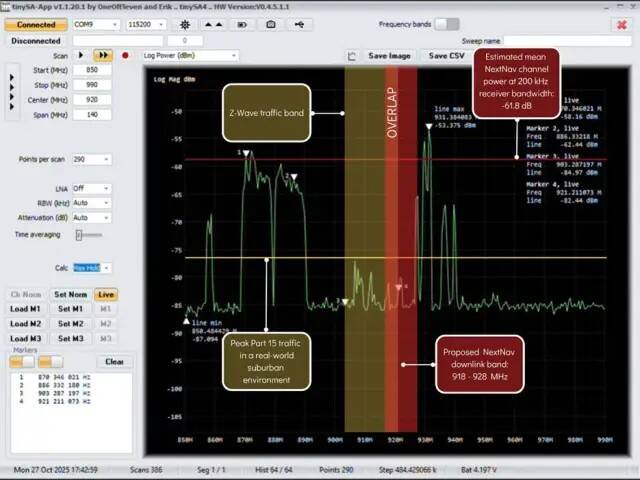
Signal analysis from the Z-Wave Alliance Unplugfest event in Carlsbad, Calif. on October 28, 2025, shows the current real-world noise floor and peak Part 15 signal power in a typical suburban environment. Analysis from Pericle Communications estimates Part 15 signal strength would need to be at least 538 times and up to 741 million times greater to achieve equivalent link reliability if NextNav’s proposed high-power downlink band is approved. (Source: Z-Wave Alliance)
The process is working
The U.S. does not need to raze existing, successful, multi-vendor IoT ecosystems to make way for a single proprietary PNT alternative. We have options. ... ... The U.S. can build resilient, multi-lateral GPS complements without rushing to sacrifice key co-existence protections in the process.
Like the Part 15 systems it is designed to protect, this process is working. The FCC’s deliberate, data-driven process, grounded in open inquiry and field testing, is not delay; it is diligence. Protecting coexistence in the lower 900 MHz band ensures innovation proceeds sustainably, not “gradually, then suddenly” at the expense of the systems that keep our infrastructure running.
Spectrum Decisions Demand Science, Not Scapegoats https://www.eetimes.com/spectrum-decisions-demand-science-not-scapegoats/
WASHINGTON, Dec. 3, 2025 – NextNav has urged the Federal Communications Commission to move quickly on its petition to authorize 5G-based positioning, navigation, and timing services in the lower 900 MegaHertz (MHz) band. ... But a coalition representing the top fire, law enforcement, and emergency communications groups has pushed back, warning that the proposal could destabilize life safety systems that millions of Americans rely on today."
So who might win this battle? MarketBeat November 29, 2025 might offer some clues by looking at NextNavs recent market growth which is increasing despite the fact NextNav is still a negative profit company...
https://www.marketbeat.com/instant-alerts/filing-geode-capital-management-llc-acquires-115261-shares-of-nextnav-inc-nn-2025-11-28/
Geode Capital Management LLC increased its holdings in NextNav Inc. .. owned 1,933,030 shares of the company's stock after buying an additional 115,261 shares during the period. ..
AlphaQuest LLC purchased ..shares of NextNav .. valued at $25,000.
Harbor Investment Advisory LLC boosted its position in NextNav by 71.0% ...now owns 3,685 shares ..
Harbor Capital Advisors Inc. grew its stake in NextNav by 15.0% .. now owns 6,888 shares of the company's stock valued at $105,000 ...
Teacher Retirement System of Texas bought a new position in NextNav .. worth about $166,000...
Nisa Investment Advisors LLC raised its holdings in NextNav by 7.7% .. now owns 11,494 shares of the company's stock worth $175,000 ...
Hedge funds and other institutional investors own 79.16% of the company's stock....
NextNav has a $1.88 billion market cap but negative profitability (PE -10.75, net margin -3,109.88%), reported $0.89M in quarterly revenue and EPS of -$0.12 (slightly beating estimates), and carries an average analyst rating of “Reduce”.

@richpowers From the post last year......"+++Could it in anyway if the proposal goes through, potentially affect Part 15 AM operations?
What happened with that?
"Like the Part 15 systems it is designed to protect, this process is working. The FCC’s deliberate, data-driven process, grounded in open inquiry and field testing, is not delay; it is diligence. Protecting coexistence in the lower 900 MHz band ensures innovation proceeds sustainably, not “gradually, then suddenly” at the expense of the systems that keep our infrastructure running".
I can't see the FCC removing interference protections in this area. Too many necessary things are there. Although I wouldn't put it passed them. They don't protect AM radio from all the interference even though stations pay then millions $$$ for licenses.
@mark Right, as I've pointed out before, the 900 mhz band has always been the only part 15 operations that specifically has protections from outside incumbents, but if NextNav gets away with their proposal those established protections will be eliminated.
It would also will set a precedent against all other part 15 uses in general. Like I said, 900mhz is the only protected part 15 band there has ever been, if they abolish that, then it primes the disregard of all the unprotected frequencies of part 15 as well. So though it doesn't affect our broadcasting hobby directly, it's still a threatening proposal to the foundations of our hobby.
I think it's a big deal and just isn't right. I hope NextNav loses.
Despite the pushback against them, NextNav is still increasing in stock as illustrated above.. that's worrisome because you know money often talks louder than justice.
Well the FCC gave NextNav an experimental licence to demonstrate itself in action...
"..today announced that it will commence operations of a 5G PNT Network in Santa Clara County, California, as early as December 11. Network operations of positioning, navigation and timing applications represent the next milestone toward commercial readiness and the mission to deliver a resilient complement to GPS.
The 5G PNT Network will consist of multiple fixed base station locations utilizing a standards-compliant 5G signal with a Positioning Reference Signal (PRS) enabled, a standalone 5G core, and NextNav’s 3D PNT architecture. The network’s authorized technical parameters will align with those in NextNav’s proposal to optimize the lower 900 MHz band to enable a terrestrial, widescale backup to GPS that is broadly available to critical infrastructure, public safety, and American consumers..."