

I think I mentioned the Schlockwood PhaseBuster before. It all sounds very interesting to me, though I don't really grasp the technicalities, the primary point suggests the circuitry used provides a better and more accurate method of summing stereo to mono. The only "flaw", (for lack of a better word) is that it too, like the Schlockwood processor, requires a floating ground power supply - which is the sole reason that I choose to go with a Culbert instead -- somewhat regrettably, because I really wanted to get the Schlockwood, but the special power supply kind of threw a little bit of a monkey wrench in my objective of a very efficient off-grid 12v installation.
Anyway, via the Schlockwood Projects page ( https://www.schlockwood.com/projects) here are the highlights of the pdf concerning the Phase Buster stereo to mono capabilities:
https://www.schlockwood.com/_files/ugd/aee96f_938461beaba74b2fb3f04dcccc49e4f7.pdf
PUBLICATION CREDITS
The bulk of this write-up first appeared as a build-it-yourself article in the November,
2015 issue of audioXpress magazine.BACKGROUND
Inspiration for this project sprang from two incidents separated by more than 20 years. ... ..He suggested offsetting the phase of one stereo channel by 90 degrees to yield a more consistent stereo program energy profile for mono that is derived from combining stereo program
channels.This quadrature trick worked quite well, giving a more honest representation of bass and vocal track energy in pop music recordings. Pop music is typically recorded as multiple individual tracks with bass and vocals commonly panned to the center of the soundstage. This results in a certain degree of energy buildup when left and right channels are summed to mono.
The more recent inspiration for this project came from my own frustration in mixing-down certain orchestral recordings to monaural. ..... ... In mixing my friend’s .wav files to mono, I found that a lot of the music suddenly went missing. Certain instruments, along with a good deal of the venue ambiance, simply disappeared! .. just refused to mix-down to satisfactory mono.
Thus one goal of this PhaseBuster project was to reduce a stereo program to more realistic mono by imparting the 90-degree phase offset between channels as suggested all those years ago. ... ..PROJECT GOALS
1. To create a monaural mix from stereo
without losing audible components that
end-up out of phase, either accidentally or
by design. .... ...STEREO TO MONO
This second PhaseBuster mode is helpful in creating a more compatible monaural mixdown from the two stereo channels. The mono mix in this mode is routed to both the left and the right PhaseBuster outputs.
L+R combines the stereo input channels in traditional summing style as the name implies. QUADRATURE SUM, on the other
hand, inserts the 90-degree phase offset between the stereo channels prior to summing them, and introduces a 2dB gain in the output path as well. Because program components common to both channels lean toward a more out-of-phase than an in-phase condition in quadrature summation, this bit of gain helps match the apparent loudness of most program
material between the two switch positions.I found that the QUADRATURE SUM position restored at least some of the musical content that went missing when the two stereo channels were combined in simple L+R fashion. Listening to the resulting mono, QUADRATURE SUM returned ambiance to the performance, sounding much the way mono LPs used to in simpler times. ... ..
The PhaseBuster is powered by a regulated 18-volt “wall-wart” switching-type power supply and further regulated by a pair of zener diodes to create a bipolar 7.5-volt supply for the op-amps. The 18-volt input must float for this to work, meaning that the PhaseBuster can’t share ground-referenced power from some convenient existing source. ...
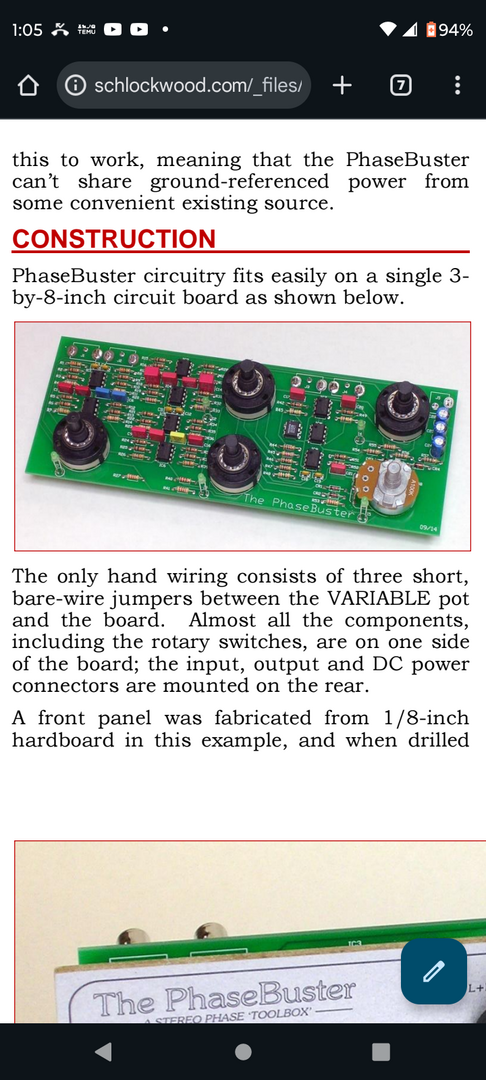

Yeah he wanted to make the Sclockwood as "high end" as he could while keeping it reasonably affordable for the part 15 market.
It wasn't considered that some would want to operate it "off the grid" from a power station or battery. I see your frustration and I too don't like when something won't work on a common power supply and voltage. My little broadcast computer works on 12 volts unlike the 19 or 20 volt desktop ones most laptops/computers need. The transmitter, 12 volts, the Sean Cuthbert 12 volts. But if I use the Decade for FM it needs 16 volts AC, won't work on DC as the same thing. It needs a plus, minus, DC voltage or "floating ground" it gets from the phase reversal from the AC supply and the power supply on board so it can't work from a power station's DC output either. Needs the inverter.
When I was suggesting things to Gerry at Procaster during the making of the Procaster FM was that it work on a common 12 volts.
By the way, I just thought, doesn't the Rangemaster need a 15 volt supply? Will it work from a 12 volt supply, like a battery?
@mark I had asked that years ago (I think at HB) and it was Keith himself that said the Rangemaster can be powered directly from a 12v. In fact it can be powered by any voltage between 12-19v. I think the power adapter it a tuslly came with was a 16v but im not certain. I have powered my Rangemaster directly from a 12v battery for several weeks one time in the past by the way.
As for the Schlockwoods.. In another thread I had posted Jim Woods replies to me, where he had mentioned:
" Our SW300 AM mod-monitor utilizes three surface-mount chips. A numerically-controlled oscillator for the two local oscillators in the circuit, and two inexpensive switching regulators to generate the positive and negative supply rails from a DC input that can vary between about 8 and 24 VDC. This was at the insistence of a fellow who did some market research for us up-front, swearing that battery operation of the field strength meter function would be a 'must.
Our second production run of SW300s occurred just as the COVID pandemic hit. And guess what parts we absolutely could not get from any source. No, we could find the oscillator chip in stock in the quantities we required, but the two switching regulators were totally unobtainable....'"
So he had to alter the way it was powered in the second run, which is probably why his processor also uses that floating ground method.
Actually Keith might have said anything from 12v to 24v - I don't remember exactly the range of voltages that would be acceptable, but my question had been would it function properly from a 12v battery and his response was a clear YES, then he went on to explain it was originally designed for battery power as a roadside transmitter that could be powered from a range of DC input powers.