

I can only go by my experience, regardless of theory. When I raised my wire antenna so that it was above my roofline, range increased substantially.
With the same setup, but the wire antenna indoors, range sucked.

Deduced
Enough raw facts and opinions have been written in this thread to make deductive thinking a useful tool for arriving at practical viewpoints.
We opened with engineered comparisons regarding two aspects of MW (Medium Wave) transmitting antennas:
1.) ground mounted; 2.) elevated
and
1.) full power licensed; 2.) 3-meter antenna at 100 mW scaled down based on the same physics.
While it was allowed that objects in the radiant field cast shadows, we learned that given the large territory of a full power signal those shadows were inconsequential.
Meanwhile, a 100 mW 3-meter antenna is also shadowed by objects, however objects remain fully sized and do not shrink in correspondence to the reduced power, and place shadows in a large portion of the small signal cast at part 15 strength, making objects of far greater significance at low power, therefore increasing the liklihood that a raised antenna might benefit from being above the terrain at the angle favorable to eliminating the shadows cast by objects.
As to my added question: whether an indoor antenna would perform on equal footing with an outdoor antenna, our deduction tells us that an indoor antenna is inside of a shadowing object and thus would be at least 50% shadowed as it passes through individual walls, further distorted by the reflections (standing-waves) within the object.
Our lesson tells us that simply scaling physics from full power to micro-power doesn't faithfully predict results in an unshrinking world.

<p style="text-align: left;">I also have noticed that trees can block out signal. Case in point when I try to get a good signal to the Deltaville Market by the time I get there my signal is about 19 to 20 dbuv which is barely listenable at about 1 and 1/4 Mile. Now on the other direction towards Taylor's restaurant and out to the Citgo gas station I can get a slightly better signal at the restaurant and the signal seems to go out further in that direction. I don't know if it's because there's less trees in that direction but it seems that there are. Towards the Deltaville Market there are several trees as you're looking in that direction. I'm imagining if it were a clear line of sight I would have a much better signal. If I were to get the antenna way above the trees I'm sure the signal would be substantially greater.</p>
To reiterate what Artisan radio said about range indoors the building that I tried to do it in when I had a talking house 5.0 connected to its wire was made out of brick no aluminum siding and I had a big bay window. Well indoors I use the wire that came with the talking house and I attempted a range test. I could not transmit very far away from my complex. I didn't even make it to the 7-Eleven which is only a half a mile or less than a half a mile away. But when I got the antenna Outdoors the range increased substantially. Now when I used a homemade ATU and connected that very same wire to it my range increased substantially and I could hear my signal at the 7-Eleven.
I used Station 8`s antenna connected to an ATU which was homemade and the range was greater yet. This antenna however it was only six foot tall and it was connected to the home brew ATU. And because the talking house transmitter uses the third prong as a ground I didn't bother with connecting any sort of ground wire to it as it was pretty much irrelevant because it already has one.
We learned two things by this experiment number one the homemade tuner or ATU produced a better signal then the built-in antenna tuner inside the talking house transmitter. This makes me wonder if the R.A.T 1.0 s design will have a better tuning coil then one that you would see inside of an AM radio and A-Rod that simply moves up and down that tuner. The homemade ATU had a coil that was wound and it was very similar to ATU's you would see in higher performance part 15 compliant transmitters this is why they do so much better.
My broadcast engineer friend built a homemade ATU that I am using now with a ASMAX2 C-Quam AM stereo transmitter with my antenna on a good 6 ft Pole and I do much better then with the antenna closer to the ground and with a 50 ohm transmitter using rg58u coax. This coax is well shielded so I'm not transmitting out my coax and most of the energy is going where it should be the antenna.
Your SWR makes a big difference having a good SWR is very important if you want range. I do believe that is why the range Master does so well because it's tuning system was very well thought about and it was made to match up with that CB whip antenna quite nicely and to top it all off it can run without a ground as many folks have used it with no ground at all but in a higher location and have achieved ranges anywhere between three to five miles which is phenomenal. So the height as well as your tuning circuit makes a big difference I would concentrate on a well-made antenna tuning circuit and see what you get also get the antenna up there and you'll find better results this is come from my own broadcast engineer friend. I've learned a lot from him as we discuss a lot of this kind of thing most of you don't realize that SWR makes a big difference even on this low powered stuff you want to get as much energy as you can out the door and into the antenna. Elaborate ground radials won't make much of a difference if you're standing wave ratio is super high you're just wasting all that energy. Concentrate on a good ATU circuit and use a good antenna analyzer when you're done and a field strength meter and get that filled straight up there is high as you can get it because that will equal your range.

RE: ...simply scaling physics from full power to micro-power doesn’t faithfully predict results...
On due research, one can discover that the factors/equations that determine the propagation loss to a radio wave in decibels or percentage when crossing through/around a lossy physical object such as a steel building or a tall hill do not include the magnitude (amount) of the radiated power producing that signal in the first place.
Over a given propagation path and for other things equal, the radiated signals of a "Part 15" AM station and a licensed, high power AM broadcast station _both_ have the same relative propagation loss in decibels and as a percentage.

As far as I'm concerned I totally agree with Artisans post earlier that really says it all...
"I can only go by my experience, regardless of theory. When I raised my wire antenna so that it was above my roofline, range increased substantially."
However, I wouldn't exactly say the range increases because of height, but rather that the height substantially helps to overcome obstructions which otherwise would decrease the range.
RE: ... the height substantially helps to overcome obstructions which otherwise would decrease the range.
However that belief is not supported by the two signal strength measurements shown in the graphic below.
The signals are essentially the same even though one path is totally blocked by terrain, and the other path is not.
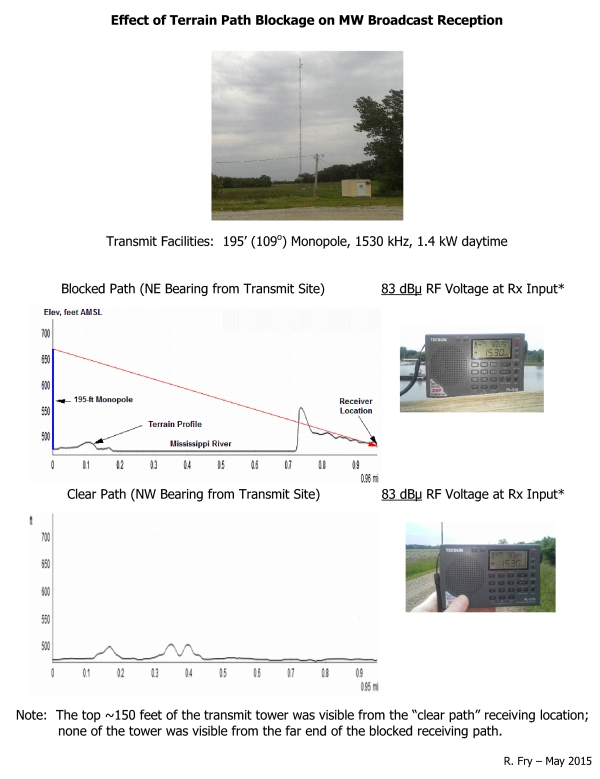
"However that belief is not supported by the two signal strength measurements shown in the graphic below."
Rich, maybe you should try that same experiment while taking measurements from a part15AM transmitter. I understand your point that it in theory, percentage wise - the reaction of the signal to obstructions should work out about the same as it does from a full power station.. but I - as ignorant as I am about such technical matters - can still accurately conclude from experience that obstructions (such as a two story house) can completely eliminate reception of a part 15 signal beyond that building.
Your charts simply can't change the fact that a building will block a part15AM signal.
All Things Not Equal
The "equality claim": "Over a given propagation path and for other things equal, the radiated signals of a “Part 15” AM station and a licensed, high power AM broadcast station _both_ have the same relative propagation loss in decibels and as a percentage."
The antennas are not equal.
A full power station is mounted at the ground while ALSO reaching around 200' into the sky, whereas ALL part 15 3-meter antennas are located at or near the ground.
The angles of incidence are not equal.
A part 15 signal hits a shadowing building or obstruction head-on, while a full power signal penetrates the obstruction from angles high, medium and low, giving it a disproportionate advantage.
For chrissake, Rich Fry.. As interested as you have been concerning part 15 for the past decade or so; why not spend $100 for a Talking House or something.. any Part 15 transmitter, and try some real world experiments.
Good point Carl.
Carl states it best. The assumption that all other things are equal between a Part 15 installation and a licensed station is not correct. Otherwise, numerous Part 15 stations would not see the results they are seeing when elevating antennas (and with all other things being equal WITH THE TWO PART 15 TRANSMITTER installations).
I'm not even sure that the statement that the percentage loss in decibels would be identical is accurate when dealing with Part 15. I'd like to see experimental proof of that as well - there are many instances in science where general hypotheses do not hold true for boundary conditions (and Part 15 broadcasting is certainly a boundary condition for radio signals, compared with licensed stations).
RE: The antennas are not equal. A full power station is mounted at the ground while ALSO reaching around 200′ into the sky, whereas ALL part 15 3-meter antennas are located at or near the ground. The angles of incidence are not equal. ... A part 15 signal hits a shadowing building or obstruction head-on, while a full power signal penetrates the obstruction from angles high, medium and low, giving it a disproportionate advantage.
Note that the _measured_ field shown at the end of a ~ 1-mile, obstructed path in the graphic linked below is the same as at the end of the 1-mile, unobstructed path shown there.
None of the tower was visible at the end of the obstructed path, yet the field there was the same as at the end of the unobstructed path.
This reality does not support the contention referenced above.
RE: ... numerous Part 15 stations would not see the results they are seeing when elevating antennas (and with all other things being equal WITH THE TWO PART 15 TRANSMITTER installations).
It is well-known (even by the FCC) that many elevated Part 15 AM system installations include conductors such as lightning grounds and other conductors that add to the radiating length of the ~ 3m vertical whip considered to be "the antenna."
Other things equal, such systems have larger useful service areas than those without added conductors — but that is due to their greater radiated power, not to the height of the top of the whip above the earth.
Where We Stand
There is an iron-clad consistency in the Postulations of R. Fry:
Mr. Fry is inargueably correct at all times and in all claims, whereas those among us who have other conflicting opinions and experiences receive no recognition for ever being fully or partially correct with the implication that we are altogether misinformed.
Yet, despite how wrong he finds us, Fry always again demonstrates how wrong we are. Most pontificators would give up after a few fruitless years.