

You better pour another cup of coffee...
Probably the number one thing asked about a Part 15 transmitter is range. Be it on this forum, or any of hundreds of other forums where radio and electronic geeks gather. From Christmas Light Show builders to would be community broadcasters. It's easy to see the most often asked question is something like "What is the Range of the XYZ Transmitter". Or "which transmitter will give me the best range".
Here's the answer. If it's a LEGAL Part 15 FM transmitter the answer is "they're all the same" and "it depends".
We all know that FM is limited to 250 uV/m at three meters. That amount of field strength is just that. It's 250 uV/m at three meters. Neither the FCC nor the laws of physics give a crap if you reached that limit with a watt and a super crappy antenna and a ton of line loss, or 2 nanowatts and a 10 element Yagi antenna. It doesn't matter if the antenna is at 5 feet, 10 feet or 100 feet in the air. As long as it's not over 250 uV/m at 3 meters it's legal, and that amount of signal will go so far, period.
Then comes the "It depends".
When I do range tests with Part 15 FM transmitters, (and I really don't anymore) if they're legal level or below, I walk from the transmitter with a fairly decent receiver in an open field. The legal ones poop out between 200 and 300 feet. The few range tests I've done with over the limit transmitters that cover several blocks obviously require me to either walk a lot, or drive. Now you've introduced a lot of environmental factors. Buildings, trees, street signs, the list is endless. The reception you get here, could be better or worse 10 feet to the side. Or under that tree. Or away from that tree. So it's really an exercise in futility. Unless you happen to have access to an open area a mile square. But then it's not a "real world" range test.
Then it completely depends on the receiver being used. I've casually tested both AM and FM range using a wide variety of radio receivers, from those in diffeent cars and trucks to different portables from communication receivers to $5 handheld transistor radios, to boom boxes to high end stereo receivers. "Hey, I get get 450 feet"! Well, with THAT radio anyway. I only get 66 feet with this one". So again, range tests are folly. People always try to quantify with something like "600 feet to a good car radio". How do you know you have a good car radio? Have you compared sensitivity to all your friends cars? Maybe you have two cars and one is better than the other, but neither is nearly as good (or bad) as your neighbors? And you can't go by specs in the manual, either. That doesn't take into account age, damage, corrosion on the antenna connector or the antenna ground to the cars body, or many other variables. Did you know car radios are somewhat directional? It's true. The radios are designed with AGC and other circuits to smooth out reception. But depending on the car's antenna, you have some amount of directionality that can be most apparent when trying to receive a weak Part 15 signal. Antenna on the fender? The cars body is the ground plane. Obviously there's more body metal in some directions than others, varying the pattern. Antenna inside the windshield across the top? Directional depending on the direction of the antenna. None of the "range tests" people want are using any sort of standard for reception. But again, in an open area, with a legal transmitter, the legal limit can only go so far. It's like having three cars all traveling at the legal limit of 60 MPH and then saying "Car number 2 will get there faster because it's more aerodynamic". No. It won't Because it, like the others, is limited to 60 MPH. Or saying "Car number two will get there faster because it has 50 more horsepower than the others". Doesn't matter. It can still only travel at the maximum allowable speed. The law makes them all equals. In the case of Part 15 FM radio the maximum allowed field strength is the speed limit.
Further, these tests -- even the field strength tests -- are done in a wide open area. So, lets say you have a legal transmitter measuring exactly 250 uV/m at three meters in the wide open. What's that field strength going to be when you put it in your house? Is the signal penetrating a 100 year old wooden structure? Is your house stucco from the 1950's with a wire mesh behind the stucco holding it together? Is your transmitter in a window? Does it have an aluminum frame? Is your house covered in aluminum siding? Have a metal roof? Are you in an apartment building or office building with steel girders? Once you're out of the open area and in your house, in your neighborhood, surrounded by other buildings, trees, power lines, phone lines, home wiring, etc all bets are off. You're going to have a wild squiggly RF pattern, and it's going to be dramatically attenuated in some directions and multiplied in others. This makes any sort of range test basically useless. And if the FCC should come by to check you out, they're NOT going to take your transmitter out into some field to see if it's legal. They're going to check and see if you're over the limit, and they may check in more than one spot! If you're over ANYWHERE, you're illegal.
For the most part, all transmitters of maximum limit output (and trust me, you'll never find two transmitters with the exact same output, even among the same brand and model) will have the same range when used in the exact same circumstances.
Lets think about antennas. Lets say you have a transmitter that gives you 250 uV/m at three meters with it's little whip antenna. You decide to put up a dipole for it. You've now put up an antenna that's going to have nulls in some directions, and gain in others. Which means in some directions you'll have increased range making your transmissions illegal, and reduced field strength in other directions greatly limiting range. Lets' review the statement above: If the FCC should come by to check you out, they're NOT going to take your transmitter out into some field to see if it's legal. They're going to check and see if you're over the limit, and they may check in more than one spot! If you're over ANYWHERE, you're illegal. So if you decide to put a dipole on your otherwise legal transmitter you WILL have areas of antenna gain that will make you illegal in some directions. If you think your dipole increased your range, you're right! And it did it by providing signal gain in some directions, while creating nulls in others. It increased range to some listeners, while decreasing it to others. Where that gain is, you're over the limit. Think of a radio signal like a round balloon. You have a nice circular pattern. Then you squish it in on the sides. The balloon bulges out in a couple places, while it's squished in at other places. Just like a radio signal that's forced into a pattern with different antenna designs. You still have x amount of signal, you're just changing it's shape, or pattern. Just as you do when squishing a balloon. This is an easy way to visualize how a typical commercial radio gain antenna works. A typical 100,000 watt FM radio station has a transmitter that actually generates about 20,000 watts. The antenna provides the gain to get 100,000 watts. (this is a bit simplified but the concept holds) The gain antenna is squishing that signal. Take your round balloon, set it on a table. The table is Earth. Squish that balloon as flat as you can and notice that there's no round top anymore, but the sides have expanded and it covers more of the Earth. That's what a gain antenna does. It focuses the RF that's shooting off into space where no one can listen to it and adds that power to the signal going out to the sides where the people are. Again, a bit simplified but gives you the general idea.
OK, so that got off topic a bit, eh?
So, there's some thought on FM range, and why doing range tests of Part 15 transmitters is really not relevant.
TIB

I have a stupid question cuz I'd really like to know and that is has ANYONE who has a FIM set any transmitter and spot on 250 uVm @ 3 meters. When I say spot on I mean not 249 or not 251 but 250 or is that even possible at all and this is why we often see some over or extremely under like the C. Crane?
I'm in a one story building (4 plex) and have my transmitter RIGHT on top of a bay window. The house is brick but have no idea what is behind the walls. The window is wood but the screen is wire and the frame around the screen is metal of course. How much (if any) do you think this hampers my signal? I know walking around the transmitter can change the SWR thus it changes the range.
There are some things I knew and some things I didn't take into account when testing a transmitter and saying "This one is a load of crap!"
Thanks for your time giving a good sesson in Radio reception.
Wow Tim, a lot to read there!
When people ask "how far do you go" if I tell them about my station I say there's no set distance, it all depends on how good or not good your radio is. The answer to the first and most asked question is hard for most to understand.
It can be 50 feet or 1000 feet(BETS-1). You can have 2 different recievers in the same place and one will get it loud and clear and the other hardly.
Another thing I'm aware of is signal strength is not equal everywhere in range. Just like commercial stations it's in pockets of stronger and weaker areas. Even in an area in very close proximity to each other.
Mark
From Reply 2: ... I'd really like to know and that is has ANYONE who has a FIM set any transmitter and spot on 250 uVm @ 3 meters. When I say spot on I mean not 249 or not 251 but 250 ...
An FM transmitter and its antenna can be adjusted to produce a specific field at a specific distance and specific elevation above the earth when operating in a specific environment. But that does not mean that this field will always be produced at that distance for other elevations -- even for the same transmit system and operating location.
For example, the graphic below shows the variation of field strength across an elevation range of 10 feet, for distances of 3 to 30 meters from the transmit antenna.
The field at a path distance of 30 meters is 100 µV/m at an elevation of 7 feet AGL, but is 200 µV/m at that distance, at a height of 17 feet AGL.
So setting an FM transmit system to produce an accurately known field at one measuring location does not mean it will produce the same field at all other measuring locations (and installation sites).

I think it would be possible, but challanging to set a transmitter to 250 uV/m. The trouble is, you're never REALLY spot on. Even with the most expensive meters available, and the most care humanly possible, there are still variables. Even in my tests in the open field there is variation in the ground below me which makes a reading taken by me and one taken someplace else even with the identical equipment, different. The test equipment all has a margin of error, +/- a given percent. Certification labs have tons of highly calibrated equipment -- if you think $4000 for a used Potomac or $15,000 for a new R-506 is high, you don't even want to imagine what these labs have invested in equiipment, not to mention specialized test rooms with grounded wire mesh walls and calibrated air (well, maybe not calibrated air). But the best we can do is use the popular field strength meters, which, of course, is what the FCC agents have at their disposal as well.
Either the C. Crane or the EDM would be relatively easy to set right on 250 uV/m, as long as it's kept in mind that there is a tolerance for error that cannot be eliminated. That said, the FCC has to work with this same tolerance and from several NOUOs I've read they always use the margin of error in favor of the person being inspected. Otherwise your defense could be margin of tolerance in equipment. Although You don't see many (any) violations where it's that close. Anyone ever seen one where the violator was, at say 275 uV/m? They always seem to be grossly over the limit.
But yes, these transmitters could be adjusted to show 250 uV/m. But as soon as you move them from the test site the reading will be somewhat different depending on many variables.
It's even tough to get the readings in the field as it is. If I stand near the meter the readings rise, I assume I'm either acting as a bit of an antenna, or providing a reflection of signal into the testing antenna increasing the reading, so I always move back from the meter until it has fallen as far as it will, usually as far as 6 feet. Additionally, walking up to the transmitter changes the reading. So to tweak one to be spot on, one would have to go make an adjustment, go back to the meter, step out of interference range, take a reading, go back to the transmitter, adjust, repeat, until you had it.
I imagine C. Crane comes in low to leave a safe margin to be legal. And at the field strength they offer, they meet the advertised range of their units quite reliably. Still they come in far under the 200 feet or so normally expected from a Part 15 FM transmitter.
The EDM I just tested came in at 240 uV/m at three meters when switched to low, and the power trimmer turned all the way down, about as close as you can get leaving a bit of room for tolerance.
As for your paricular situation, I don't know that anyone could predict. It's likely going to be hindering field strength in some directions, and increasing it in others.
TIB
While legal operation is determined by field strength only, there IS value in predicting range. Yes, it may not be exact, and it is totally dependent on your radio, but there's nothing wrong with giving out estimates - say, in my case, anywhere between 25 to 250 meters ( in the case of BETS) and my unique installation parameters.
People never ask what my field strength is - it's always, without fail, how far can I receive it?
Hi Tim: Questions for you on your FM tx test.
1) Have you ever done testing on the antenna for the FM tx your testing to
Make sure the antenna is resonating correctly on a mfj 259 meter ?
If you don't do this check the antenna will resonating improperly and. Will cause harmonic
On other frequency and it will get you into trouble !
2) If you want to reduce power then use a attenuator or a dummy load !
3) By using a improper cut antenna can either damage your rf output
On your transmitter or reduce tx range !
Have a nice day station 8
But when people ask "how far can I receive it" there is no answer. And the answer would be the same for any transmitter operating at the legal limit. No matter the brand of transmitter, if you have 6 different makes of transmitters, all set for 250 uV/m at three meters, and each one set up in the exact same location, with the same antenna, etc. The answer will be the same. The range of a transmitter doesn't vary except if the field strength is different. So, no, people won't ask that, but when the question is asked the answer is always "It depends".
It depends on the quality of your radio. What sort of receiving antenna you may have, what type of interference may be in the area, and mostly, where their location may fall in the unaviodably varying signal path. A listener who is getting the benefit of a reflected signal, compared to one who has something blocking signal a bit will have two very different ranges.
A range test in an open field, such as I have done really offers no correlation to a range test done in the real world. And a range test done in one location with one radio will be completely different than one in a different location (even at the same distance) with a different radio.
TIB
Thank you Tim! Wow. We had a 12-bay, 20,000 watt Continental Electronics/ERI setup at Oldies 95. We had a 12 bay of these ERIs:

So the balloon was definitely squashed! LOL! How does circular polarization factor in? For those not familiar, the emission looks like this:
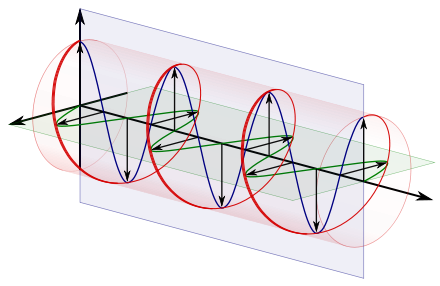
In action, it looks like this:

Does it actually affect gain or signal strength or...I see most of these require multiple bays to get 0 Gain! So maybe this could bring it down to legal...or am I mistaken? Not an ERI, Shively or Jampro obviously, but Progressive Concepts makes a single bay that is -3dB for $300. Two questions:
1. What is MINUS Gain? UNsquashing the balloon? How do ya do that?
2. I can get 3.4dB Gain from a Comet 95-SL Co-Linear 5/8ths vertical. $100. Takes up to 200 watts.
Why on earth would I spend $2000 for a 4-bay circular, only giving me 3.3dB Gain? And having to mount this monster:

Of course that is for LPFM and such. But can you guys edu-ma-cate me?
Doug
I can see where range estimates don't mean as much, just hearing about them on line. It's all about personal experience, and some boasting, like when neighbors ask what the AMs range is, I might say more than about a mile, but the signal is noisy, at least on my radio.
I can't see anyone listening and getting enjoyment out of it at that range though, that would be a long shot. Range is still one of the first questions that everyone asks, so where do you guys cover?
It's the same with holiday lights displays, home drive-ins, silent discos, but they seem a little more focused than broadcasting, just wanting to know if they can reach all of their patrons or visitors, as I read the sites.
I went through a period when I was range nutty, learning about this stuff, and building all of the transmitter circuits out of electronics magazines. It was on my mind all the time for a while, and it my own situation I could do real world tests.
Just don't trust anyone when they tell you how high you can get on some part 15 drug!
The bottom line, anyway you look at it, regardless how receptive the receiver, is that part 15 FM is not capable of broadcasting to even a tiny neighborhood, it is what it is and has it's uses, but it is unable to legally produce any kind substantial range, perhaps one or two houses over at most.
Here's an interesting quote on what cheif engineer of the FCC had to say in a correspondence between he and R Fry some years ago
"The expected range for unlicensed FM is considerably less than that of unlicensed AM - probably on the order of about 30 feet or so. Yes, I know that a Public Notice was released saying that unlicensed AM and FM transmitters have 200 feet of range. On the practical side, however, you're lucky to even get 30 feet in the FM band.
I did see one experiment achieve 400 feet of range when operated in a remote area with a low background noise level and no other FM stations any where near the selected frequency, using a very sensitive FM receiver with a good antenna, and transmitting in a mono mode with 75 kHz of deviation applied to the modulation.
This is why our rules do not specify a range - it's a relative term that is completely dependent on the environment. The same applies to range estimates for operation in the AM band. (That same Public Notice also incorrectly stated that you can have 50 mW ERP in the AM band and 10 uW in the FM band. The 250 uV/m at 3 m limit in the FM band translates to an ERP of 11.4 nW or 0.000,000,014 W. A field strength level of 24 uV/m at 30 m, as permitted under Section 15.209 at 1000 kHz, translates to an ERP of 10.5 nW. The non-technical author of the notice should have checked with the engineers before writing this. Note that the numbers in this Public Notice are not binding - the equipment must meet the standards in the actual regulations.).." http://www.radiodiscussions.com/showthread.php?540838-FCC-s-John-Reed-Comments-on-Part-15-AM-Rules-and-Interpretations
On a side note, I always wondered what that public notice meant by "effective service range".
Duggers antennas, what happens is the stacked antenna bays work in concert, putting out signals in phase in one direction, usually toward the horizon, and out of phase in another direction, up and down.
The directions that the signals are in phase, they add, so you're shooting your signal out to the horizon all around the antenna, and out of phase they subtract so not as much power straight up and down where it's not needed by receivers.
Multiple phased antennas stacked like that concentrate the signal's power in a controlled way.
Circular polarization is an idea to reach the receiver's antenna whether it's more vertical like on a car, or flat like a boombox radio with the antenna down. Since you're trying to reach receiver antennas at all angles, you lose signal over what a dipole would have, because the transmitter antenna is trying to serve all receiver antennas, whether sticking up or laying flat, or somewhere in between.
It ends up being half, or 3 db of "loss" with a single circularly polarized antenna, compared to a dipole. The power isn't really lost though, it's just going to receiver antennas that are in different positions than yours, or maintaing signal if you have your antenna at different angles. That's what circular polarization is about, maintaining signal.
The stacked antennas add gain, so with two on a tower, gain is doubled over one, or back to zero gain again! Using 4 should double power, so it would be like your 20 kw transmitter's ERP is 40 kw. Stacking more bays increases the power proportionally, and yes it makes a bigger antenna, but the big thing is power savings each month, and a less expensive transmitter to maintain, smaller transmission line up to the antenna.
Responding to some questions in Reply 9 here:
The gain of all antennas is rated as compared to the free-space gain of a reference antenna such as an isotropic radiator (stated in units of dBi), or a 1/2-wave, center-fed, linear dipole (stated in units of dBd).
An antenna gain stated only in units of "dB" is meaningless, because the zero dB reference for that gain is unknown.
The free space gain, per polarization, of a single element using VHF bands and above when radiating circular polarization is about 3 dB less than if that element radiated all of its applied power in one plane of polarization, because the power at its feedpoint is divided/radiated equally among ALL polarization planes.
So if the reference gain is that of a linear, 1/2-wave, center-fed dipole in free space, then the gain of that circulary-polarized element is about -3 dBd (not -3 dB).
Thank you Rich and Nate!
The gain of all antennas is rated as compared to the free-space gain of a reference antenna such as an isotropic radiator.
Yes, this is the dBi reference. An isotropic radiator in free space is ideal. Unfortunately, we cannot have such, so we use the dipole. So the circular still puts out the same power. That's out, I guess. What's that song...
"Rubber Ducky, you're the one...!"
Doug
Other things equal, a Z-matched "rubber ducky" transmit antenna using a helically-wound conductor radiates almost identical fields to those of a Z-matched transmit antenna using a linear (non-helical) conductor having that same aperture.